
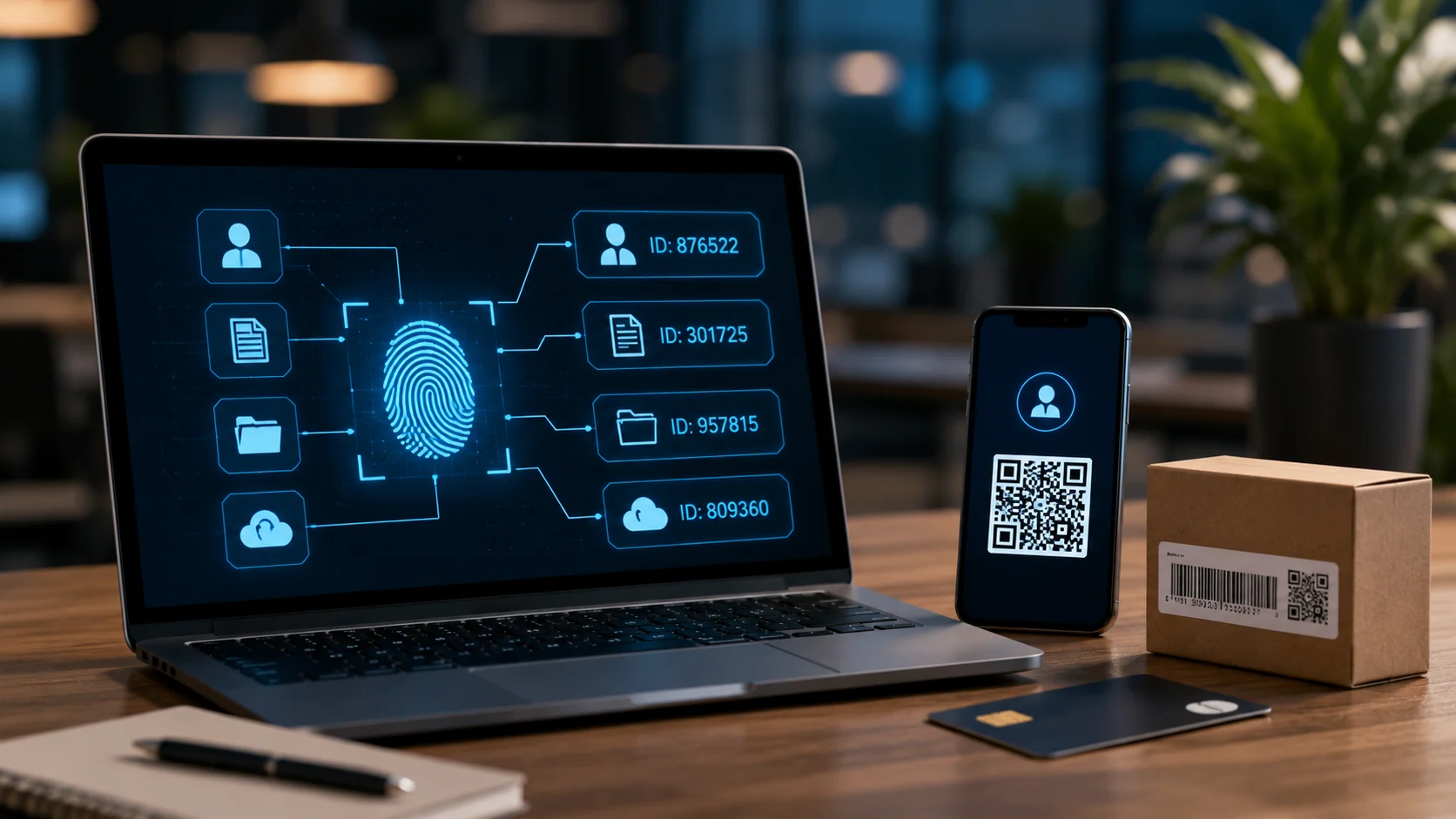
Unique Identifier: Meaning, Types & Examples
A unique identifier is a value used to distinguish one item, record, object, person, device, transaction, or digital resource from every other item within a defined system. Unique identifiers appear almost everywhere in modern technology, even when users never see them directly. Databases use them to keep records separate, applications rely on them to track accounts and sessions, networks use identifiers to recognize devices, and businesses assign reference numbers to orders, invoices, customers, and products. The concept sounds simple, but good identifier design is essential for data accuracy and reliable system behavior. Without dependable unique values, records can become confused, duplicated, overwritten, or linked to the wrong information. Understanding how identifiers work therefore helps explain many fundamental ideas in databases, software development, networking, security, and business information systems.
A unique identifier does not necessarily need to look complicated. It could be a simple sequential number such as 100245, a globally unique value such as a UUID, a database primary key, a product code, or another string generated according to specific rules. What matters is that the identifier is unique within the scope for which it was designed. For example, an employee number may need to be unique only inside one company, while an identifier used across distributed software systems may need much broader uniqueness. Some identifiers are meaningful to humans, while others are intentionally opaque and machine-generated. The right design depends on factors such as scale, security, performance, interoperability, and whether the value may ever need to change.
This guide explains the meaning of a unique identifier, how unique IDs work, the major types used in modern systems, and practical examples from databases, software, networks, business operations, and the internet. It also covers UUIDs, GUIDs, primary keys, composite identifiers, natural keys, surrogate keys, device identifiers, and other related concepts. You will learn why uniqueness matters, how systems generate identifiers, and why something that looks unique is not automatically a good identifier. The article also explains common mistakes such as exposing predictable IDs, reusing deleted values, or confusing an identifier with authentication. Whether you work with data or simply want a clearer understanding of technology terminology, the principles are widely applicable. A strong identifier strategy helps systems remain organized, scalable, and easier to maintain.
What Is a Unique Identifier?
A unique identifier, often shortened to unique ID or UID in general discussion, is a value assigned to an entity so that the system can distinguish it from other entities. The entity could be a customer, database row, document, computer, product, payment, software object, shipment, or virtually anything else that needs to be tracked. The identifier acts as a dependable reference point even when other information about the entity changes. Two customers may have identical names, for example, but their customer IDs should still be different. This distinction prevents systems from assuming that similar descriptive information represents the same thing. Uniqueness therefore provides a stable way to tell records apart without relying on names, descriptions, or other potentially duplicated attributes.
The word unique must always be understood within a particular scope. An invoice number may be unique within one accounting system but could easily match an invoice number issued by another company. A student ID might identify one student uniquely within a university but have no meaning outside that institution. By contrast, some identifiers are designed for extremely broad or effectively global uniqueness. UUIDs are a common example because their format and generation methods make collisions exceptionally unlikely when implemented properly. Defining the required scope is one of the first steps in designing an identifier. A system does not necessarily need global uniqueness when organizational or application-level uniqueness is sufficient.
Identifiers also differ from ordinary descriptive attributes. A person’s display name, job title, city, or email-like label may help describe that person, but not every descriptive field is suitable as a permanent identifier. Descriptive values can change, may contain errors, and may not be unique. An identifier ideally remains stable so relationships within the system do not break when other details are updated. For example, changing a customer’s postal address should not create a new customer record if the underlying customer remains the same. A stable customer ID allows applications to update changing attributes while preserving the identity of the record. This separation between identity and description is fundamental to good data modeling.
A unique identifier can be visible or hidden from end users. Order numbers and tracking numbers are often intentionally displayed because customers need them for communication and support. Internal database IDs, session identifiers, and application object IDs may remain hidden because users have no reason to interact with them directly. Visibility can influence identifier design because human-facing IDs may need to be reasonably short, readable, and easy to communicate. Machine-facing identifiers can prioritize uniqueness, performance, and generation efficiency instead. Some systems even maintain separate identifiers for internal and external use. This allows databases to use an optimized internal key while customers interact with a friendlier reference number.
A unique identifier is not the same thing as proof of identity. Knowing a customer number, record ID, or account identifier does not automatically prove that someone is authorized to access the associated information. Authentication confirms who a user is, while authorization determines what that user can access or modify. An identifier merely points to a particular entity or resource. Treating identifiers as secrets can create security problems when systems assume that guessing an ID should be impossible. Secure applications protect resources through proper access controls regardless of whether identifiers are predictable or visible. This distinction becomes particularly important in web applications, APIs, cloud systems, and other environments where resource IDs may appear in requests.
Why Unique Identifiers Are Important in Modern Systems
The most basic purpose of a unique identifier is preventing ambiguity. Consider a business database containing several customers named John Smith or several products with similar descriptions. Relying only on names would make it difficult to determine which order belongs to which customer or which inventory record should be updated. A unique customer ID or product ID eliminates that uncertainty. Applications can connect information using the identifier even when descriptive values happen to match. This becomes more important as databases grow because duplicates and naming conflicts become increasingly common. Unique identifiers provide the precision needed to manage large collections of data reliably.
Unique identifiers also make relationships between different datasets possible. A database might store customer details in one table and orders in another, connecting them through a customer identifier. The order record does not need to repeat every piece of customer information because it can simply reference the appropriate customer ID. This approach reduces duplication and makes updates easier to manage. Similar relationships appear in inventory systems, healthcare software, banking applications, customer relationship management platforms, and enterprise resource planning systems. Identifiers act like stable links between related information. Without them, systems would need more complicated and error-prone ways to determine which records belong together.
Another benefit is reliable automation. Software needs exact references when processing tasks such as updating an account, sending an invoice, modifying a document, or retrieving a transaction. Human-readable descriptions are often too ambiguous for these operations. An identifier gives software a precise target so automated workflows can run consistently. For example, an e-commerce system may use an order ID to connect payment status, inventory allocation, shipping information, returns, and customer service records. The customer may see only one order number, while many internal processes use related identifiers behind the scenes. Good identifier design therefore supports both operational efficiency and accurate data processing.
Identifiers also contribute to traceability. Businesses frequently need to follow an item or event through multiple stages, such as tracking a shipment, support ticket, payment, manufacturing batch, or software request. Assigning a unique reference allows different systems and teams to discuss exactly the same object. Logs can record identifiers so administrators can reconstruct what happened during a failure or security investigation. Customer support representatives can retrieve the right case quickly when a user provides a ticket number. Developers can follow request IDs across distributed services to diagnose application problems. In all these situations, uniqueness makes information easier to trace from one stage to another.
Scalability is another reason identifiers matter. A numbering approach that works for a small spreadsheet may become difficult when millions of records are created across multiple servers or geographic regions. Large distributed systems may need identifiers that different machines can generate independently without constantly contacting one central database. This requirement has encouraged widespread use of UUIDs and other distributed ID-generation approaches. However, large-scale systems must also consider storage size, database indexing, ordering, and operational complexity. Choosing an identifier is therefore not only about avoiding duplicates. It is also a design decision that can influence system performance, integration, security, and long-term maintainability.
Common Types of Unique Identifiers
Sequential numeric IDs are among the simplest and most familiar unique identifiers. A database may assign records values such as 1, 2, 3, 4, and so on whenever new rows are created. These identifiers are compact, easy to index, and simple for developers to understand. Many relational database systems provide automatic identity or auto-increment functionality that makes sequential ID generation straightforward. The approach works especially well when one database controls creation of the records. However, sequential IDs can become more complicated in distributed environments where several independent systems generate records simultaneously. They are also predictable, which may matter when IDs are exposed through public applications or APIs.
Universally unique identifiers, usually called UUIDs, are another widely used identifier type. A UUID is typically represented as a 128-bit value displayed in hexadecimal groups, producing a familiar format with letters, numbers, and hyphens. Different UUID versions use different generation strategies, including random values, timestamps, namespace-based inputs, and combinations of data. Their enormous address space makes accidental collisions extremely unlikely when generated appropriately. UUIDs are useful when records need to be created independently across different systems without relying on one central sequential counter. They are commonly found in distributed applications, cloud platforms, APIs, databases, mobile apps, and software development frameworks.
GUID stands for globally unique identifier and is closely associated with Microsoft’s terminology and technologies. In many practical contexts, GUID and UUID refer to values using the same general 128-bit identifier structure. Developers may encounter the term GUID in programming languages, database systems, operating-system components, and enterprise applications. The naming difference often depends on the platform rather than representing a completely different concept. Like UUIDs, GUIDs are useful when generating identifiers independently across machines or applications. They can reduce coordination requirements when distributed components need to create objects simultaneously. Understanding the relationship between UUID and GUID helps prevent confusion when documentation or software tools use one term instead of the other.
Composite identifiers use more than one field together to establish uniqueness. Imagine a classroom system where a course code alone is not enough to identify an enrollment because many students take the same course. The combination of student ID and course ID could uniquely identify each enrollment record. Database designers may implement this combination as a composite primary key or enforce it through a unique constraint. Composite identifiers can naturally represent relationships where uniqueness exists only through several values together. However, they can make database relationships and application code more cumbersome if many columns need to be carried through related tables. Whether to use a composite key or introduce a separate surrogate ID depends on the system design.
Human-friendly identifiers form another useful category. Order numbers, case numbers, ticket IDs, invoice references, and shipment codes are often designed so people can read, type, remember, or communicate them. These identifiers may contain prefixes that indicate a record type, such as ORD for an order or INV for an invoice. Some include dates, region codes, check digits, or randomized characters. Human-readable design can improve customer support and operational workflows, but care is needed because meaningful components may change or reveal information unintentionally. A business might therefore maintain both an internal machine-generated key and an external reference number. Separating those purposes allows each identifier to be optimized for the people or systems that use it.
Unique Identifiers in Databases
Databases depend heavily on identifiers because every record needs a reliable way to be distinguished and referenced. In a relational database, a primary key is the field or combination of fields selected to identify each row uniquely. A customer table might use customer_id as its primary key, while a product table might use product_id. Primary keys must not contain duplicate values, and they generally should not be null because every row needs an identity. Other tables can then reference these values using foreign keys. This creates structured relationships between data while protecting consistency. Primary keys are therefore one of the most important places where the concept of a unique identifier appears in everyday software development.
A natural key uses existing real-world data as the identifier rather than introducing an artificial value. For example, a system might consider a particular registration number, catalog code, or externally assigned business identifier unique enough to serve as a key. Natural keys can be appealing because the value already has meaning outside the database. However, designers must ask whether the value can change, whether it is truly unique, and whether its format is under the organization’s control. Real-world data often turns out to be less permanent than expected. If a supposedly stable value changes, every relationship depending on it may become harder to maintain. This risk is why many systems prefer separate surrogate keys.
A surrogate key is an identifier created specifically for the database rather than derived from descriptive business data. Auto-increment integers and UUIDs are common surrogate keys. They usually carry little or no meaning beyond identifying the record, which is often an advantage because business attributes can change without affecting relationships. A customer may change their name, address, company, or contact information while their internal customer ID remains stable. Surrogate keys also simplify references when natural uniqueness would otherwise require several fields. However, the database may still need unique constraints on important business fields. A surrogate ID prevents duplicate primary keys, but it does not automatically prevent duplicate customer accounts or product codes.
Unique constraints provide another way to enforce uniqueness without making a field the primary key. A user table might have an internal numeric primary key while also requiring each username to be unique. The database can enforce that business rule using a unique constraint or unique index. This allows the primary identifier to remain stable while preventing inappropriate duplication in other fields. Several unique constraints may exist within the same table when the application has multiple uniqueness requirements. Database design therefore distinguishes between the record’s primary identity and other values that must happen to remain unique. Making this distinction explicit can improve data quality and prevent application-level checks from becoming the only protection against duplicates.
Database performance can be affected by identifier choice, particularly in large systems. Small numeric keys are efficient to store and index, while randomly generated identifiers can lead to different insertion and index-maintenance patterns. Modern databases provide many strategies for handling UUIDs and other large keys effectively, but designers should still understand the tradeoffs. Identifier length also affects foreign keys because the value may be repeated across multiple related tables. At the same time, distributed applications may value independent ID generation more than the storage efficiency of short integers. There is no universally best database identifier. The right choice depends on scale, architecture, security requirements, replication, integration needs, and how records are created.
UUIDs and GUIDs Explained Simply
A UUID can look complicated, but its purpose is straightforward: generate an identifier that can be treated as unique without requiring one central authority to assign every value. Because the identifier contains 128 bits, the possible value space is enormously large. Proper generation methods make the chance of two independently generated values colliding extremely small. This characteristic allows different servers, devices, and applications to create records simultaneously without asking one central counter for the next available number. Distributed systems benefit greatly from this independence. Developers can create an object locally, assign its UUID immediately, and later synchronize it with another system while maintaining a stable identity.
Not every UUID is generated in the same way. Different versions define different methods for constructing the 128-bit value. Some versions include time-related information, some derive values from namespaces and names, and others rely heavily on random or pseudorandom data. More recent approaches can also provide better ordering properties for modern databases and distributed applications. Developers should therefore select a version according to system requirements rather than assuming every UUID generator behaves identically. Libraries normally handle the complex formatting and generation details. Application developers should rely on well-tested implementations instead of trying to invent their own random identifier algorithms.
UUIDs are useful in APIs because public resources often need identifiers that remain stable across services. An application might expose endpoints for documents, products, messages, or user-created objects where each resource is referenced using a UUID. This prevents different servers from needing coordinated sequential numbering while allowing records to move between systems. UUIDs can also make simple enumeration more difficult because users cannot easily predict the next value by adding one. However, unpredictability must not be confused with authorization. A private document with a difficult-to-guess UUID still requires proper access controls. Security should never depend solely on the assumption that nobody will discover an identifier.
GUIDs generally serve the same practical purpose in platforms that use Microsoft’s terminology. Developers working with .NET applications, Windows systems, SQL databases, or related technologies often encounter GUID data types and functions. Although formatting conventions can vary, these values are commonly compatible with UUID concepts. The term globally unique reflects the intention that independently generated values should not collide across systems. Absolute mathematical guarantees depend on generation method and implementation, so the practical objective is extremely strong uniqueness rather than magical certainty. For typical application workloads, properly generated GUIDs provide more than enough identifier space to make accidental duplication extraordinarily unlikely.
The main disadvantages of UUIDs relate to readability, storage size, and sometimes database performance. A value such as 7d9f31ce-8296-4eb3-a58c-27d10b7c8650 is far harder for a human to communicate than order number 38125. UUIDs also occupy more space than small integer keys, especially when represented inefficiently as text. Random insertion patterns may influence indexes in some database designs. These issues do not make UUIDs bad; they simply mean identifiers should match their intended use. Many systems use UUIDs internally while presenting shorter human-friendly references externally. This combination provides distributed uniqueness without forcing users to read long strings whenever they contact customer support.
Unique Identifier Examples in Everyday Technology
E-commerce systems provide some of the easiest examples of unique identifiers. When a customer places an order, the platform creates an order ID that distinguishes that purchase from every other transaction. Individual products may have product IDs, shopping-cart items can have line-item identifiers, payments receive transaction IDs, and shipments receive tracking references. One purchase can therefore involve several different identifiers representing separate objects within the workflow. Customer service teams rely on these references to retrieve the correct information quickly. Behind the scenes, databases connect those objects through internal keys. What appears to a shopper as one simple order actually depends on a network of identifiers that keep every step organized.
Social media and messaging applications also use identifiers extensively. User accounts have internal IDs, posts and comments need unique references, conversations may have thread IDs, and media files require identifiers that distinguish them from millions of other uploads. A username may appear to identify a user publicly, but platforms often maintain an internal immutable ID because usernames can sometimes change. This allows links between posts, followers, permissions, and activity records to remain stable even when display information changes. Message IDs can also support synchronization between devices and help systems prevent duplicate processing. Users rarely see most of these values, but they are fundamental to the service’s data model.
Devices and networks use many forms of identification as well. Hardware interfaces may have MAC addresses used within network communication, while mobile devices, operating systems, cloud platforms, and applications may maintain their own device identifiers. IP addresses can identify network endpoints within particular contexts, but they are not always stable or uniquely tied to one physical person or device over time. A home router may assign different local IP addresses, while multiple devices can share a public internet address through network translation. This illustrates an important point: not every value that seems identifying is suitable as a permanent unique identifier. Scope, stability, and purpose determine whether a value can reliably represent an entity.
Business operations contain countless identifier examples beyond software engineering. Employees may have employee IDs, invoices have invoice numbers, inventory items use stock-keeping units, warehouses track batches or serial numbers, and support systems create ticket numbers. Hospitals, laboratories, universities, logistics providers, and government organizations similarly rely on controlled identifiers to separate records. Some references are intended to be unique only inside one organization, while others follow external numbering standards. Human-readable identifiers are particularly valuable in these environments because staff frequently communicate them verbally or enter them manually. Well-designed identifiers can therefore reduce operational errors as well as improve technical data integrity.
Software development itself generates numerous identifiers. Source-control systems assign hashes to commits and objects, cloud infrastructure platforms create resource IDs, logging systems use request or correlation IDs, and APIs attach identifiers to operations and records. Distributed tracing often depends on trace IDs that allow engineers to follow one user request through several microservices. Without those references, diagnosing failures across complex architectures would be considerably harder. Containers, virtual machines, jobs, processes, and application instances may also receive unique labels. Modern computing is full of objects created and destroyed automatically, making scalable identifier generation essential. Unique IDs quietly provide the structure needed to make these dynamic environments manageable.
How Unique Identifiers Are Generated
One of the simplest generation methods is sequential numbering. A central system stores a counter and increments it whenever a new record is created. If the previous customer received ID 5001, the next customer may receive 5002. This method is easy to understand and works extremely well when a single database controls creation. Database engines can generate these values automatically, reducing the chance of accidental duplication. Sequential values are also compact and naturally sortable. However, central counters require coordination, which can become more difficult when many independent systems create records. Predictable numbering may also expose information such as approximate record volume when IDs appear publicly.
Random generation takes a different approach by selecting values from a sufficiently large space so collisions become extremely unlikely. UUID version 4 is a familiar example because most of its bits are derived from random or pseudorandom data. The huge number of possible values means systems can generate IDs independently with very low collision probability. Random IDs are useful for distributed environments and are difficult for users to enumerate sequentially. However, the random source must be implemented correctly, particularly when identifiers have security-related implications. Developers should use established system libraries rather than homegrown random-number code. Good tooling already exists for generating identifiers according to widely understood formats.
Time-based generation incorporates timestamps or related temporal information into the identifier. This can help systems produce values that are roughly sortable according to creation time, which may benefit databases, logs, and distributed processing. Some identifier formats combine a timestamp with randomness or machine-specific information to reduce collision risk when many records are created at the same moment. Time-ordered identifiers have become attractive because they can combine distributed generation with more index-friendly insertion patterns. However, embedding time information may reveal when an object was created, which is not always desirable. Systems should consider whether that metadata exposure matters before choosing an identifier whose structure contains meaningful information.
Hash-based identifiers are generated by processing input data through a hashing algorithm. Versioned resources, files, source-control objects, cached content, and deduplication systems may use hashes because identical content can produce the same deterministic result. This differs from assigning a random ID because the identifier may be derived from the object’s data itself. Content-addressable systems benefit from this property because they can refer to an object based on what it contains. However, hashes involve considerations such as algorithm strength, collision resistance, input normalization, and whether the identifier needs to remain stable after content changes. A content hash is excellent for some purposes but inappropriate as a permanent identity for an object whose contents frequently change.
Organizations sometimes generate structured human-readable identifiers using several components. An invoice might combine a year, branch code, and sequence number, while a support ticket might include a prefix followed by random characters. This can make references easier to categorize and communicate, but structure introduces additional design decisions. If meaningful components change, the identifier should usually remain stable rather than being rewritten. Designers should also avoid embedding sensitive information into IDs unnecessarily. Customer birth dates, internal classifications, or geographical details can create privacy and maintenance problems when exposed publicly. Good structured identifiers include only information that genuinely improves usability without turning the identifier into an overloaded data field.
Best Practices for Designing Unique Identifiers
A strong unique identifier should remain stable throughout the life of the entity it represents. If a customer moves to another city, changes their name, or switches email addresses, their internal customer ID should normally stay the same. Using mutable descriptive information as a primary identifier creates unnecessary complexity because related records may need to be updated whenever the value changes. Stable identifiers separate identity from attributes. This principle is particularly important when records are referenced across multiple databases, services, or external integrations. Once an identifier has been distributed widely, changing it becomes difficult. Designers should therefore choose values that are unlikely to require modification later.
Uniqueness should also be enforced at the appropriate system layer rather than merely assumed. A web application may check whether a username already exists before creating a new account, but two requests arriving simultaneously can sometimes bypass application-level checks. A database unique constraint provides stronger protection because it guarantees the rule at the storage layer. Similar principles apply to distributed systems, where collision handling may still be appropriate even when the chosen identifier algorithm makes collisions extremely unlikely. Defense in depth helps prevent duplicate data caused by programming bugs, concurrency issues, or unexpected integrations. Good identifier systems combine sensible generation with explicit validation where uniqueness truly matters.
Avoid embedding excessive business meaning inside identifiers. A product ID does not usually need to encode its category, warehouse, supplier, creation date, and price structure all at once. Business rules change, and a clever identifier can become misleading when the organization reorganizes. Separating descriptive fields from the identifier makes the system easier to evolve. Human-facing reference numbers may still include useful prefixes or limited structure, but the permanent internal key should remain stable when business attributes change. Simplicity reduces hidden dependencies. Identifiers work best when their primary job is identity rather than attempting to become miniature records containing every important attribute.
Public identifiers should be designed with security and privacy in mind. Sequential IDs are not inherently insecure, but exposing them can make enumeration easier if access controls are weak. Random or opaque identifiers may reduce easy guessing, yet they do not replace authentication and authorization. Applications must verify that the requesting user has permission to access every referenced resource. Identifiers should also avoid containing sensitive personal data that could leak through URLs, logs, analytics tools, screenshots, or support messages. A safe identifier generally reveals as little unnecessary information as possible. Privacy-conscious design becomes especially important when values may leave internal systems and appear in browser addresses, emails, or third-party integrations.
Finally, document how identifiers are created, scoped, stored, and used. Teams should know whether an ID is globally unique, unique within one table, reusable after deletion, case-sensitive, permanent, public, or internal. Clear naming conventions such as customer_id, order_id, and transaction_id can reduce confusion when multiple identifiers exist in one workflow. Documentation also helps integrations understand which identifier should be used for synchronization. Large systems frequently contain several values that look interchangeable but have different purposes. Treating identifier strategy as part of architecture rather than an implementation detail reduces mistakes later. A well-designed unique identifier should make data easier to reference, not introduce another source of ambiguity.
Common Unique Identifier Mistakes to Avoid
One common mistake is assuming that a value is unique simply because duplicates have not appeared yet. A small dataset may contain no repeated names or email addresses, but that does not mean those fields are guaranteed to remain unique indefinitely. Data grows, business rules change, and integrations introduce information from new sources. Identifiers should be selected based on explicit uniqueness requirements rather than accidental current conditions. If a field must remain unique, the system should enforce that rule wherever practical. Otherwise, developers may discover duplicates only after relationships already depend on the value. Designing for future scale is far easier than repairing inconsistent identities after years of accumulated data.
Another mistake is reusing identifiers after records are deleted. Suppose customer 1050 is removed and the system later assigns 1050 to a new customer. Historical logs, backups, exported reports, or external applications may still contain the old reference, causing confusion about which customer the number represents. Reuse can therefore break the assumption that an identifier corresponds to one entity throughout historical time. Storage savings from recycling numbers are usually insignificant compared with the risk of ambiguity. Many systems simply continue generating new IDs even when older records disappear. Preserving historical uniqueness can make auditing, troubleshooting, and integration substantially safer.
Changing identifiers because descriptive information changes is also problematic. If an employee ID contains a department code, moving the employee to another department may tempt the organization to issue a new ID. That change can break links across payroll, benefits, access control, reporting, and external systems. Similar issues arise when product identifiers encode categories that later change. Stable identity should usually survive business reorganizations. Attributes such as department, location, or category belong in separate fields that can be updated independently. This is one reason surrogate keys are so common. They provide an intentionally meaningless identity that remains valid even while real-world information evolves.
Confusing uniqueness with secrecy can lead to serious security flaws. A UUID may be difficult to guess, but that does not mean anyone possessing it should automatically receive access to the associated record. URLs, browser histories, analytics systems, screenshots, and shared messages can expose identifiers unintentionally. Secure applications evaluate permissions independently for every protected resource. Conversely, using sequential IDs is not necessarily dangerous when authorization is implemented correctly. Identifier unpredictability can provide an additional layer of resistance against enumeration, but it should never serve as the primary defense. Security architecture must assume that resource IDs may eventually become known.
Poor consistency across systems is another frequent problem. One application may identify a customer by customer ID, another by email address, and a third by an external account number without a clear mapping between them. Mergers, migrations, and software integrations can make these inconsistencies increasingly difficult to manage. Establishing a canonical identifier or maintaining explicit cross-reference tables can reduce confusion. Systems should also preserve source identifiers when importing data so records can be traced back reliably. Identity resolution becomes increasingly important as organizations connect more applications. A clear identifier strategy prevents teams from repeatedly guessing whether two records from different systems represent the same real-world entity.
Frequently Asked Questions About Unique Identifiers
What is a unique identifier in simple terms?
A unique identifier is a value that distinguishes one record, object, user, device, or resource from all others within a defined system. Examples include customer IDs, order numbers, database primary keys, and UUIDs.
What is an example of a unique identifier?
An order number such as ORD-583241 can be a unique identifier if no other order in the system receives the same value. A database row ID, employee number, device ID, or UUID can serve the same general purpose in different environments.
Is a UUID the same as a unique identifier?
A UUID is one specific type of unique identifier designed to provide extremely strong uniqueness across systems. Not every unique identifier is a UUID because simple integers, composite keys, reference numbers, and other formats can also uniquely identify entities.
What is the difference between a primary key and a unique identifier?
A primary key is a database concept used to uniquely identify each row in a table. A unique identifier is a broader concept that can apply to databases, devices, files, customers, transactions, software objects, and many other entities.
Can two unique identifiers ever be the same?
They should not be the same within the scope where uniqueness is required. Poor generation methods, programming errors, incorrect data imports, or rare collisions can create duplicates, which is why important systems often enforce uniqueness through database constraints or other validation mechanisms.