
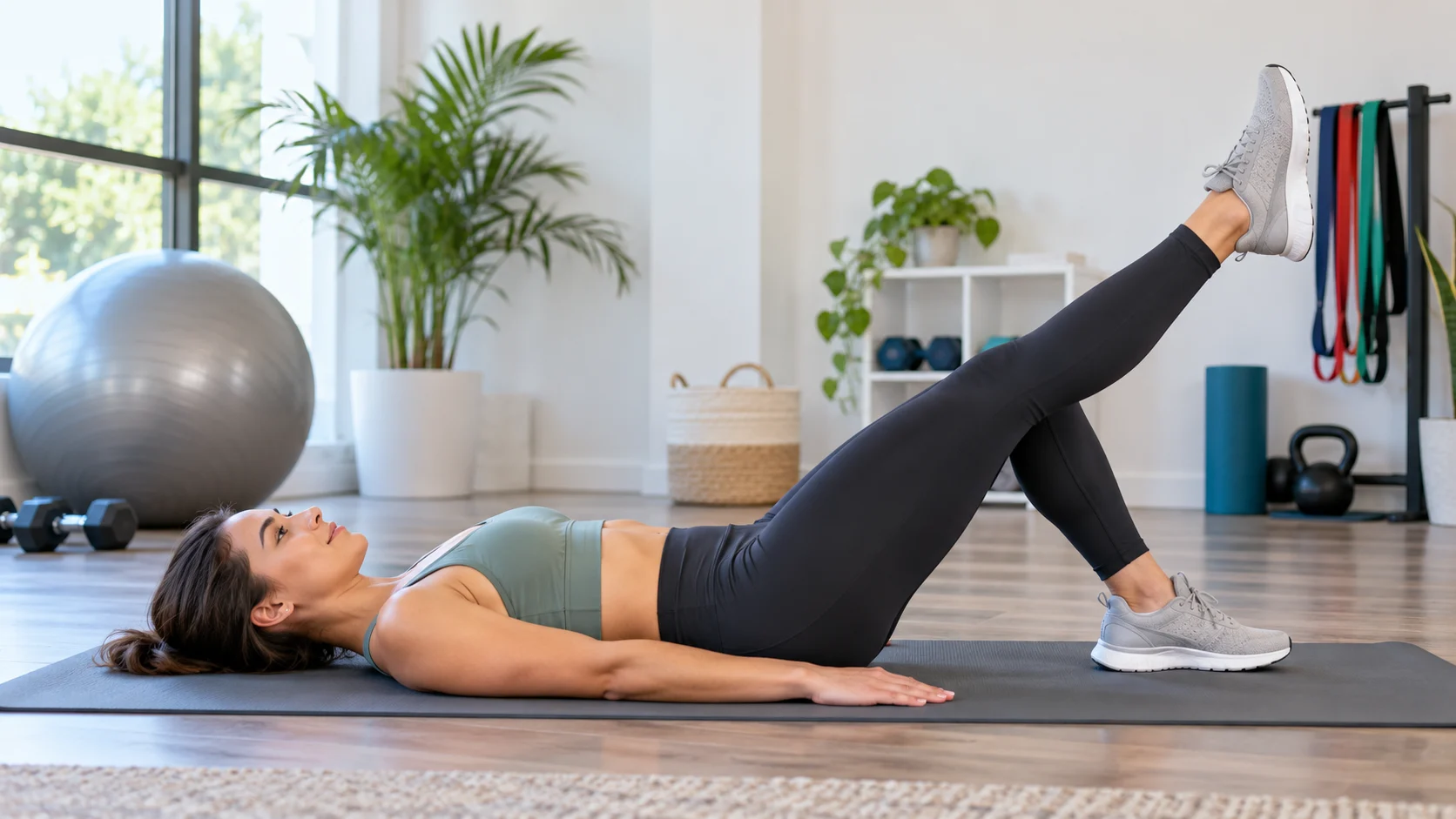
What Are Straight Leg Raises?
Straight leg raises are a simple strengthening exercise that mainly targets the hip flexors while also engaging the quadriceps and core muscles. The movement is commonly used in rehabilitation, fitness routines, and lower-body strength programs because it requires little equipment. It can be performed lying on your back, making it accessible for beginners and people rebuilding leg strength.
The basic exercise involves keeping one leg straight and lifting it away from the floor while the opposite knee remains bent for support. Because the knee stays extended, the quadriceps must work to maintain a straight leg throughout the movement. At the same time, the hip flexors help raise the leg and the abdominal muscles help stabilize the pelvis.
Straight leg raises may look easy, but proper technique matters. Lifting too high, arching the lower back, or allowing the knee to bend can shift the effort away from the intended muscles. A slow, controlled movement usually produces better results than trying to perform many fast repetitions.
What Muscles Do Straight Leg Raises Work?
The hip flexors do much of the work during straight leg raises. These muscles help lift the thigh toward the torso and include the iliopsoas and other muscles around the front of the hip. They become more active as the leg rises from the floor and continue working to control the leg as it lowers again.
The quadriceps, especially the rectus femoris, help keep the knee straight throughout the exercise. You may notice tension across the front of the thigh before the leg even leaves the floor. This is normal because the quadriceps must maintain knee extension while the hip flexors produce the larger lifting motion.
The abdominal muscles also contribute by helping keep the pelvis steady. If the core is not controlling the movement, the lower back may arch as the leg rises. The exercise therefore trains several muscle groups together, even though the front of the hip and thigh typically feel most active during each repetition.
Benefits of Straight Leg Raises
Straight leg raises can help strengthen the muscles around the hip and thigh without requiring heavy weights. This makes them useful for beginners, home exercisers, and people who need a lower-load strengthening option. The movement can be adjusted easily by changing repetitions, lifting height, tempo, or adding light ankle resistance later.
The exercise can also help maintain quadriceps activity when more demanding movements such as squats or lunges are temporarily difficult. Because the knee remains relatively still, straight leg raises may be used in some rehabilitation programs when appropriate. However, their suitability depends on the injury, surgery, or condition being treated.
Another benefit is improved awareness of pelvic and core control. Performing the exercise slowly teaches you to lift one leg without allowing the entire pelvis or lower back to move excessively. This coordination can support more advanced exercises later, especially those that require the trunk and hips to work together.
How to Do a Straight Leg Raise Correctly
Lie on your back with one knee bent and the foot flat on the floor. Keep the other leg straight with the toes pointing comfortably upward. Relax your shoulders, keep the head supported, and gently tighten the thigh of the straight leg before you begin lifting.
Slowly raise the straight leg until it reaches roughly the height of the opposite knee or a position that feels controlled. Keep the knee extended and avoid swinging the leg upward with momentum. Your pelvis should remain relatively still, and the lower back should not dramatically arch away from the floor.
Pause briefly at the top, then lower the leg slowly until it nearly reaches the floor. Complete the desired repetitions before switching sides. If you cannot maintain a straight knee or stable pelvis, reduce the lifting height rather than forcing the leg higher.
How High Should You Lift Your Leg?
You do not need to raise the leg as high as possible to make straight leg raises effective. Lifting to around 30 to 45 degrees, or roughly level with the opposite knee, is often enough for many people. Going much higher may reduce muscular tension or encourage unnecessary movement through the pelvis and lower back.
The best height depends on your strength, mobility, and ability to maintain control. Someone with strong hip flexors and good core stability may comfortably lift slightly higher, while a beginner may need a smaller range. The exercise should remain smooth rather than becoming a contest to see how far the leg can travel.
If your lower back arches noticeably as the leg rises, reduce the range. A smaller, controlled movement is more useful than a larger one performed with poor technique. Over time, you may be able to increase the height as strength and coordination improve.
Common Straight Leg Raise Mistakes
One of the most common mistakes is bending the knee during the lift. This reduces the demand on the quadriceps and changes the exercise mechanics. Tighten the front of the thigh before raising the leg and maintain that tension until the leg returns to the starting position.
Another mistake is lifting the leg too quickly. Swinging creates momentum, which can make the exercise feel easier without challenging the muscles effectively. Use a controlled tempo on both the lifting and lowering phases, especially during the descent where the muscles continue working to manage the leg.
Excessive lower-back arching is also common. If the pelvis tips forward as the leg rises, the hip flexors may pull strongly on the pelvis without enough trunk control. Reduce the height, slow the movement, and gently engage the abdomen to keep the exercise focused and comfortable.
How Many Straight Leg Raises Should You Do?
Beginners may start with one or two sets of eight to twelve controlled repetitions on each side. This gives you enough practice to learn the movement without creating excessive fatigue. The exact number is less important than maintaining good form throughout the entire set.
As the exercise becomes easier, you can gradually increase repetitions or add another set. You might also slow the lowering phase or pause briefly at the top to increase difficulty. Progression should happen gradually rather than adding resistance immediately after mastering only a few basic repetitions.
If you are doing straight leg raises as part of rehabilitation, follow the volume recommended by your healthcare professional. Some conditions require lower repetitions or specific movement limits. Stop if pain increases substantially or if the exercise produces symptoms that feel different from ordinary muscular effort.
Straight Leg Raises for Knee Rehabilitation
Straight leg raises are often included in knee rehabilitation because they strengthen the quadriceps without requiring repeated bending of the knee. This can be useful when the knee is sensitive to loaded squats or deeper flexion. The exercise allows the thigh muscles to work while the knee remains in a more stable position.
Before lifting, it is important to fully tighten the quadriceps and keep the knee straight. If the knee droops or bends during the movement, the muscles may not be controlling the leg effectively. Some rehabilitation programs use a towel under the knee or additional exercises first to improve quadriceps activation.
Not every knee problem should be treated with straight leg raises, and exercise timing matters after injury or surgery. Follow professional instructions when restrictions are present. If the knee becomes more swollen, painful, or unstable after the exercise, stop and ask whether the movement needs to be modified.
Straight Leg Raises and Core Stability
Although straight leg raises primarily target the hip and thigh, core control is important for keeping the pelvis stable. The abdominal muscles help resist excessive arching as the leg lifts. This makes the exercise a useful introduction to coordinating lower-body movement with trunk stability.
You can improve core involvement by gently bracing the abdomen before lifting the leg. Avoid holding your breath or pulling the stomach inward as hard as possible. The goal is light control that allows normal breathing while preventing large pelvic movements.
Whole-body strength is useful because different muscle groups support one another during movement. Lower-body exercises can be combined with upper-body work, including neck strengthening exercises, to create a more balanced training routine. A complete program develops strength across several regions instead of focusing on one muscle group alone.
Variations of Straight Leg Raises
A side-lying straight leg raise targets different hip muscles. Lie on your side with the bottom leg slightly bent for support and lift the top leg upward while keeping the pelvis stacked. This variation emphasizes the hip abductors, including the gluteus medius, rather than the front hip muscles.
Prone straight leg raises are performed lying on the stomach and lifting one leg backward. This shifts the emphasis toward the glutes and hamstrings while challenging hip extension. Keep the movement small enough that the lower back does not arch excessively as the leg rises.
You can also perform straight leg raises with light ankle weights once the basic version becomes easy. Resistance should be added gradually because even a small weight increases the effort significantly. Maintain the same slow technique and remove the weight if form begins to deteriorate.
When Straight Leg Raises May Cause Discomfort
Some people feel hip flexor tension during straight leg raises because these muscles work hard to lift the leg. Mild muscular effort is expected, but sharp pain in the front of the hip is not. Reduce the range or stop if the movement causes pinching, catching, or increasing discomfort.
Lower-back discomfort may occur when the pelvis is not well controlled. This is often a sign that the exercise is too difficult, the leg is being lifted too high, or the core is fatiguing. Reducing the range or performing fewer repetitions may make the movement more manageable.
Pain in the knee itself should also be taken seriously, especially if it increases throughout the set. Straight leg raises are often used in knee rehabilitation, but they are not automatically appropriate for every condition. Persistent or worsening symptoms should be discussed with a qualified healthcare professional.
How to Progress Straight Leg Raises
Progression can begin by slowing the exercise rather than immediately adding weight. Try lifting the leg for two seconds, pausing briefly, and lowering it over three or four seconds. A slower tempo increases muscular control and makes each repetition more challenging without changing the movement itself.
You can also increase repetitions gradually as endurance improves. Once you can complete multiple sets with consistent technique, light ankle weights may be introduced. Start with a small amount of resistance because the long lever created by the straight leg makes added weight feel more demanding than expected.
Eventually, you may progress toward functional exercises such as step-ups, split squats, lunges, and other weight-bearing movements. Straight leg raises can build foundational strength, but they should not remain your only lower-body exercise forever. A balanced program should gradually include movements that challenge the hips, knees, and trunk together.
When to Get Professional Advice
Seek professional guidance if you are unsure whether straight leg raises are appropriate after surgery, a significant injury, or a recent medical diagnosis. Rehabilitation exercises should match the stage of healing and the restrictions given by your healthcare team. Doing more exercise is not always better when tissues are still recovering.
You should also get help if the exercise repeatedly causes sharp pain, significant swelling, numbness, or weakness. These symptoms may indicate that another structure or condition needs evaluation. A physiotherapist or other qualified professional can assess your movement and recommend a safer alternative if needed.
Stop immediately and seek urgent care if leg weakness appears suddenly alongside severe back pain, loss of bladder or bowel control, or numbness around the groin. These symptoms are uncommon but require prompt medical evaluation. Straight leg raises should never delay treatment of serious neurological warning signs.
Conclusion
Straight leg raises are a simple exercise for strengthening the hip flexors, quadriceps, and supporting core muscles. They require minimal equipment and can be useful in general fitness or selected rehabilitation programs. The key is keeping the knee straight, controlling the pelvis, and lifting only as high as you can manage comfortably.
Begin with a small number of slow repetitions and progress gradually. You can increase the challenge through additional repetitions, longer pauses, slower lowering, or light ankle resistance. Once basic strength improves, add more functional lower-body exercises to build strength across a wider variety of movements.
If straight leg raises cause sharp pain, increased swelling, neurological symptoms, or persistent discomfort, stop and seek professional advice. The exercise should feel controlled rather than forced. When performed correctly, straight leg raises can be a practical way to build lower-body strength and prepare for more advanced training.
FAQs
What muscles do straight leg raises work?
Straight leg raises mainly work the hip flexors and quadriceps while the abdominal muscles help stabilize the pelvis. Different variations can also target the glutes, hamstrings, or outer hip muscles.
How many straight leg raises should I do?
Beginners can often start with one or two sets of eight to twelve repetitions per side. Increase volume gradually while keeping the knee straight and the movement slow and controlled.
Are straight leg raises good for knee pain?
They are sometimes used in knee rehabilitation because they strengthen the quadriceps without much knee movement. However, not every knee condition is the same, so persistent pain should be assessed professionally.
Should my lower back hurt during straight leg raises?
No. Lower-back discomfort may mean you are lifting too high, losing pelvic control, or performing too many repetitions. Reduce the range and focus on gentle abdominal engagement.
Can I do straight leg raises every day?
Light straight leg raises may be performed frequently in some rehabilitation programs, but daily training is not necessary for everyone. Frequency should depend on resistance, recovery, symptoms, and your overall exercise plan.