
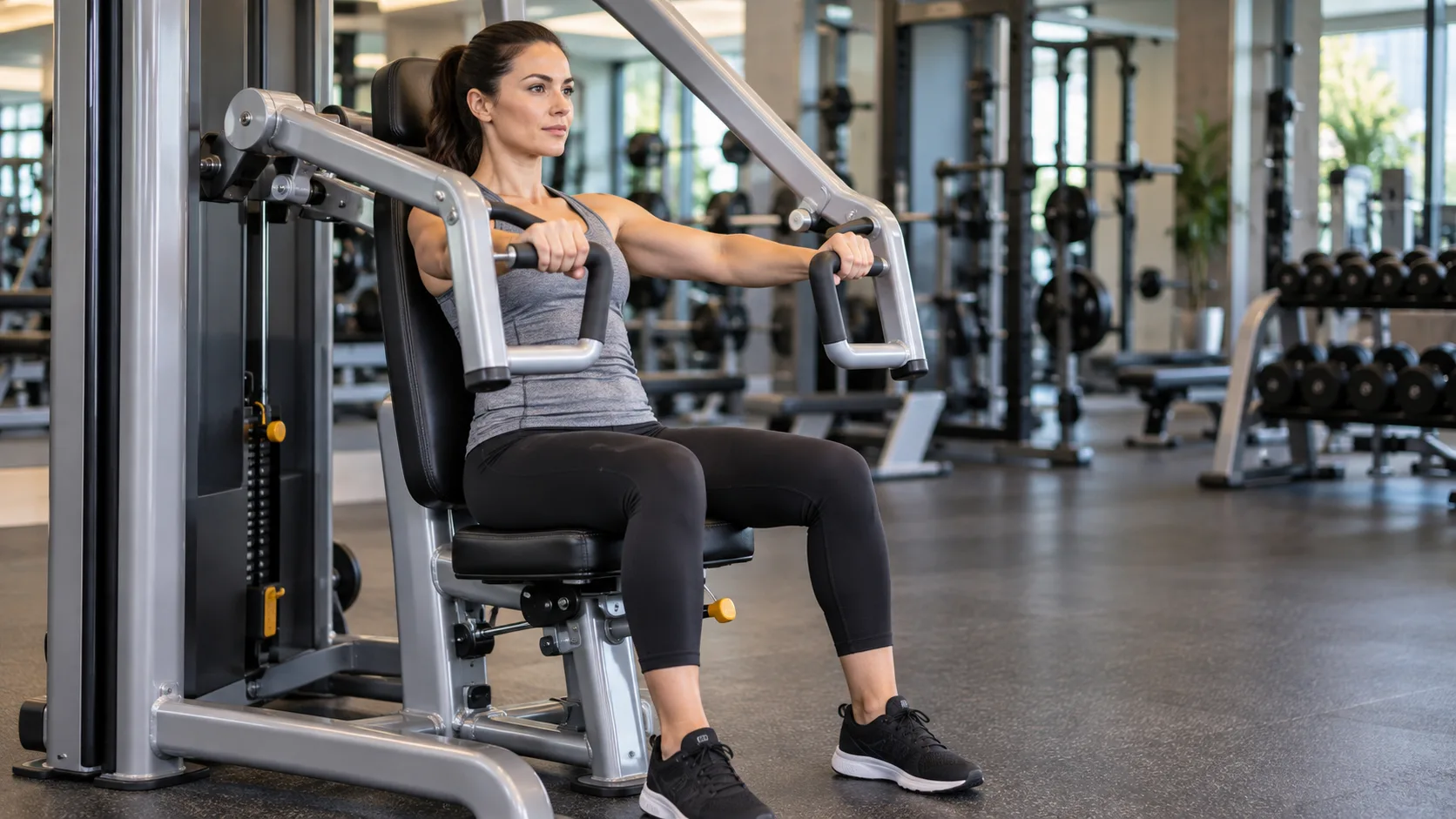
What Is a Seated Chest Press?
The seated chest press is a resistance exercise that primarily trains the chest, shoulders, and triceps. It is usually performed on a machine with a supported seat and backrest, making it easier to control than many free-weight pressing exercises. Because the machine guides the movement path, it can be a practical choice for beginners and experienced lifters alike.
During the exercise, you push handles forward from chest level until the arms are nearly straight, then return them under control. The movement resembles a bench press but is performed while seated upright or slightly reclined. The machine provides stability, allowing you to focus more directly on pressing strength and muscle engagement.
The seated chest press is commonly used in full-body and upper-body workouts. It can help build pushing strength for everyday activities and other exercises. Good setup matters, because seat height, handle position, resistance, and elbow angle can all influence how comfortable and effective the exercise feels.
What Muscles Does the Seated Chest Press Work?
The pectoralis major is the primary muscle worked during the seated chest press. This large chest muscle helps move the upper arms forward and toward the center of the body. It produces much of the force required to push the handles away from your torso during each repetition.
The front portion of the deltoids, commonly called the anterior deltoids, also assists with the pressing motion. These shoulder muscles help raise and move the arms forward. Depending on the machine angle and grip position, you may feel more or less shoulder involvement while still keeping the chest as the main target.
The triceps work to straighten the elbows during the press. They become especially active near the end of the pushing phase as the arms approach extension. Muscles around the shoulder blades and trunk also contribute by stabilizing your upper body and helping you maintain a strong, controlled position against the backrest.
Benefits of the Seated Chest Press
One major benefit of the seated chest press is that it provides a stable environment for developing upper-body pushing strength. The backrest supports the torso, and the machine guides the handles through a predictable path. This makes it easier to concentrate on the target muscles without managing the balance demands of dumbbells or a barbell.
The exercise is also simple to progress. Most machines allow you to increase resistance in small steps, making it easy to track improvements over time. You can gradually increase weight, repetitions, or sets while keeping the movement pattern consistent and monitoring whether your technique remains controlled.
Another advantage is accessibility. Beginners can learn the pressing movement without needing a spotter, while experienced lifters can use the machine to add extra chest volume after free-weight exercises. The seated chest press can therefore work as a primary movement or as a supplemental exercise within a broader strength-training program.
How to Set Up the Seated Chest Press Machine
Start by adjusting the seat so the handles sit around mid-chest level. If the handles are too high, the shoulders may feel unnecessarily stressed, while handles positioned too low can change the pressing angle. The ideal setup allows your forearms and elbows to move comfortably while your upper back stays supported.
Sit with your feet flat on the floor and your back against the pad. Keep your shoulders relaxed rather than shrugging them toward your ears. Your elbows should usually sit slightly below or level with the shoulders, depending on the machine, and your wrists should remain relatively straight instead of bending backward excessively.
Choose a light to moderate starting resistance while you learn the setup. You should be able to complete each repetition smoothly without rocking your torso or struggling to control the handles. Once the seat position and movement feel natural, resistance can be increased gradually based on your goals and strength level.
How to Perform a Seated Chest Press Correctly
Grip the handles comfortably and keep your upper back supported by the pad. Take a breath, gently brace your trunk, and press the handles forward in a smooth motion. Avoid aggressively lifting the shoulders or pushing your head away from the backrest as the resistance becomes more challenging.
Continue pressing until your arms are almost straight, but avoid forcefully locking the elbows. Pause briefly if desired, then bring the handles back toward your chest under control. The returning phase should be slow enough that you maintain tension through the chest and shoulders instead of letting the machine pull your arms backward.
Keep your feet planted and your lower body relaxed but stable throughout the set. Your hips should remain on the seat instead of sliding forward. The goal is to create a strong base so the upper body can perform the pressing movement efficiently without unnecessary movement through the spine or pelvis.
Common Seated Chest Press Mistakes
Using too much weight is one of the most common mistakes. Excessive resistance can cause you to shorten the range, bounce the handles, arch the lower back, or lose control on the return. A slightly lighter load performed with smooth repetitions usually provides a better training stimulus than heavier weight moved with poor technique.
Another mistake is allowing the elbows to flare excessively outward. A very wide elbow position may make the shoulders feel uncomfortable, especially when the handles return toward the chest. Keeping the elbows at a natural angle slightly below shoulder level can help create a stronger and more comfortable pressing position.
Some people also let their wrists bend backward as the weight becomes challenging. Try to keep the knuckles, wrists, and forearms aligned as closely as possible. Maintaining a neutral wrist position can make the press feel more stable and reduces unnecessary strain through the hands and forearms.
How Many Seated Chest Press Reps Should You Do?
Beginners may start with two or three sets of around eight to twelve repetitions. Choose resistance that feels challenging by the final few reps while still allowing you to maintain consistent technique. If you can complete every repetition easily, a small increase in weight may be appropriate during a later workout.
For muscle growth, moderate repetition ranges such as eight to fifteen reps can work well. Higher-repetition sets can also be effective with lighter resistance when the muscles are trained close enough to fatigue. The exact number matters less than using a challenging load and gradually increasing the training stimulus over time.
Strength-focused training may eventually use heavier resistance and fewer repetitions. However, beginners should prioritize learning control before chasing heavier weights. Progress works best when technique remains stable and you can complete the full movement without bouncing, excessive arching, or needing momentum to finish the set.
Seated Chest Press vs. Bench Press
Both the seated chest press and bench press train the chest, shoulders, and triceps, but they challenge the body differently. The machine version guides the movement and supports the torso, reducing balance demands. The bench press requires more stabilization because you control the barbell or dumbbells throughout the entire movement.
Free-weight bench pressing may develop more coordination and overall control, while the seated machine can make it easier to target the pressing muscles directly. Neither option is automatically better for every goal. Beginners, bodybuilders, athletes, and general fitness enthusiasts may use one or both depending on their needs.
Using both exercises can provide useful variety. You might perform the bench press first for heavier compound work and use the seated chest press afterward for additional volume. Alternatively, someone who feels more comfortable with machines can use the seated press as the main chest exercise while gradually developing free-weight skills.
How Your Lower Body Supports the Exercise
Although the seated chest press is an upper-body exercise, your lower body still helps create a stable base. Keeping both feet firmly on the floor can reduce unnecessary shifting through the hips and trunk. A steady lower body allows the chest, shoulders, and arms to focus more effectively on producing pressing force.
You should not need to push aggressively through the legs or twist your pelvis during normal repetitions. If you find yourself sliding forward or lifting one foot from the ground, the resistance may be too heavy. Adjusting the seat and reducing the load can make the exercise more controlled and comfortable.
If maintaining the seated position causes discomfort elsewhere, address that problem rather than ignoring it. For example, persistent inner thigh pain near the groin can make wide or awkward seated positions uncomfortable. Adjust your stance and seek professional advice if pain continues or interferes with normal training.
Seated Chest Press for Beginners
The seated chest press is often a good beginner exercise because the machine provides clear movement guidance. You do not need to balance separate dumbbells or control a barbell above your chest. This allows new lifters to learn how pressing feels while building basic strength and confidence.
Start with a light weight and practice the entire movement before increasing resistance. Focus on keeping your shoulders relaxed, wrists straight, and back supported. Beginners should avoid copying the loads used by more experienced gym members because individual strength and machine designs vary significantly.
Progress gradually once you can perform several sets without losing form. Increasing the weight by a small amount is usually enough to create a new challenge. You can also add repetitions before adding resistance, which is often a simple way to progress while keeping the exercise comfortable and controlled.
How to Progress the Seated Chest Press
Progressive overload means gradually making the exercise more challenging as your body adapts. You might increase resistance, complete an extra repetition, add another set, or improve tempo and control. The change does not need to be dramatic because small improvements can add up significantly over several months of consistent training.
Avoid increasing the weight simply because you reached a specific number of workouts. Progress when the current resistance feels manageable through the full range and your form remains stable. If a heavier load causes the shoulders to shrug, the wrists to collapse, or the back to arch dramatically, reduce the resistance.
You can also use slower lowering phases to make lighter loads more demanding. Taking two or three seconds to return the handles toward the chest increases time under tension and encourages better control. This can be especially useful when machine weight jumps are larger than you are ready to handle.
Seated Chest Press Safety Tips
Warm up before challenging chest training by moving the shoulders and performing a few lighter sets. Gradually increasing resistance allows the muscles and joints to prepare for heavier work. There is usually no need for a long or complicated warm-up if the first few sets are appropriately light and controlled.
Stop the exercise if you experience sharp shoulder, chest, or arm pain rather than ordinary muscular effort. Painful clicking, numbness, tingling, or sudden weakness also deserves attention. These symptoms are different from the normal burning or fatigue that can develop near the end of a challenging set.
People recovering from shoulder surgery, chest injury, or significant upper-body problems should follow professional guidance before using resistance machines. A physiotherapist or healthcare professional can help determine whether the exercise is appropriate and which range or resistance level is suitable during recovery.
Best Practices for Better Chest Press Results
Train the seated chest press consistently rather than changing exercises every workout. Repeating the movement for several weeks makes it easier to track strength improvements and refine technique. Once progress slows or your goals change, variations in grip, machine angle, or exercise selection can provide a different training stimulus.
Include pulling exercises such as rows and pulldowns alongside pressing work. Balanced upper-body training strengthens the back, shoulders, and chest rather than focusing only on muscles at the front of the body. This approach can improve overall strength and make your training program more complete.
Recovery matters as much as the workout itself. Give the chest, shoulders, and triceps enough time to recover before another demanding pressing session. Adequate sleep, sufficient nutrition, and a sensible training schedule can help you progress more consistently than simply adding more sets every time you visit the gym.
Conclusion
The seated chest press is an effective machine-based exercise for training the chest, front shoulders, and triceps. Its supported design makes it accessible for beginners while still allowing experienced lifters to use challenging resistance. Proper setup and controlled movement are essential for getting the most from each repetition.
Keep the handles around chest level, maintain stable wrists, and press without excessive shoulder shrugging or lower-back arching. Use a manageable load and control both the pushing and returning phases. Gradual progression through additional resistance, repetitions, or sets can help build strength and muscle over time.
The exercise works best as part of a balanced program that includes pulling movements, lower-body training, and adequate recovery. Stop and adjust if you experience sharp pain or neurological symptoms. With consistent technique and sensible progression, the seated chest press can be a practical tool for improving upper-body pushing strength.
FAQs
What muscles does the seated chest press work?
The seated chest press primarily works the pectoralis major, anterior deltoids, and triceps. Muscles around the shoulders and trunk also help stabilize the body throughout the movement.
Is the seated chest press good for beginners?
Yes. The machine guides the movement and supports the torso, making it easier for beginners to learn pressing mechanics. Start with light resistance and increase gradually as control improves.
How many reps should I do on the seated chest press?
Two or three sets of eight to fifteen repetitions can work well for many people. Choose resistance that feels challenging while still allowing smooth movement and consistent technique.
Is a seated chest press better than a bench press?
Neither is universally better. The seated press offers more stability, while the bench press requires greater coordination and control. Both can be useful depending on experience, goals, and comfort.
Why do my shoulders hurt during the chest press?
Shoulder discomfort may come from poor seat height, excessive elbow flaring, too much weight, or an underlying shoulder problem. Adjust your setup and stop if pain remains sharp or persistent.