
Seebeck Effect Explained: How It Works & Uses
The Seebeck effect is a thermoelectric phenomenon in which a temperature difference across a material or circuit produces an electrical voltage. It is one of the core principles behind thermocouples, thermoelectric generators, temperature sensors, and several energy-harvesting technologies. Although the physics can sound complex, the basic idea is straightforward: when one part of a conductor or semiconductor is hotter than another, charge carriers move differently across the temperature gradient. This movement creates an electrical potential that can be measured or used to produce useful power. The amount of voltage depends on the materials involved and the size of the temperature difference. Understanding the Seebeck effect therefore provides a useful foundation for learning how heat and electricity can interact directly.
The effect is especially important because it allows temperature differences to be converted into electrical signals without using moving mechanical parts. This makes thermoelectric devices attractive in situations where reliability, compact size, silent operation, or low maintenance matters. A thermocouple can measure temperature inside industrial equipment by detecting a Seebeck voltage, while a thermoelectric generator can recover a small portion of otherwise wasted heat and turn it into electrical energy. The same principle has been used in scientific instruments, power generation systems, automobiles, manufacturing, and remote equipment. Modern research continues to explore materials that can create stronger thermoelectric performance. As energy efficiency becomes increasingly important, interest in waste-heat recovery and solid-state energy conversion continues to grow.
The Seebeck effect should not be viewed as a way to create energy from nothing. Electrical energy is generated because heat flows through a temperature difference, and the thermoelectric material converts part of that thermal energy into electrical energy. The efficiency of this conversion depends heavily on the properties of the materials and the operating temperatures. Some materials are excellent electrical conductors but poor thermoelectric materials, while specially engineered semiconductors can provide much stronger performance. This guide explains the Seebeck effect meaning, how the phenomenon works, the Seebeck coefficient, common materials, thermocouples, thermoelectric generators, practical applications, limitations, and its relationship with other thermoelectric effects. The goal is to make the concept understandable without oversimplifying the underlying science.
What Is the Seebeck Effect?
The Seebeck effect is the generation of an electrical voltage when different parts of a conducting or semiconducting system are maintained at different temperatures. The effect is named after Thomas Johann Seebeck, who observed thermoelectric behavior in circuits made from dissimilar materials during the nineteenth century. In a simple thermoelectric circuit, two different materials can be connected and exposed to different temperatures at their junctions. The temperature difference creates a voltage that depends on the thermoelectric properties of the materials. If the circuit is closed, this voltage can drive an electrical current. If the circuit is left open, the voltage can be measured and related to the temperature difference.
At the microscopic level, the Seebeck effect is connected to the way charge carriers respond to temperature. In metals, the main charge carriers are electrons, while semiconductors may involve both electrons and positively behaving charge carriers known as holes. Hotter regions contain carriers with greater average thermal energy, which affects how they diffuse through the material. This creates an imbalance in charge distribution along the temperature gradient. An internal electric field develops as charges redistribute, and the resulting potential difference can be detected between the hot and cold ends. The exact behavior depends on the electronic structure, carrier concentration, scattering mechanisms, and other properties of the material.
A single material can exhibit a Seebeck voltage when a temperature gradient exists across it, but practical thermocouple measurements typically use two different materials. This is because a measuring circuit must be completed, and the measurable voltage depends on the difference between the Seebeck coefficients of the materials involved. If two materials respond differently to the same temperature gradient, their thermoelectric voltages do not cancel completely. The remaining voltage can then be measured. This makes material selection extremely important in thermocouple design. Different combinations are chosen according to temperature range, stability, accuracy, chemical resistance, mechanical strength, and cost.
The Seebeck effect belongs to a broader group of thermoelectric phenomena in which heat and electrical behavior influence one another. It is closely related to the Peltier effect and the Thomson effect, although each describes a different relationship. The Seebeck effect focuses on the production of voltage from a temperature difference. The Peltier effect describes heating or cooling that occurs when electric current crosses a junction between certain materials. The Thomson effect describes reversible heating or cooling within a single conductor carrying current while a temperature gradient exists. Together, these effects form the theoretical basis of thermoelectric conversion technologies used for temperature sensing, cooling, and electrical power generation.
A simple way to understand the Seebeck effect is to think of it as a heat-driven electrical imbalance. Heat causes carriers in the hotter region to behave differently from those in the cooler region, producing a measurable electrical potential. The larger the temperature difference, the larger the voltage generally becomes within the material’s useful operating range. However, the relationship is not always perfectly constant across very large temperature ranges because material properties can vary with temperature. Engineers therefore use calibration data and material-specific coefficients when precise measurements are required. This combination of simple physical behavior and practical measurability is why the Seebeck effect has remained important in science and engineering for generations.
How Does the Seebeck Effect Work?
The Seebeck effect begins when a temperature gradient is created across a material. One end may be heated while the opposite end remains cooler, producing a difference in thermal energy throughout the structure. Charge carriers in the hotter region have higher average energy and tend to diffuse toward regions where the carrier energy distribution is lower. As this movement occurs, charge begins to accumulate unevenly. The redistribution of charge creates an electric field that opposes further diffusion. Eventually, a balance develops between the thermally driven carrier movement and the electrical force caused by charge separation.
The electrical potential created across the material is called the Seebeck voltage or thermoelectric voltage. Its magnitude depends on both the temperature difference and the Seebeck coefficient of the material. In a simplified case where the coefficient remains approximately constant, the generated voltage is proportional to the temperature difference. This means that doubling the temperature difference can approximately double the thermoelectric voltage under suitable conditions. Real materials can behave more complicatedly because their Seebeck coefficients may change with temperature. Accurate thermoelectric calculations therefore often require integrating the coefficient over the actual temperature range rather than relying on a single constant value.
When two different conductors or semiconductors form a thermocouple, their different Seebeck responses create a useful measurable signal. Suppose material A and material B are joined at one end and connected to a measuring instrument at another temperature. Each material develops its own thermoelectric response along the temperature gradient. Because their Seebeck coefficients differ, the net voltage measured across the circuit is not zero. That voltage can be related to the temperature difference between the sensing junction and the reference point. This is the fundamental operating principle behind thermocouple temperature measurement.
The direction and size of the Seebeck voltage depend on the carrier behavior of the materials. Some materials have positive Seebeck coefficients, while others have negative coefficients. A positive value generally indicates a particular direction of voltage relative to the thermal gradient, while a negative value indicates the opposite direction. In semiconductor thermoelectric devices, p-type and n-type materials are often paired because their Seebeck coefficients have opposite signs. This increases the voltage produced by each thermoelectric couple. Connecting many couples electrically in series can then produce a much larger total output voltage than a single element would generate alone.
Heat flow remains essential throughout the process because a thermoelectric generator requires a maintained temperature difference to continue producing useful voltage. If the hot and cold sides eventually reach the same temperature, the thermoelectric voltage falls toward zero. This is why practical thermoelectric generators need both a heat source and an effective way to remove heat from the cold side. Heat sinks, cooling plates, air flow, or liquid cooling may be used depending on the application. The electrical output therefore depends not only on the thermoelectric material but also on thermal system design. Maintaining a strong, controlled temperature gradient is a central requirement for effective Seebeck-based power generation.
Understanding the Seebeck Coefficient
The Seebeck coefficient is a material property that describes how much thermoelectric voltage is generated for a given temperature difference. It is commonly represented by the symbol S and expressed in volts per kelvin, although microvolts per kelvin are frequently used because many materials generate relatively small voltages. A larger absolute Seebeck coefficient means the material can produce a larger voltage for the same temperature gradient. The sign of the coefficient indicates the direction of the resulting thermoelectric potential under an established convention. Engineers use the Seebeck coefficient when comparing thermoelectric materials and estimating how much voltage a device may generate. It is therefore one of the most important parameters in thermoelectric design.
For a simplified case, the relationship can be written conceptually as voltage being approximately equal to the Seebeck coefficient multiplied by the temperature difference. If a material has a coefficient of 200 microvolts per kelvin and experiences a 100-kelvin temperature difference, the idealized voltage contribution would be around 20 millivolts. Actual devices can differ because material coefficients change with temperature and several materials may be involved. Electrical resistance, contact resistance, thermal losses, and measurement conditions also influence practical performance. The simplified relationship is nevertheless useful for understanding why larger temperature differences and stronger thermoelectric materials can produce larger voltages.
Metals generally have smaller Seebeck coefficients than many useful thermoelectric semiconductors. This does not make metals unimportant because they provide excellent stability and predictable characteristics for thermocouple applications. Semiconductor materials can achieve much higher thermoelectric voltages, making them attractive for thermoelectric generators and cooling devices. Materials such as bismuth telluride have become well known in thermoelectric technology because they provide a useful combination of electrical and thermal properties near common operating temperatures. Other materials are selected for higher-temperature applications. The ideal choice depends on the operating range and whether the device is designed primarily for sensing, power generation, or cooling.
The Seebeck coefficient is closely connected to the electronic structure of a material. Carrier concentration, carrier mobility, energy distribution, and scattering mechanisms all influence thermoelectric behavior. Increasing electrical conductivity alone does not necessarily produce a better thermoelectric material because thermoelectric performance requires balancing several competing properties. A strong material generally benefits from a high Seebeck coefficient, good electrical conductivity, and low thermal conductivity. Low thermal conductivity helps maintain the temperature difference across the material instead of allowing heat to pass through too easily. Designing materials that combine these characteristics is a major challenge in thermoelectric research.
Temperature itself can change the Seebeck coefficient, meaning a material may perform differently at low, moderate, and high temperatures. This is one reason thermocouple tables and calibration curves are used rather than assuming a perfectly linear voltage relationship across every operating condition. Engineers select thermoelectric materials that remain predictable and stable within the intended temperature range. Material degradation, oxidation, mechanical stress, or contamination can also alter performance over time. Accurate thermoelectric systems therefore depend on both suitable material selection and appropriate calibration. Understanding the Seebeck coefficient helps explain why different thermocouple types and thermoelectric modules are optimized for particular environments instead of using one universal material combination.
Seebeck Effect in Thermocouples
Thermocouples are among the most familiar practical applications of the Seebeck effect. A thermocouple typically consists of two conductors made from different materials that are connected at a sensing junction. When the sensing junction and the reference side are at different temperatures, the difference in Seebeck coefficients produces a measurable thermoelectric voltage. That voltage is then converted into a temperature reading through calibration data. Because thermocouples can operate over broad temperature ranges and are relatively simple in construction, they are widely used in manufacturing, industrial furnaces, engines, laboratories, heating systems, food processing, and many other environments. Their durability makes them particularly valuable where delicate electronic sensors may not survive.
Thermocouples do not directly measure absolute temperature from one junction alone. Instead, they fundamentally respond to the temperature difference between the measurement junction and a reference point. Modern instruments use cold-junction compensation to determine the temperature at the reference connection and correct the measurement accordingly. This allows the system to calculate the actual temperature at the sensing junction. Without appropriate compensation, changes in the temperature of the measuring instrument or terminal connection could affect the result. Modern digital thermocouple interfaces perform this correction automatically. The user therefore sees a direct temperature reading even though the underlying Seebeck mechanism is based on a temperature difference.
Different thermocouple types use different material combinations because no single pair is ideal for every environment. Type K thermocouples are widely used for general-purpose temperature measurement and can cover a broad range. Type J, T, E, N, R, S, and B thermocouples provide different characteristics related to sensitivity, operating temperature, oxidation resistance, stability, and cost. Some combinations are better suited to cryogenic temperatures, while others can measure very high furnace temperatures. Selecting the correct thermocouple requires considering both the expected temperature and the surrounding chemical or mechanical environment. Incorrect material selection can reduce measurement accuracy or shorten sensor life.
Thermocouple signals are relatively small, often measured in millivolts, which makes measurement electronics important. Electrical noise from motors, power systems, radio-frequency sources, and poorly grounded equipment can interfere with low-level thermoelectric signals. Instrumentation therefore may use shielding, filtering, differential measurement, proper grounding, and suitable cable routing to improve signal quality. Extension wires must also match the appropriate thermocouple characteristics when required. Using incorrect wire materials can introduce additional thermoelectric junctions that distort the measurement. Good installation practices are therefore just as important as choosing the correct sensor type.
The simplicity of thermocouples remains one of their greatest strengths. They can be manufactured in small sizes, embedded in surfaces, inserted into pipes, placed inside machines, or protected with durable metal sheaths. Their response time can be fast when the sensing junction has low thermal mass, although heavily protected probes may respond more slowly. Thermocouples also tolerate vibration and harsh conditions better than many alternative sensors. Their accuracy can be lower than some resistance-based temperature sensors in certain ranges, but their broad operating capability often outweighs that limitation. The Seebeck effect therefore continues to provide a dependable foundation for temperature sensing across an enormous range of industrial and scientific applications.
Seebeck Effect in Thermoelectric Generators
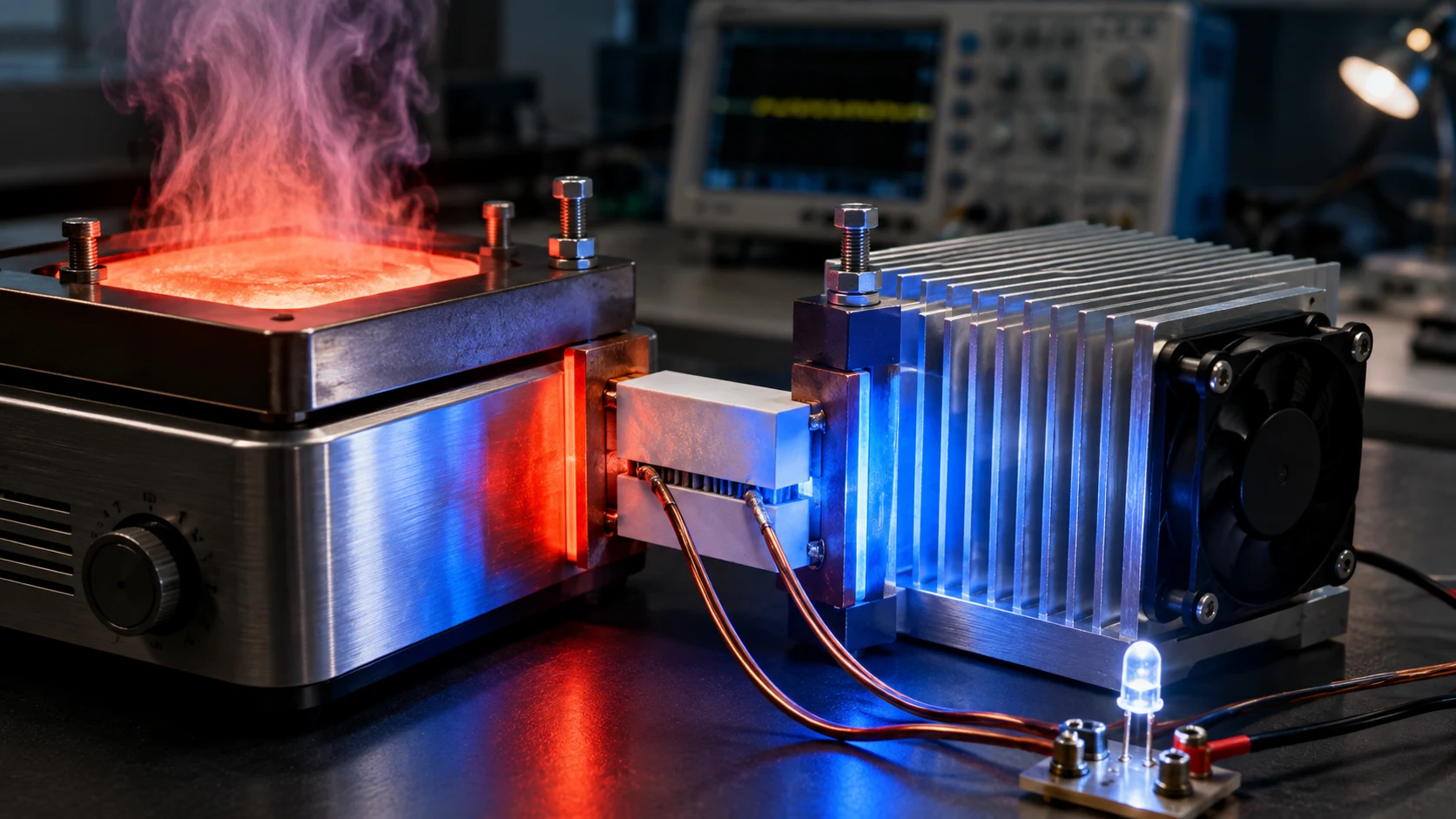
A thermoelectric generator uses the Seebeck effect to convert a temperature difference directly into electrical power. Instead of using the small voltage only as a measurement signal, the device connects many thermoelectric elements together so their combined output can drive an electrical load. Most modules contain alternating p-type and n-type semiconductor legs connected electrically in series and thermally in parallel. One side of the module is heated while the opposite side is kept cooler. Each thermoelectric couple contributes a small voltage, and those voltages add together across the complete module. The result is a solid-state generator with no moving pistons, turbines, or mechanical shafts.
Thermoelectric generators are attractive because they can operate quietly and require relatively little mechanical maintenance. Their lack of moving parts means there are fewer components to wear through friction. They can also be compact and scalable, allowing small modules to power sensors or larger assemblies to recover energy from industrial heat. However, thermoelectric conversion efficiency is usually lower than that of many conventional heat-engine systems under comparable high-power conditions. Their strongest advantage often appears where simplicity, reliability, remote operation, or otherwise wasted heat matters more than maximum efficiency. This makes them especially useful in specialized energy-harvesting applications.
Waste-heat recovery is one of the most discussed applications of Seebeck-based power generation. Industrial furnaces, engines, exhaust systems, manufacturing processes, and power equipment release significant amounts of thermal energy that may otherwise dissipate into the environment. A thermoelectric generator can be placed between a hot surface and a cooling system to convert part of that temperature difference into electricity. The generated power may support sensors, electronics, monitoring systems, or auxiliary equipment. In larger applications, engineers evaluate whether the electrical output justifies the cost, thermal design complexity, and added system weight. Economic viability depends strongly on temperature, installation conditions, and material performance.
Remote power is another valuable application because thermoelectric generators can function where batteries are difficult to replace or conventional generators are impractical. A persistent heat source can potentially supply electrical energy for monitoring instruments or communication devices. Some systems use combustion, geothermal heat, or other long-lasting thermal sources. Space exploration has also used radioisotope thermoelectric generators, which convert heat from radioactive decay into electricity through thermoelectric materials. These systems are designed for exceptional reliability over long periods rather than high conversion efficiency. The same Seebeck principle applies, even though the heat source and engineering requirements differ substantially from ordinary commercial modules.
The output of a thermoelectric generator depends heavily on thermal management. A powerful heat source does not guarantee strong electrical output if the cold side becomes almost as hot as the hot side. The module needs a sustained temperature difference, which means heat must flow through the device while the cold side is effectively cooled. Heat sinks, liquid loops, radiators, and airflow can help maintain this gradient. Electrical loading also matters because maximum power is obtained only under appropriate operating conditions. Practical Seebeck power generation therefore requires coordinated thermal, electrical, mechanical, and material design rather than simply placing a thermoelectric module against a hot object.
Materials Used for the Seebeck Effect
Thermoelectric materials must balance several properties that normally compete with one another. A useful material should produce a substantial Seebeck voltage, conduct electricity efficiently, and resist conducting heat too quickly. High electrical conductivity helps generated current flow with lower resistance, while low thermal conductivity helps preserve the temperature difference that drives the effect. Unfortunately, materials that conduct electricity well often also conduct heat effectively. This relationship makes thermoelectric material development challenging. Researchers attempt to manipulate electronic and crystal structures so charge carriers move efficiently while heat-carrying vibrations are disrupted. The quality of this balance strongly influences the performance of thermoelectric generators and cooling modules.
Bismuth telluride is one of the best-known thermoelectric semiconductor materials, especially for applications near room temperature and moderately elevated temperatures. It is commonly used in commercial Peltier modules and can also support Seebeck-based energy generation. Both p-type and n-type forms can be engineered by adjusting composition and doping. Its relatively strong thermoelectric performance makes it useful for compact modules, although mechanical, cost, and temperature limitations still need consideration. Materials optimized for one temperature range may lose performance or stability at higher temperatures. Engineers therefore select compounds according to where the device will actually operate rather than relying on one material for every thermoelectric application.
Lead telluride and related compounds have been studied and used for higher-temperature thermoelectric applications. Other material families include skutterudites, half-Heusler compounds, silicon-germanium alloys, metal oxides, and several emerging semiconductor systems. Each family offers different strengths and limitations involving operating temperature, material availability, toxicity, stability, manufacturability, and cost. High-temperature applications can benefit from materials that remain stable where room-temperature thermoelectrics would degrade. However, excellent laboratory performance does not automatically translate into commercial success. Materials must also survive repeated thermal cycling, mechanical stress, manufacturing processes, and long-term operation in real environments.
Researchers increasingly investigate nanostructured thermoelectric materials because controlling structure at very small scales can alter both electrical transport and heat conduction. Nanostructures may scatter heat-carrying phonons more strongly while preserving useful electrical transport, which can improve thermoelectric performance. Superlattices, nanocomposites, and engineered grain structures are among the approaches explored. However, manufacturing advanced nanostructured materials consistently and economically can be difficult. Performance gains must be balanced against production cost, durability, scalability, and environmental considerations. The most scientifically impressive material is not always the best choice for mass-market thermoelectric products.
Sustainability is becoming increasingly important in thermoelectric material selection. Some high-performing compounds rely on elements that are scarce, expensive, or environmentally problematic. Researchers therefore explore more abundant and less hazardous alternatives that can still deliver useful efficiency. Recycling, supply-chain availability, manufacturing energy, and long-term disposal may become more important as thermoelectric technology expands. A material that offers slightly lower performance but significantly better availability and safety may be preferable for large-scale deployment. The future of Seebeck-based technology will likely depend not only on higher efficiency but also on finding materials that can be produced responsibly, economically, and reliably at industrial scale.
Practical Uses of the Seebeck Effect
Temperature measurement remains the largest everyday use of the Seebeck effect. Thermocouples are used to monitor ovens, furnaces, kilns, boilers, engines, chemical processes, HVAC systems, manufacturing equipment, and laboratory experiments. Their ability to operate across broad temperature ranges makes them especially valuable in industrial environments. Controllers can use thermocouple signals to adjust heaters, shut systems down when temperatures become unsafe, or maintain precise process conditions. In food manufacturing, temperature monitoring helps support consistent heating and cooling processes. In metals processing, thermocouples can measure environments where conventional electronic sensors would not survive.
Automotive systems provide another potential area for thermoelectric energy recovery. Internal-combustion engines release substantial heat through exhaust gases and cooling systems. Thermoelectric generators can theoretically convert part of that otherwise wasted thermal energy into electricity. The recovered electrical power could reduce some load on the vehicle’s alternator or supply auxiliary electronics. However, automotive implementation must consider weight, cost, exhaust back pressure, thermal cycling, cooling requirements, and material durability. These practical engineering challenges have limited widespread adoption. Nevertheless, waste-heat recovery remains an active area of interest because improved materials and system designs could make thermoelectric generation more attractive in selected transport applications.
Wearable electronics and small sensors are another promising field for Seebeck energy harvesting. The human body is warmer than many surrounding environments, creating a small temperature difference that can potentially power low-energy devices. Thermoelectric generators placed against the skin may convert part of this heat flow into electricity. The available power is typically limited because the temperature difference is modest, but modern low-power electronics can sometimes operate with very small energy budgets. Applications may include health-monitoring sensors, wireless transmitters, or devices that reduce dependence on frequent battery charging. Comfort, flexibility, efficiency, and thermal design remain important development challenges.
Industrial monitoring can benefit from thermoelectric generators when sensors are installed near hot equipment. Instead of running power cables or frequently replacing batteries, a small generator can harvest heat from machinery or pipes. That energy can support temperature sensors, vibration monitors, wireless communication, or condition-monitoring electronics. Self-powered sensors are particularly attractive in remote or difficult-to-access industrial locations. The available energy depends on the actual temperature difference and how effectively heat can be transferred through the thermoelectric module. When designed appropriately, such systems can reduce maintenance requirements and improve the practicality of distributed industrial monitoring.
The Seebeck effect also supports specialized scientific, aerospace, and remote-energy applications. Spacecraft operating far from the Sun may not receive enough solar energy for conventional photovoltaic systems, making long-lived thermoelectric power sources valuable. Scientific instruments can use thermocouples for precise thermal monitoring in experiments where small sensors are needed. Geothermal systems may offer persistent heat gradients that can support low-maintenance generation in suitable environments. Even consumer technologies can use thermoelectric modules for small energy-harvesting demonstrations or specialized power supplies. The wide range of applications reflects one major advantage of the Seebeck effect: a temperature difference can be converted directly into an electrical signal without requiring moving mechanical components.
Advantages and Limitations of the Seebeck Effect
One of the greatest advantages of Seebeck-based devices is their solid-state design. Thermoelectric generators can produce electricity without turbines, pumps, pistons, or other moving components inside the conversion element itself. This can reduce mechanical wear, vibration, noise, and routine maintenance requirements. Thermocouples are similarly simple and rugged, allowing them to operate in environments where more complex sensors may fail. Small thermoelectric devices can also be manufactured in compact forms and integrated into tight spaces. These characteristics make the Seebeck effect particularly attractive in remote, harsh, or maintenance-sensitive applications where reliability is more important than achieving the highest possible energy efficiency.
Scalability is another advantage because thermoelectric elements can be used in very small sensors or combined into larger power-generation assemblies. A tiny thermocouple junction may generate only a small measurement voltage, while thousands of thermoelectric couples can be assembled into modules or systems producing more useful electrical power. Modules can also be connected electrically or thermally to match the requirements of a particular application. This modularity gives designers flexibility. However, increasing the number of elements also increases cost, electrical connections, thermal interface requirements, and potential failure points. Scaling therefore requires careful engineering rather than simply adding more modules indefinitely.
The major limitation of thermoelectric power generation is efficiency. Many practical thermoelectric generators convert only a modest portion of available heat flow into electrical power compared with advanced mechanical heat engines operating under suitable conditions. Material properties place fundamental limits on performance, and additional losses occur through electrical resistance, heat leakage, contacts, and imperfect thermal interfaces. Low efficiency may be acceptable when the heat would otherwise be wasted or when only a small amount of electrical power is needed. It becomes more problematic when thermoelectric generation must compete directly with efficient conventional power systems. Economic value therefore depends strongly on the application rather than efficiency alone.
Maintaining a temperature difference is another practical challenge. If the cold side heats up too much, the Seebeck voltage and available power decline even when the heat source remains hot. Effective cooling can require heat sinks, fans, coolant loops, or large radiating surfaces. These supporting components can increase system size, weight, cost, and complexity. In some environments, natural air cooling may be sufficient, while high-power applications may require active thermal management. Heat also needs to pass through the thermoelectric material efficiently enough to sustain generation without damaging the module. Thermal system design can therefore become more difficult than the electrical connection itself.
Material cost and durability can also limit thermoelectric deployment. Some high-performance materials contain expensive, scarce, brittle, or environmentally sensitive elements. Thermoelectric modules may experience repeated expansion and contraction as temperatures change, creating mechanical stress over time. High temperatures can cause diffusion, oxidation, or degradation in materials and electrical contacts. Engineers need packaging that protects the device without adding excessive thermal resistance. These challenges are especially important in automotive and industrial environments where temperature cycles can be frequent and severe. Continued advances in materials science, manufacturing, packaging, and thermal engineering are therefore essential for expanding the practical uses of the Seebeck effect.
Seebeck Effect vs Peltier and Thomson Effects
The Seebeck effect, Peltier effect, and Thomson effect are closely related thermoelectric phenomena, but they describe different situations. The Seebeck effect converts a temperature difference into an electrical voltage. If a thermoelectric material has a hot side and a cold side, charge-carrier behavior can create a potential difference that may drive current. This makes the Seebeck effect useful for thermocouples and thermoelectric generators. The central input is a temperature difference, while the useful output is electrical voltage or power. Remembering this direction of energy conversion is the easiest way to distinguish Seebeck behavior from the related Peltier effect.
The Peltier effect works in the opposite practical direction. When electrical current passes through a junction between suitable materials, heat can be absorbed at one junction and released at another. This creates a cooling effect on one side and heating on the other. Thermoelectric coolers, often called Peltier modules, use this principle to provide solid-state temperature control. The same physical module can often demonstrate both effects: supplying current can create heating and cooling through the Peltier effect, while imposing a temperature difference can produce electrical voltage through the Seebeck effect. This reversibility is one of the most interesting features of thermoelectric technology.
The Thomson effect occurs within a single homogeneous conductor when electrical current flows through a temperature gradient. Depending on the direction of current and the material properties, heat may be absorbed or released along the conductor. The effect is generally less familiar to everyday users because it is not as directly visible as thermocouple voltage or Peltier cooling. However, it is important for a complete thermodynamic understanding of thermoelectric systems. The Thomson coefficient links temperature gradients, electrical current, and reversible heat behavior within the material. Researchers and engineers account for these relationships when analyzing thermoelectric transport in greater detail.
These three effects are connected through fundamental thermodynamic relationships. The material properties governing one thermoelectric effect are not completely independent of those governing the others. This connection allows scientists to analyze Seebeck, Peltier, and Thomson behavior using a consistent theoretical framework. In practical engineering, however, designers often focus on whichever effect serves the intended function. A temperature sensor emphasizes Seebeck voltage, a solid-state cooler emphasizes the Peltier effect, and advanced thermoelectric modeling may include Thomson heating. Understanding the relationships prevents the misconception that these are unrelated technologies simply because their applications look different.
The easiest comparison is to focus on cause and result. With the Seebeck effect, a temperature difference produces voltage. With the Peltier effect, an electrical current produces heating and cooling at material junctions. With the Thomson effect, electrical current interacts with a temperature gradient within one conductor to produce or absorb heat along its length. All three involve coupled electrical and thermal transport. Their shared foundation demonstrates that electricity and heat are deeply connected at the material level. Learning these distinctions makes thermoelectric generators, thermocouples, and solid-state coolers much easier to understand as parts of one broader field.
Conclusion
The Seebeck effect is the thermoelectric phenomenon in which a temperature difference produces an electrical potential. Heat changes the behavior and distribution of charge carriers within conductors and semiconductors, creating a voltage between regions at different temperatures. The effect can occur within individual materials, but practical devices often use combinations of materials with different Seebeck coefficients. This difference makes the thermoelectric voltage easier to measure or combine into useful power. The underlying concept is simple enough to describe in a few sentences, yet its detailed behavior depends on electronic structure, carrier transport, temperature, thermal conductivity, and material composition.
Thermocouples demonstrate one of the most established uses of the Seebeck effect. Two dissimilar conductors create a voltage that depends on the temperature difference between their junctions, allowing temperature to be determined through calibration. This approach provides a durable and relatively inexpensive way to measure temperatures in engines, furnaces, industrial machines, laboratories, and many other environments. Modern electronic instruments compensate for the reference junction and convert small thermoelectric voltages into readable temperature values. Although thermocouples may not provide the highest accuracy in every situation, their wide operating ranges and physical durability make them extremely useful. The Seebeck effect therefore remains essential to industrial temperature monitoring.
Thermoelectric generators use the same effect for a different purpose by combining many thermoelectric couples to create useful electrical power. Their solid-state construction offers advantages such as quiet operation, compact design, and minimal mechanical wear. They can recover waste heat, support remote sensors, or provide long-term power in specialized environments. Their main challenges involve conversion efficiency, material cost, and the need to maintain a strong temperature difference. Effective cooling of the cold side is just as important as heating the hot side. Successful thermoelectric generation therefore depends on both advanced materials and careful thermal system engineering.
Material science continues to play a major role in improving Seebeck-based technology. An ideal thermoelectric material needs a strong Seebeck coefficient, good electrical conductivity, and low thermal conductivity. Combining those characteristics is difficult because many material properties influence one another. Researchers are exploring semiconductors, nanostructures, complex crystal systems, and more sustainable compounds in an effort to improve performance. Better materials could expand applications in waste-heat recovery, wearable electronics, industrial sensing, transportation, and distributed energy harvesting. Cost, toxicity, material availability, durability, and manufacturability will remain important alongside laboratory efficiency.
Ultimately, the Seebeck effect provides a direct connection between thermal energy and electrical behavior. It explains how heat differences can become measurable electrical signals and, under suitable conditions, usable electrical power. The effect also forms part of a larger thermoelectric family that includes Peltier cooling and Thomson heating. These relationships have allowed engineers to build devices that sense temperature, cool electronics, recover waste heat, and operate in locations where conventional power systems may be impractical. As interest in efficiency and energy recovery grows, thermoelectric technology may find increasingly specialized roles. Understanding the Seebeck effect therefore offers valuable insight into both fundamental physics and modern engineering applications.