
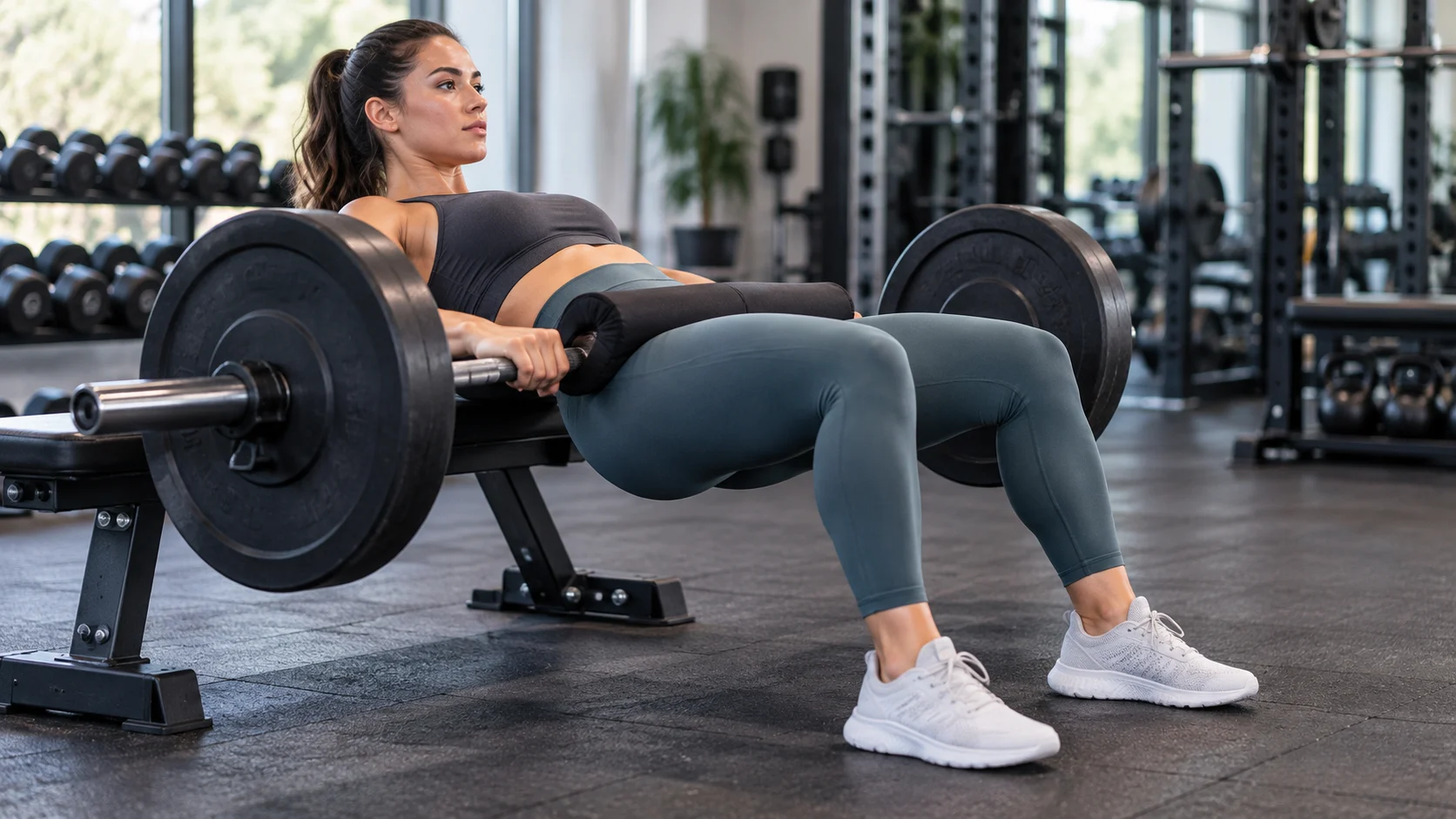
What Muscles Do Hip Thrusts Work?
Hip thrusts primarily target the gluteus maximus, the largest muscle in the buttocks and one of the body’s main hip extensors. This muscle produces much of the force needed to raise the hips from the bottom position. Because the movement emphasizes hip extension, hip thrusts are widely used in lower-body programs focused on building stronger and more powerful glutes.
The hamstrings and adductor magnus also assist during the exercise. These muscles help extend the hips and control the pelvis as the body moves through each repetition. Although they contribute meaningfully, they generally act as supporting muscles rather than replacing the glutes as the primary target when the exercise is performed with good technique.
The quadriceps and core contribute as well, although their role is different. The quadriceps help stabilize the knee position, while the abdominal and spinal muscles help keep the torso controlled. This makes the hip thrust a compound lower-body exercise involving several muscles, even though most people use it mainly to strengthen and develop the glutes.
Gluteus Maximus: The Primary Hip Thrust Muscle
The gluteus maximus is the main muscle responsible for extending the hip, which is the primary movement performed during a hip thrust. As you drive the hips upward, this muscle contracts strongly to bring the pelvis into line with the torso. The exercise places considerable tension on the glutes near the top of the movement.
Strong glutes are useful for much more than appearance. They contribute to walking, running, sprinting, climbing stairs, jumping, lifting, and rising from a seated position. Improving glute strength can therefore support athletic performance and everyday movement while giving the lower body a stronger foundation for other exercises.
To emphasize the glutes, finish the movement by squeezing them rather than arching the lower back. Your hips should reach a controlled extended position without the ribs flaring dramatically upward. A strong lockout should come from hip extension, not from forcing the spine farther backward after the glutes have already completed the movement.
Do Hip Thrusts Work the Hamstrings?
The hamstrings assist the glutes because they also help extend the hips. These muscles run along the back of the thigh and work during both the lifting and lowering portions of a hip thrust. However, their involvement can change depending on foot position, knee angle, load, and individual body proportions.
If your feet are positioned too far from your body, you may feel the hamstrings working more strongly. Some people even experience hamstring cramping when the setup places too much demand on the back of the thighs. Moving the feet slightly closer and reducing the weight can often help shift more effort toward the glutes.
The goal is not to completely remove hamstring involvement because the muscles naturally work together during hip extension. Instead, look for a setup where the glutes feel like the main driving force while the hamstrings assist. Balanced muscle recruitment is normal and usually preferable to trying to isolate one muscle perfectly.
How the Quads and Adductors Help
The quadriceps help maintain knee position during hip thrusts, particularly as the feet press into the floor. They are not usually the primary target, but they contribute to lower-body stability throughout the exercise. Placing the feet too close to the hips can increase knee flexion and make the quadriceps feel more active.
The adductor magnus, located along the inner thigh, can also contribute to hip extension. This muscle works alongside the glutes, especially depending on the angle of the hip. The adductors also help stabilize the thighs and pelvis so the knees remain controlled rather than collapsing inward or moving unpredictably.
These supporting muscles explain why hip thrusts should not be viewed as a completely isolated glute exercise. The body naturally uses several muscle groups together to produce efficient movement. Good technique allows the glutes to dominate while the quadriceps, hamstrings, adductors, and stabilizers provide the support needed to complete each repetition.
How to Perform a Hip Thrust Correctly
Sit on the floor with your upper back against a stable bench and your knees bent. Position your feet about hip-width apart and place them far enough forward that your shins are close to vertical at the top. If using a barbell, add padding around the hips so the load feels secure and comfortable.
Drive through your feet and raise your hips while keeping the chin slightly tucked. Allow the upper back to pivot naturally against the bench rather than trying to keep the torso completely rigid. Continue until the hips reach full extension and the glutes feel strongly engaged without excessive arching through the lower back.
Lower the hips under control rather than dropping quickly to the floor. Keep tension through the glutes and maintain a stable foot position throughout the repetition. A controlled lifting and lowering phase usually provides a better training stimulus than bouncing or using momentum simply to move more weight.
Best Foot Position for Hip Thrusts
Foot position significantly affects how a hip thrust feels. If the feet are too close to the hips, you may feel more tension in the quadriceps and have difficulty achieving a comfortable lockout. If they are too far forward, the hamstrings may take over and make it harder to feel the glutes working.
A useful starting point is to aim for roughly vertical shins at the top of the movement. This does not need to be exact because leg length and body proportions differ. Make small adjustments until you can fully extend the hips while keeping pressure evenly distributed through the feet and maintaining good control.
Your feet should remain stable instead of rolling onto the toes or outer edges. Think about pressing the whole foot into the floor while allowing the knees to track naturally. A stable base makes it easier to transfer force through the hips and prevents unnecessary movement that can reduce the effectiveness of the exercise.
Common Hip Thrust Form Mistakes
One of the most common mistakes is hyperextending the lower back at the top. This happens when someone tries to lift the hips higher after reaching full extension. Instead of increasing glute activation, the extra movement often comes from the lumbar spine and can make the exercise feel uncomfortable or less controlled.
Another common error is using too much weight. Excessive resistance can shorten the range of motion, encourage bouncing, and make it difficult to squeeze the glutes fully. Start with a manageable load and increase gradually only after you can complete every repetition through a consistent range with good technique.
Letting the knees collapse inward can also reduce control. Keep them aligned comfortably with the feet rather than forcing them excessively outward or allowing them to drop inward. Strengthening the outer hips with exercises such as seated hip abduction can complement hip thrusts by targeting additional muscles involved in hip stability.
Hip Thrusts vs. Glute Bridges
Hip thrusts and glute bridges both train hip extension and heavily involve the glutes. The main difference is that a glute bridge is performed with the upper back on the floor, while a hip thrust places the upper back on a bench. This changes the range of motion and how easily resistance can be added.
Hip thrusts usually allow a greater range and can be loaded more heavily with barbells or machines. They are often preferred when glute strength or muscle growth is a major training goal. Glute bridges can still be very effective, particularly for beginners, home workouts, warm-ups, or situations where limited equipment is available.
Neither exercise is automatically better for every person. Glute bridges may feel more comfortable for someone learning basic hip extension, while hip thrusts provide more options for long-term progression. Both can fit into the same program and may be used at different times depending on training goals and available equipment.
How Many Hip Thrusts Should You Do?
Beginners may start with two or three sets of around eight to twelve repetitions using a manageable load. This range allows enough practice to develop technique while also building basic strength. The final repetitions should feel challenging, but you should still be able to maintain a smooth lockout and controlled lowering phase.
For muscle growth, moderate repetition ranges such as eight to fifteen reps can work well when the resistance is challenging enough. Higher repetitions may also be useful with lighter loads. The most important factor is gradually increasing the training challenge while maintaining good technique and recovering adequately between sessions.
For strength-focused training, lower repetitions with heavier resistance may eventually be appropriate. However, heavier loading should come after learning consistent form. Increasing weight too quickly can cause the lower back, hamstrings, or quads to compensate, reducing the quality of the glute-focused movement you are trying to train.
How Often Should You Train Hip Thrusts?
Many people can perform hip thrusts two or three times per week depending on total lower-body training volume. The best frequency depends on how heavy you train, how many sets you perform, and what other glute or leg exercises are already in your program. Recovery should always be considered when planning frequency.
You do not need to perform hip thrusts every day to make progress. Muscles adapt to training during recovery, so repeatedly challenging the glutes without enough rest can reduce performance. If soreness remains significant or your strength drops from one session to the next, more recovery time may be useful.
A balanced program might include heavy hip thrusts during one session and a lighter variation during another. Squats, lunges, deadlifts, step-ups, and hip abduction exercises can fill the rest of the week. Using several movement patterns helps strengthen the hips comprehensively rather than depending on one exercise alone.
Best Hip Thrust Variations
Bodyweight hip thrusts are a useful starting point for beginners because they allow you to learn the movement without worrying about external load. Focus on keeping the pelvis controlled and fully squeezing the glutes at the top. Once this becomes easy, resistance can be added gradually using a dumbbell, barbell, or machine.
Single-leg hip thrusts increase the challenge without requiring heavy weights. One foot remains on the floor while the other leg stays raised, forcing each side to work independently. This variation also demands more pelvic control, so start slowly and avoid letting one side of the hips drop during the repetition.
Banded hip thrusts add resistance around the thighs and may increase awareness of the outer hip muscles. Machine hip thrusts provide another convenient option because setup can be quicker than using a barbell. The best variation is one that feels comfortable, allows progressive resistance, and keeps the target muscles working through a controlled range.
How to Build Better Glutes With Hip Thrusts
Hip thrusts can be highly effective for glute development, but they should not be the only exercise in your program. Squats, Romanian deadlifts, lunges, split squats, and step-ups train the glutes in different positions. Combining several movement patterns can create a broader stimulus for strength and muscle growth.
Progressive overload is essential for long-term results. This can involve adding weight, performing more repetitions, increasing sets, slowing the tempo, or improving technique. Progress does not need to happen every workout, but the muscles should gradually face greater demands over weeks and months if continued adaptation is the goal.
Nutrition and recovery also influence muscle development. Adequate protein, enough overall food, consistent sleep, and sensible training frequency help the body adapt to strength work. Even excellent hip thrust technique cannot compensate for an overall program that provides too little recovery or inconsistent training over time.
Conclusion
Hip thrusts primarily work the gluteus maximus while the hamstrings, adductors, quadriceps, and core contribute to the movement. Their strong emphasis on hip extension makes them a valuable exercise for developing glute strength and size. Proper setup helps keep the glutes as the main driver throughout each repetition.
Focus on stable foot placement, controlled movement, and a strong glute squeeze at the top without hyperextending the lower back. Start with manageable resistance and increase the challenge gradually. Good technique should remain consistent even as the weights become heavier and training volume increases.
For the best results, combine hip thrusts with other lower-body exercises that challenge the hips from different angles. Squats, lunges, deadlifts, abduction work, and single-leg movements can create a balanced program. Consistency, progressive overload, and adequate recovery matter more than relying on one exercise alone.
FAQs
What is the main muscle worked during hip thrusts?
The gluteus maximus is the primary muscle worked during hip thrusts. The hamstrings, adductors, quadriceps, and core assist with hip extension, stability, and controlling the movement.
Do hip thrusts work the hamstrings?
Yes, the hamstrings assist with hip extension during hip thrusts. They are generally secondary to the glutes, although foot placement can change how strongly you feel them working.
Are hip thrusts good for building glutes?
Yes. Hip thrusts can support glute growth when combined with progressive resistance, sufficient training volume, appropriate nutrition, and recovery. They work best alongside other lower-body exercises.
How many hip thrusts should I do?
Beginners can often start with two or three sets of eight to twelve repetitions. Choose a resistance that feels challenging while still allowing a full, controlled range of motion.
Should I feel hip thrusts in my lower back?
Your lower back may stabilize the movement, but it should not be the main area working. Excessive back discomfort may indicate poor pelvic control, too much weight, or hyperextension.