
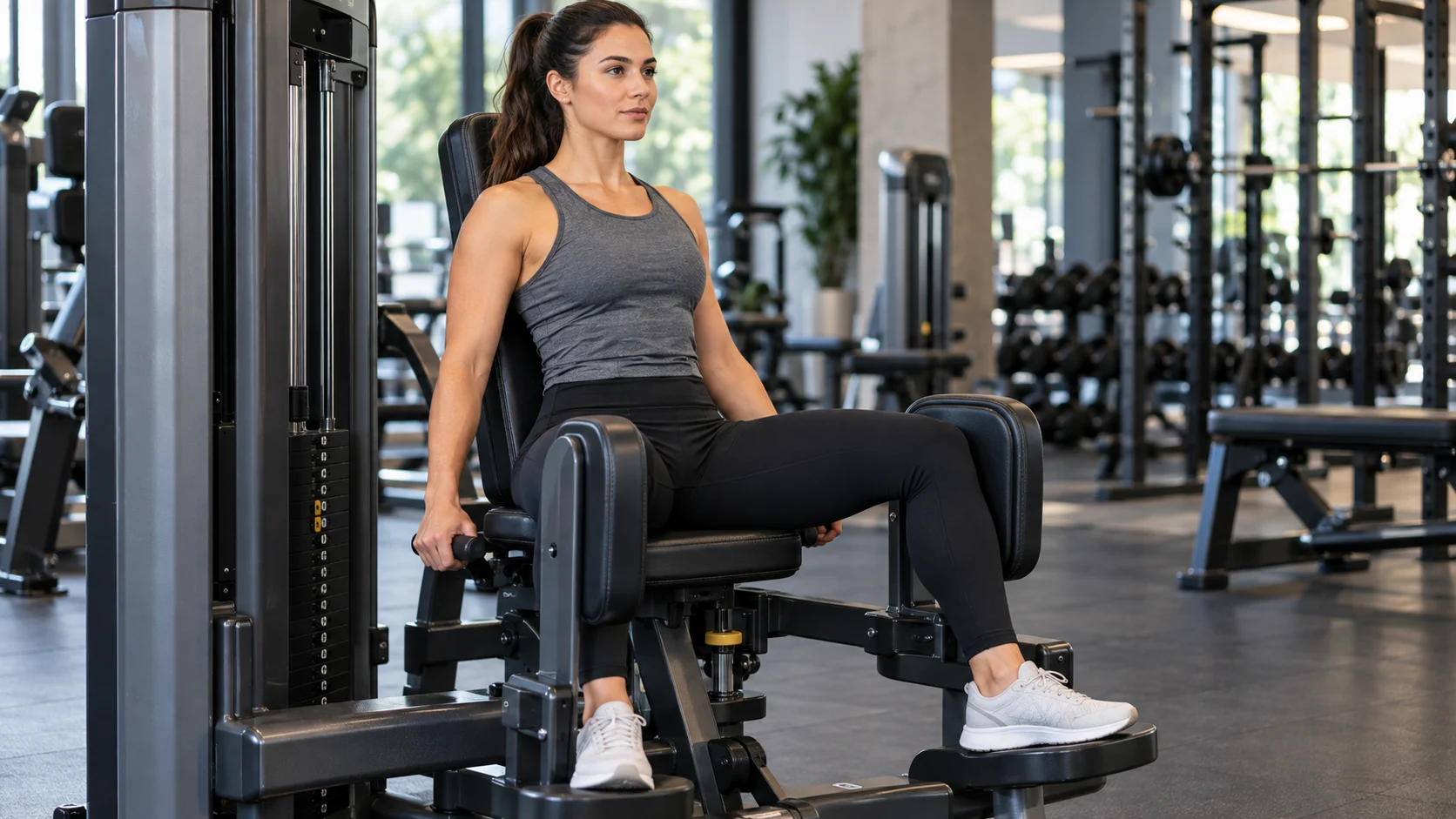
What Is Seated Hip Abduction?
Seated hip abduction is an exercise that involves moving the thighs outward away from the body’s midline while remaining in a seated position. It is commonly performed on a hip abduction machine or with a resistance band around the thighs. The movement primarily targets muscles along the outside of the hips and helps develop lower-body strength and control.
The exercise is popular in gyms because the machine provides a stable setup and makes resistance easy to adjust. Beginners can learn the basic movement without having to balance or coordinate several joints at once. More experienced exercisers may use heavier resistance or different torso positions to change how the hip muscles are challenged.
Seated hip abduction should be performed slowly and under control rather than by rapidly swinging the knees outward. The hips should remain comfortably positioned, and resistance should allow a smooth range of motion. Good technique helps keep the focus on the target muscles while reducing unnecessary movement through the lower back or pelvis.
What Muscles Does Seated Hip Abduction Work?
The gluteus medius is one of the main muscles involved in seated hip abduction. Located on the outer portion of the hip, it helps move the leg away from the body and contributes to pelvic stability during walking and single-leg activities. Strengthening this muscle can support better control during many lower-body movements.
The gluteus minimus also contributes to hip abduction and helps stabilize the hip joint. Although smaller and deeper than the gluteus medius, it works alongside other muscles to control the position of the thigh. The tensor fasciae latae, located toward the front and outside of the hip, can also assist during the movement.
The gluteus maximus may contribute depending on hip position and how the exercise is performed. Different portions of the glute muscles work together rather than acting as completely isolated structures. This is why seated hip abduction is best viewed as an outer-hip strengthening exercise rather than a movement that targets only one muscle.
Benefits of Seated Hip Abduction
One of the main benefits of seated hip abduction is stronger hip abductor muscles. These muscles help control the thigh and pelvis when you walk, run, climb stairs, or stand on one leg. Improving their strength can make lower-body movements feel more stable and controlled during both exercise and everyday activities.
The exercise can also support lateral movement because the hip abductors help move the legs away from the body. Athletes who change direction, shuffle sideways, or perform cutting movements rely on these muscles repeatedly. Seated hip abduction cannot replace sport-specific training, but it can provide useful isolated strengthening within a broader program.
Another benefit is accessibility. The seated position reduces balance demands, allowing people to focus more directly on muscular effort. This can make the exercise useful for beginners, people returning to strength training, or anyone who wants additional hip work after compound exercises such as squats, lunges, or step-ups.
How to Do Seated Hip Abduction Correctly
Sit comfortably on the hip abduction machine with your back supported and your feet positioned according to the equipment instructions. Place the outside of your thighs against the pads and choose a manageable resistance. Keep your pelvis stable and sit tall without dramatically arching or rounding your lower back.
Press your knees outward slowly until you reach a comfortable range. Pause briefly when the hip muscles feel strongly engaged, then return the legs toward the starting position with control. Do not allow the weight stack to slam down between repetitions because the returning phase is also part of the exercise.
Keep your breathing natural throughout the set. Exhale as you press outward if that feels comfortable, then inhale as you return. If you need to rock your torso or use momentum to move the resistance, the weight is probably too heavy and should be reduced.
How Far Should You Open Your Knees?
There is no universal distance that everyone must reach during seated hip abduction. Hip structure, flexibility, machine design, and individual comfort all influence the available range. Move outward until you feel strong muscular tension without forcing the hips into a painful or pinching position.
Using a larger range is not automatically better if technique deteriorates. Some people can open their knees widely while maintaining good control, while others naturally have less hip abduction. A controlled range that feels comfortable is more useful than trying to match another person’s movement on the same machine.
The returning phase should also remain controlled. Avoid allowing the knees to snap inward quickly because this reduces muscular control and may make the movement feel uncomfortable. Keep light tension on the muscles throughout the set rather than completely relaxing between every repetition.
Common Seated Hip Abduction Mistakes
Using too much weight is one of the most common mistakes. Excessive resistance often causes people to bounce, lean dramatically, or shorten the movement. While heavier weights can eventually be useful, the resistance should still allow the hips to move smoothly without requiring momentum to complete each repetition.
Another mistake is allowing the knees to move inward too quickly after opening them. The muscles are still working during this lowering phase, and controlling it can make the exercise more effective. Returning slowly also helps you maintain awareness of hip position and prevents the machine from pulling your legs inward abruptly.
Holding the breath or excessively bracing the entire body can also make the exercise unnecessarily tense. The torso should remain stable, but you should still be able to breathe comfortably. Keep your hands relaxed on the handles and focus most of your effort on pressing the thighs outward through the hips.
How Many Reps of Seated Hip Abduction Should You Do?
Beginners may start with two or three sets of approximately 10 to 15 controlled repetitions. Choose resistance that makes the final few repetitions challenging without causing technique to break down. If you can easily complete every repetition with little muscular effort, gradually increasing resistance may be appropriate.
Higher repetitions can also be useful because the hip abductors often perform endurance-related stabilization during daily activities. Sets of 15 to 20 repetitions may create a strong muscular challenge with lighter resistance. Lower repetition ranges with greater resistance can be used as strength improves, provided movement remains controlled.
You do not need to train to complete muscular failure during every set. Leaving a small amount of effort in reserve can still provide an effective stimulus while making recovery easier. Progress over time by adjusting resistance, repetitions, sets, or tempo instead of trying to maximize every variable simultaneously.
Seated Hip Abduction vs. Standing Hip Abduction
Both seated and standing hip abduction exercises target muscles around the outer hip, but the demands are different. The seated version provides more external stability, allowing you to focus primarily on producing force. Standing variations require the supporting leg, trunk, and balance systems to work together while the moving leg abducts.
Standing hip abduction may transfer more directly to activities that require single-leg control. It can be performed with a resistance band, cable machine, or body weight. However, balance difficulties may limit how much resistance you can use, especially when you are first learning the exercise.
There is no need to choose only one variation. Seated hip abduction can build targeted strength, while standing exercises can challenge that strength in a more functional position. Including both at different points in a training program may provide a useful combination of muscle development, balance, and movement control.
Seated Hip Abduction and Glute Development
Seated hip abduction can contribute to glute development because several gluteal muscles help move the thighs outward. The gluteus medius and minimus receive a strong training stimulus during controlled repetitions. These muscles contribute to the shape and function of the outer hip region in addition to providing stability.
However, seated abduction alone is unlikely to provide complete glute training. The gluteus maximus is strongly involved in hip extension, so exercises such as hip thrusts, squats, Romanian deadlifts, and lunges challenge the glutes differently. A balanced program should train multiple hip movements rather than relying on one machine.
Progressive overload is also important when muscle growth is a goal. Over time, gradually increasing resistance or training volume gives the muscles a reason to adapt. Adequate nutrition and recovery matter as well, because muscle growth depends on the overall training environment rather than one specific exercise.
Can Seated Hip Abduction Help Hip Stability?
The hip abductors play an important role in keeping the pelvis controlled when body weight moves onto one leg. This happens repeatedly during walking, running, and climbing stairs. Strengthening these muscles may improve their capacity to resist excessive pelvic dropping or unwanted side-to-side movement during everyday and athletic activities.
However, seated hip abduction does not fully reproduce the coordination required during standing movement. Because the machine supports your body, balance and foot control are less involved. This means the exercise is useful for developing strength but should ideally be paired with exercises such as step-downs, single-leg balance, and split squats.
Think of seated abduction as one tool rather than a complete hip-stability program. Strong muscles need opportunities to use that strength during more complex movement. Combining isolated exercises with functional lower-body work can help bridge the gap between machine-based strength and real-world movement control.
Seated Hip Abduction During Pregnancy
Exercise during pregnancy can often continue with appropriate modifications when a maternity healthcare provider has not advised restrictions. Seated hip abduction may feel comfortable for some people because it trains the outer hips without requiring a large amount of balance. Resistance and range should remain appropriate for changing comfort and mobility throughout pregnancy.
Pregnancy can bring several pelvic sensations that influence exercise choices. For example, brief sharp pelvic symptoms sometimes described as lightening crotch may make certain positions uncomfortable. If an exercise repeatedly triggers sharp pelvic pain, reduce the range, lower the resistance, or stop and discuss the symptom with your healthcare provider.
Pregnancy is not the time to force progression simply to maintain previous gym numbers. Changes in body position, fatigue, pelvic pressure, and overall comfort should guide exercise decisions. Seek professional advice for persistent pain, bleeding, fluid leakage, regular contractions, dizziness, or other concerning symptoms during or after exercise.
When Seated Hip Abduction May Cause Discomfort
A burning or fatigued feeling in the outer hip muscles during the final repetitions can be normal during resistance training. Sharp pain deep within the hip joint is different and should not be ignored. Reduce the range and resistance if the exercise produces pinching, catching, or uncomfortable joint pressure.
Some people may also feel the exercise mainly in the front of the hips. Small adjustments to posture, resistance, and hip position can sometimes change the sensation. However, there is no requirement to force a particular torso angle simply because it is popular online or claimed to isolate a specific glute muscle.
Persistent discomfort should be assessed rather than repeatedly trained through. Hip pain can involve muscles, tendons, joints, nerves, or other structures. A physiotherapist or healthcare professional can help identify why the exercise is painful and determine whether another variation would be more appropriate.
Best Practices for Adding Seated Hip Abduction to Your Workout
Seated hip abduction can be performed near the beginning or end of a lower-body session depending on your goals. If outer-hip strength is a priority, performing it earlier may allow you to use more resistance. If it is supplemental glute work, placing it after squats, lunges, or hip thrusts may make more sense.
Two or three sessions per week can provide enough exposure for many people, depending on total lower-body training volume. The hips also need time to recover from demanding exercise. More frequent training is not automatically better if soreness and fatigue begin reducing your performance during other important movements.
Track technique and progression rather than focusing only on the number displayed on the machine. Different machines use different lever systems, so comparing weights between gyms may be misleading. Consistent improvement on the same equipment, combined with good form and comfortable movement, is a more useful measure of progress.
Conclusion
Seated hip abduction is an accessible exercise for strengthening the muscles along the outside of the hips, particularly the gluteus medius and gluteus minimus. These muscles support pelvic control, lateral movement, and balance during everyday activities. The seated machine provides stability, making it useful for beginners and experienced exercisers alike.
Perform the movement with controlled outward and inward phases, comfortable hip positioning, and resistance that does not require momentum. Progress gradually through additional resistance, repetitions, or sets as your strength improves. Combining seated abduction with squats, lunges, step-ups, and other hip exercises creates a more complete lower-body program.
Stop or modify the exercise if it causes sharp hip pain, pinching, or persistent discomfort. Individual anatomy and mobility affect how much range feels comfortable, so there is no perfect knee position for everyone. Used appropriately, seated hip abduction can be a practical addition to glute, hip-strengthening, and stability-focused training.
FAQs
What muscles does seated hip abduction work?
Seated hip abduction primarily targets the gluteus medius and gluteus minimus, with assistance from the tensor fasciae latae and other hip muscles that help move and stabilize the thigh.
Is seated hip abduction good for glutes?
Yes. It can strengthen the outer glute muscles, particularly the gluteus medius and minimus. For complete glute development, combine it with hip extension exercises such as hip thrusts and squats.
How many seated hip abductions should I do?
A common starting point is two or three sets of 10 to 15 controlled repetitions. Adjust the resistance so the exercise feels challenging without requiring bouncing, rocking, or shortened range.
Should I lean forward during seated hip abduction?
A slight change in torso position can alter how the exercise feels, but leaning forward is not required. Use a position that allows comfortable hip movement and good control without pain.
Can I do seated hip abduction every day?
Daily training is usually unnecessary for strength or muscle growth. Two or three sessions per week can work well for many people while allowing enough recovery between challenging lower-body workouts.