
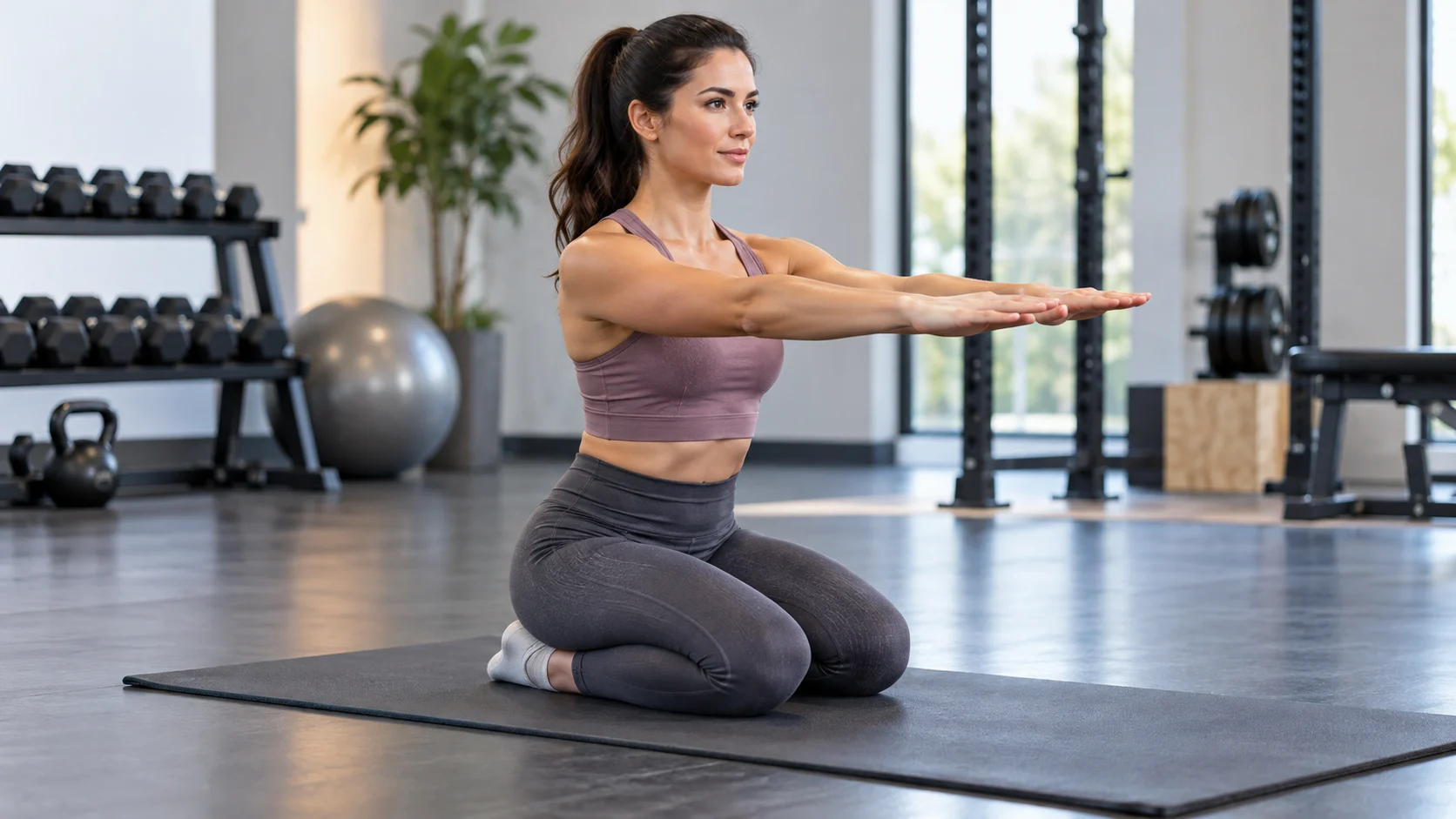
What Is a Kneeling Squat?
A kneeling squat is a lower-body exercise performed from a kneeling position rather than standing on the feet. You begin with both knees on a padded surface, sit the hips backward toward the heels, and then drive the hips forward to return upright. The movement primarily trains hip extension while reducing many of the balance demands found in traditional standing squats.
Unlike a regular squat, the kneeling squat involves very little movement at the ankles and less knee travel because the knees remain on the floor. This changes how the lower body produces force and places greater emphasis on the hips. The glutes become especially important as you extend the hips and move from the lowered position back to an upright kneeling posture.
Kneeling squats can be performed using body weight, a resistance band, dumbbell, kettlebell, or barbell depending on experience. Beginners should first learn the movement without additional resistance. Good control is more important than adding heavy weight because the goal is to strengthen the hips while keeping the knees, pelvis, and spine comfortable.
What Muscles Do Kneeling Squats Work?
The gluteus maximus is the primary muscle worked during kneeling squats. Its main role is extending the hips, which occurs as you move from sitting back toward the heels into an upright kneeling position. Because the lower legs stay relatively fixed, the exercise creates a strong opportunity to focus on glute-driven hip extension without needing to balance on the feet.
The hamstrings and adductor magnus also assist with hip extension. These muscles work alongside the glutes as you move the pelvis forward and help control the lowering portion when you sit back. Their contribution varies depending on your hip position, resistance, movement range, and individual anatomy, but they generally act as important supporting muscles.
The core and spinal stabilizers also work to keep the torso controlled throughout the exercise. Your abdominal muscles help prevent excessive lower-back arching as the hips extend. Although kneeling squats are usually considered a glute-focused exercise, maintaining stable trunk alignment makes the movement more efficient and reduces unnecessary compensation through the lumbar spine.
Benefits of Kneeling Squats
Kneeling squats can help strengthen the glutes and improve hip extension without requiring the same ankle mobility as traditional squats. This can make them useful as an accessory exercise for people who want additional hip-focused work. They may also help beginners understand how to squeeze and extend the glutes before moving to more complex standing exercises.
The stable kneeling position reduces balance demands because the lower legs remain in contact with the ground. This allows you to focus on controlling the hips and torso rather than worrying about foot placement or losing balance. For some exercisers, this makes the movement easier to learn than standing squat variations that require greater coordination.
Kneeling squats can also add variety to lower-body strength programs. They train the glutes differently from lunges, hip thrusts, deadlifts, and traditional squats, which can help create a more balanced routine. However, they should usually complement rather than completely replace standing exercises because everyday movement also requires strength through the knees, ankles, and feet.
How to Do a Kneeling Squat Correctly
Start by kneeling on a mat or padded surface with your knees approximately hip-width apart. Keep your torso upright, ribs relaxed, and pelvis in a comfortable neutral position. Your feet can rest naturally behind you, and you may place your hands across your chest until you feel confident performing the exercise without using your arms for balance.
Slowly push your hips backward toward your heels while keeping your chest controlled. You do not need to sit completely onto your heels if doing so causes discomfort or makes your lower back round excessively. Lower only as far as you can maintain smooth movement, then drive the hips forward by squeezing the glutes.
Finish in a tall kneeling position without aggressively pushing the pelvis forward or arching the lower back. Your shoulders, hips, and knees should form a relatively straight line at the top. Pause briefly, then repeat the movement slowly so both the lowering and lifting portions remain controlled.
Common Kneeling Squat Mistakes
One common mistake is arching the lower back at the top of the movement. Some people try to push the hips farther forward after full extension has already been reached. This extra motion usually comes from the lumbar spine rather than the glutes, so stop once the hips are comfortably extended and the body is upright.
Another mistake is dropping toward the heels too quickly. The lowering phase should remain controlled because the glutes and other hip muscles continue working as the body moves backward. Using momentum can reduce muscular tension and make it harder to notice whether the knees, hips, or lower back are moving comfortably.
Using too much resistance before mastering the bodyweight version is another frequent problem. Heavy loads can cause the torso to lean excessively or the hips to move unevenly. Learn to control the movement first, then add resistance gradually rather than increasing weight simply because the exercise feels easier than a traditional squat.
Are Kneeling Squats Safe for Your Knees?
Kneeling squats place direct contact pressure on the knees because they remain on the floor throughout the exercise. A thick exercise mat or folded pad can make the position more comfortable. People with healthy knees may tolerate this well, but discomfort from kneeling pressure should not be ignored simply because the movement itself feels easy.
If you have recent knee surgery, significant swelling, bursitis, or pain when kneeling, this exercise may not be appropriate. You can often train the same hip muscles using bridges, hip thrusts, or standing exercises that do not require direct knee contact. Exercise choice should reflect your current comfort and medical restrictions rather than a generic program.
Sharp knee pain during the movement is a reason to stop. Mild pressure from the floor is different from pain inside or around the joint. If kneeling repeatedly causes swelling, significant tenderness, or difficulty using the knee afterward, consider another exercise and seek professional advice if symptoms continue.
How to Add Resistance to Kneeling Squats
Once bodyweight kneeling squats feel easy, you can hold a dumbbell or kettlebell close to your chest. Keeping the weight near your torso makes it easier to control and reduces unnecessary strain on the shoulders. Start with a light load and make sure the movement still comes primarily from the hips.
Resistance bands can also be useful. A band positioned appropriately can create additional tension as the hips extend, making the glutes work harder near the top. Bands allow gradual progression without requiring large weights and can be convenient for home workouts where heavier equipment is unavailable.
If holding weights is uncomfortable because of a hand problem, modify the exercise rather than forcing your grip. For example, persistent finger swelling should be understood before heavy gripping, and this guide to swollen finger causes explains several possibilities. Machines, bands, or bodyweight variations may be easier while hand symptoms are being addressed.
Kneeling Squat vs. Traditional Squat
Traditional squats involve movement at the hips, knees, and ankles while the feet remain on the floor. Kneeling squats remove most ankle involvement and greatly reduce the amount of knee movement. This makes them more focused on hip extension and less representative of full lower-body movement used during standing activities.
Traditional squats generally develop a broader combination of quadriceps, glute, adductor, and trunk strength. They also challenge balance and coordination through the feet and ankles. Kneeling squats emphasize the hips more specifically, making them better suited as an accessory exercise rather than a complete replacement for standing squats.
Both exercises can fit into the same program. You might use traditional squats as a main compound movement and kneeling squats afterward for additional glute work. Exercise selection should depend on your goals, available equipment, joint comfort, and whether you want general lower-body strength or more focused hip-extension training.
Kneeling Squat vs. Hip Thrust
Kneeling squats and hip thrusts both emphasize hip extension and target the gluteus maximus. However, the body positions are very different. Hip thrusts are performed with the upper back supported and the feet on the floor, while kneeling squats keep the knees and lower legs in contact with the ground.
Hip thrusts generally allow greater external loading and are often easier to progress heavily. Kneeling squats may feel simpler and require less equipment, especially when performed with body weight or a light resistance band. Both exercises can produce strong glute engagement when performed with controlled technique.
There is no need to choose one exercise permanently. Hip thrusts may be more useful for heavier glute strength work, while kneeling squats can provide an alternative pattern or warm-up exercise. Using several hip-extension exercises across a training program can help prevent boredom and build strength through slightly different positions.
How Many Kneeling Squats Should You Do?
Beginners can start with two or three sets of approximately eight to fifteen repetitions. Perform each repetition slowly enough that you can control both the backward and forward portions. Stop the set before your technique changes significantly, especially if the lower back begins arching or you start using momentum.
For muscle-building goals, moderate or higher repetitions can work well when resistance is challenging enough. Adding a dumbbell, kettlebell, or band can increase difficulty without dramatically increasing the number of repetitions. Progressive overload should happen gradually so the glutes continue adapting while technique remains consistent.
You do not need to perform kneeling squats every day. Two or three lower-body sessions per week may provide enough exposure depending on your overall program. Consider how much glute work you already perform through squats, deadlifts, hip thrusts, lunges, and other exercises before adding more volume.
How to Include Kneeling Squats in Your Workout
Kneeling squats can work well as part of a warm-up when performed with body weight. A few controlled repetitions can help you focus on hip extension and glute engagement before heavier lower-body training. Keep the effort moderate so the exercise prepares the muscles rather than tiring them before your main lifts.
You can also perform kneeling squats later in the session as an accessory exercise. After squats or deadlifts, use moderate resistance and controlled repetitions to add more glute-focused volume. This approach is particularly useful when you want extra hip work without performing another demanding standing compound exercise.
Another option is including the movement in a home workout alongside bridges, split squats, side steps, and core exercises. Since kneeling squats require minimal equipment, they are easy to add to simple routines. The key is making sure your overall program still includes exercises for the knees, ankles, upper body, and general movement.
When to Avoid Kneeling Squats
Avoid kneeling squats if kneeling itself causes significant knee pain or if you have been advised not to put pressure through the front of the knees. Recent surgery, acute swelling, or certain knee conditions may require another exercise. A physiotherapist or healthcare professional can recommend alternatives when restrictions are present.
The movement should also be stopped if it causes sharp hip or lower-back pain. Mild muscular effort is expected, but pinching, radiating symptoms, numbness, or increasing joint pain is different. Reducing resistance or range may help, but persistent symptoms deserve evaluation rather than repeatedly training through them.
People returning from significant injury should also progress carefully. Bodyweight movement may be appropriate before external resistance, but this depends on the injury and stage of recovery. Exercise should support healing and strength rather than becoming a test of how much discomfort you can tolerate.
Conclusion
Kneeling squats are a hip-focused lower-body exercise that primarily strengthens the gluteus maximus while also involving the hamstrings, adductors, and core. The movement is performed by sitting the hips toward the heels and then extending them back into a tall kneeling position. It requires little equipment and can be adjusted for different strength levels.
For good form, keep the torso controlled, move slowly, and finish each repetition by squeezing the glutes instead of arching the lower back. Use padding under the knees and choose a range that feels comfortable. Once the bodyweight version is easy, gradually add resistance through bands, dumbbells, or kettlebells.
Kneeling squats work best as part of a balanced lower-body program rather than as the only squat variation you perform. Combine them with standing squats, lunges, hinges, hip thrusts, and other exercises. Stop or modify the movement if it creates significant knee, hip, or lower-back pain.
FAQs
What muscles do kneeling squats work?
Kneeling squats mainly work the gluteus maximus, with assistance from the hamstrings and adductors. The core also helps stabilize the torso and pelvis throughout the movement.
Are kneeling squats good for glutes?
Yes. The exercise emphasizes hip extension, which strongly involves the gluteus maximus. For complete glute training, combine kneeling squats with hip thrusts, lunges, squats, and other lower-body movements.
Do kneeling squats hurt your knees?
They can feel uncomfortable if direct kneeling pressure irritates your knees. Use a padded mat and stop if you experience sharp joint pain, increasing swelling, or significant discomfort afterward.
How many kneeling squats should I do?
Beginners can start with two or three sets of eight to fifteen controlled repetitions. Increase resistance or repetitions gradually while keeping the movement smooth and your lower back controlled.
Are kneeling squats better than regular squats?
They serve different purposes. Kneeling squats emphasize hip extension and glutes, while regular squats train the hips, knees, and ankles together and generally provide more complete lower-body strength development.