
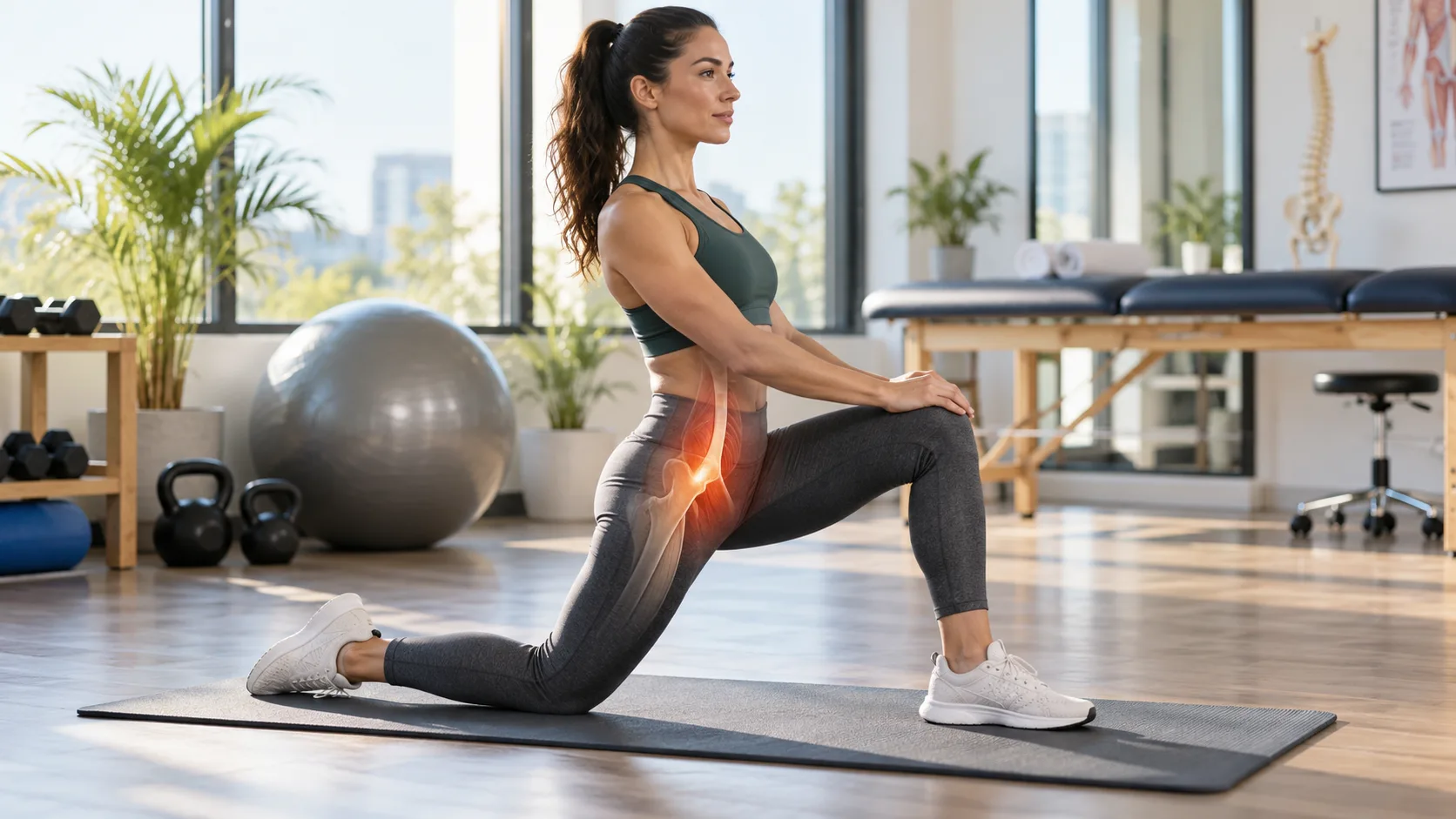
What Is the Psoas Muscle?
The psoas is a deep muscle located near the lower spine and pelvis that plays an important role in hip movement. The psoas major begins along the lumbar spine and travels through the pelvis before attaching to the upper femur. It works closely with the iliacus, and together these muscles are commonly referred to as the iliopsoas.
One of the psoas muscle’s main functions is hip flexion, which means bringing the thigh toward the torso. It becomes active when you walk, run, climb stairs, march, or lift your knee. Because of its location, the psoas also contributes to controlling the relationship between the lower back, pelvis, and hip during movement.
A strong and well-controlled psoas can support efficient lower-body movement, but the muscle does not need to be constantly stretched or “released.” Tightness around the front of the hip can have several causes, including fatigue, weakness, prolonged sitting, and training demands. Exercise selection should therefore include both mobility and strengthening rather than focusing only on stretching.
What Are the Benefits of Psoas Exercises?
Psoas exercises can improve hip flexor strength, which is useful for everyday movements such as walking, stairs, and getting into a car. Strong hip flexors also contribute to faster activities including running and sprinting. Training them can improve your ability to raise and control the thigh instead of relying on momentum.
Another benefit is improved coordination between the hips and trunk. The psoas connects the lower spine with the femur, so controlled exercises can challenge the muscles that stabilize the pelvis while the leg moves. This can be useful when building strength for activities requiring repeated lifting of the knees or changes in hip position.
Psoas training may also help create a more balanced lower-body program. Many routines heavily emphasize the glutes, quadriceps, and hamstrings while giving less direct attention to hip flexion. Adding appropriately progressed hip-flexor exercises can develop strength through another important movement pattern without requiring a complicated workout.
Supine March for Beginner Psoas Strength
The supine march is a beginner-friendly psoas exercise that also challenges abdominal control. Lie on your back with both knees bent and feet flat on the floor. Gently tighten your trunk, then slowly lift one foot a few inches while bringing the knee toward the torso without allowing the pelvis to rotate.
Lower the foot slowly and repeat with the opposite leg. Keep your breathing relaxed and avoid flattening your back forcefully into the floor. The goal is to maintain a stable pelvis while the hip flexors lift each leg independently through a manageable range.
Start with one or two sets of eight to twelve repetitions on each side. If your lower back begins arching or your hips shift noticeably, shorten the range or stop the set. Once the movement becomes easy, you can progress to tabletop marches or add light resistance while maintaining the same control.
Standing Knee Raises for Functional Hip Flexor Strength
Standing knee raises train the psoas in an upright position that resembles walking and stair climbing. Stand next to a wall or chair for balance, shift your weight onto one leg, and slowly lift the opposite knee toward your waist. Keep your torso tall and avoid leaning backward as the knee rises.
Pause briefly at the top, then lower the foot under control. The standing leg should remain stable without the pelvis dropping or rotating excessively. Lifting the knee higher is not automatically better, especially if the movement starts coming from the lower back instead of the hip.
You can progress this exercise with a resistance band around the feet or by using a low cable attached near the ankle. Increase resistance gradually because heavier loads can make it tempting to swing the leg. Controlled repetitions will usually train the hip flexors more effectively than fast, momentum-driven movement.
Straight Leg Raises for Psoas Training
Straight leg raises can challenge the hip flexors while also requiring the quadriceps to keep the knee extended. Lie on your back with one knee bent and the opposite leg straight. Tighten the thigh of the straight leg, then lift it slowly without allowing the pelvis to tip or the lower back to arch dramatically.
Raise the leg only as high as you can maintain control, then lower it slowly toward the floor. A moderate range is enough to challenge the psoas and supporting hip flexors. If you feel strong pinching at the front of the hip, reduce the range rather than forcing the leg higher.
This exercise can become demanding quickly because the long, straight leg creates a larger lever. Beginners should start without ankle weights and focus on slow technique. Once several controlled sets become comfortable, light resistance can be introduced gradually rather than jumping immediately to heavier loads.
Seated Hip Flexion Exercises
Seated hip flexion is a simple way to strengthen the psoas with minimal balance demand. Sit near the front of a sturdy chair with both feet flat on the floor. Keeping your torso controlled, lift one knee toward your chest without using your hands or leaning far backward.
Lower the foot slowly and repeat on the opposite side. You should feel the front of the hip working while your trunk stays relatively steady. Avoid pulling the knee as high as possible if doing so causes cramping or makes the pelvis roll backward.
Resistance can be added by placing a light band around the feet or attaching a small ankle weight. You can also hold the raised position for a few seconds to increase difficulty. This variation is useful when standing exercises are challenging or when you want a simple hip-flexor exercise that can be performed almost anywhere.
How to Stretch the Psoas Safely
A half-kneeling hip flexor stretch is commonly used to target tissues around the front of the hip. Place one knee on a padded surface and the opposite foot in front of you. Gently shift the pelvis forward until you feel a mild stretch through the front of the hip on the kneeling side.
Keep your ribs controlled and avoid creating the stretch by aggressively arching the lower back. A slight pelvic tuck may help some people feel the stretch more clearly. The movement should remain comfortable and should not create sharp pressure in the hip joint or significant discomfort around the lower back.
Stretching can temporarily reduce the sensation of tightness, but it should not replace strengthening. A muscle can feel tight because it is fatigued or underprepared for the demands placed on it. Combining gentle mobility with progressive resistance is usually more useful than repeatedly performing deep stretches throughout the day.
Psoas Exercises and Whole Lower-Body Movement
The psoas works as part of a larger movement system rather than functioning by itself. Walking and running require coordination between the hip flexors, glutes, quadriceps, hamstrings, calves, feet, and trunk. Improving only one muscle will not automatically correct every movement problem, so balanced training remains important.
Lower-body discomfort can also change how the hips are used. For example, someone dealing with ankle bursitis may temporarily alter their walking pattern to avoid pressure around the heel or ankle. Those compensations can change hip demand even though the original problem is farther down the leg.
This is why a complete program should consider strength and mobility across the entire lower body. Squats, bridges, step-ups, calf raises, balance work, and hip flexor exercises can complement one another. The best combination depends on your goals, symptoms, experience, and the activities you want to perform comfortably.
Common Psoas Exercise Mistakes
One common mistake is lifting the knee by leaning the torso backward. This reduces the amount of controlled hip flexion and may place unnecessary stress on the lower back. Keep the ribs and pelvis relatively steady so the movement comes mainly from the hip.
Another mistake is using excessive resistance too soon. Heavy bands or ankle weights can cause swinging, breath-holding, or loss of pelvic control. Start with body weight or very light resistance and increase difficulty only when your movement remains smooth from the first repetition to the last.
People also sometimes assume that every sensation of front-hip tightness requires aggressive stretching. Deep stretching can irritate sensitive tissues when the actual issue is weakness, fatigue, or joint discomfort. If stretching repeatedly makes the area feel worse, focus on comfortable movement and seek professional guidance when symptoms continue.
How Often Should You Train the Psoas?
For most people, direct psoas strengthening two or three times per week can be enough when combined with general lower-body exercise. A short session may include two or three movements performed for a few controlled sets. You do not need a long daily routine to develop stronger hip flexors.
Beginners can start with approximately eight to fifteen repetitions per side depending on the exercise. Isometric holds can also be used for several seconds at a time. The exact number is less important than maintaining good technique and gradually increasing the challenge as strength improves.
Recovery should guide your training frequency. If the front of the hips remains very sore or walking feels uncomfortable after every session, reduce the volume or resistance. Direct hip-flexor training should complement running, cycling, squats, and other activities rather than adding so much fatigue that overall movement quality declines.
When Psoas Exercises May Not Be Appropriate
Stop an exercise if it creates sharp pain, catching, or strong pinching in the front of the hip. These sensations can have several causes and should not be treated simply as evidence that the psoas needs more stretching or strengthening. Reducing the range may help, but persistent symptoms deserve assessment.
People recovering from hip surgery, significant back injuries, or other medical conditions should follow professional rehabilitation guidance. Some exercises or ranges may need modification during healing. The right progression depends on the condition, surgical procedure, symptoms, and current strength rather than a universal exercise plan.
Seek medical advice for persistent groin pain, progressive weakness, numbness, severe back symptoms, or difficulty walking normally. Hip flexor exercises can be valuable for many people, but they are not a substitute for diagnosing an underlying joint, nerve, or medical problem when warning signs are present.
Conclusion
Psoas exercises can strengthen the deep hip flexors that help lift the thigh and coordinate movement between the lower spine, pelvis, and legs. Supine marches, standing knee raises, straight leg raises, and seated hip flexion are practical options that can be adjusted for different fitness levels.
Good form matters more than lifting the knee as high as possible or adding heavy resistance quickly. Keep the pelvis controlled, move slowly, and avoid compensating through the lower back. Combine strengthening with gentle mobility when needed rather than relying only on repeated psoas stretching.
A balanced lower-body program should include hip flexion alongside hip extension, knee strength, calf work, balance, and general movement. Stop exercises that cause sharp pain or neurological symptoms and seek professional guidance when problems persist. Progressive, controlled training is the most practical way to build useful psoas strength.
FAQs
What is the best exercise for the psoas?
Standing knee raises, supine marches, and seated hip flexion are useful options. The best exercise depends on your strength, balance, comfort, and ability to control the pelvis without compensating through the lower back.
How do I know if my psoas is weak?
Difficulty lifting the knee, rapid hip-flexor fatigue, or poor control during marching may suggest limited strength. However, these signs are not diagnostic because several muscles contribute to hip flexion.
Should I stretch my psoas every day?
Daily stretching is not necessary for everyone. Gentle mobility may help if the front of the hip feels stiff, but strengthening and general movement are also important for long-term function.
Can psoas exercises help lower-back pain?
They may help when hip-flexor weakness or poor movement control contributes to symptoms, but lower-back pain has many possible causes. Persistent or worsening pain should be professionally assessed.
Can you overwork the psoas?
Yes. Excessive hip-flexor training, running, cycling, or repeated knee-lifting movements can cause fatigue and soreness. Balance direct psoas work with recovery and other lower-body exercises.