
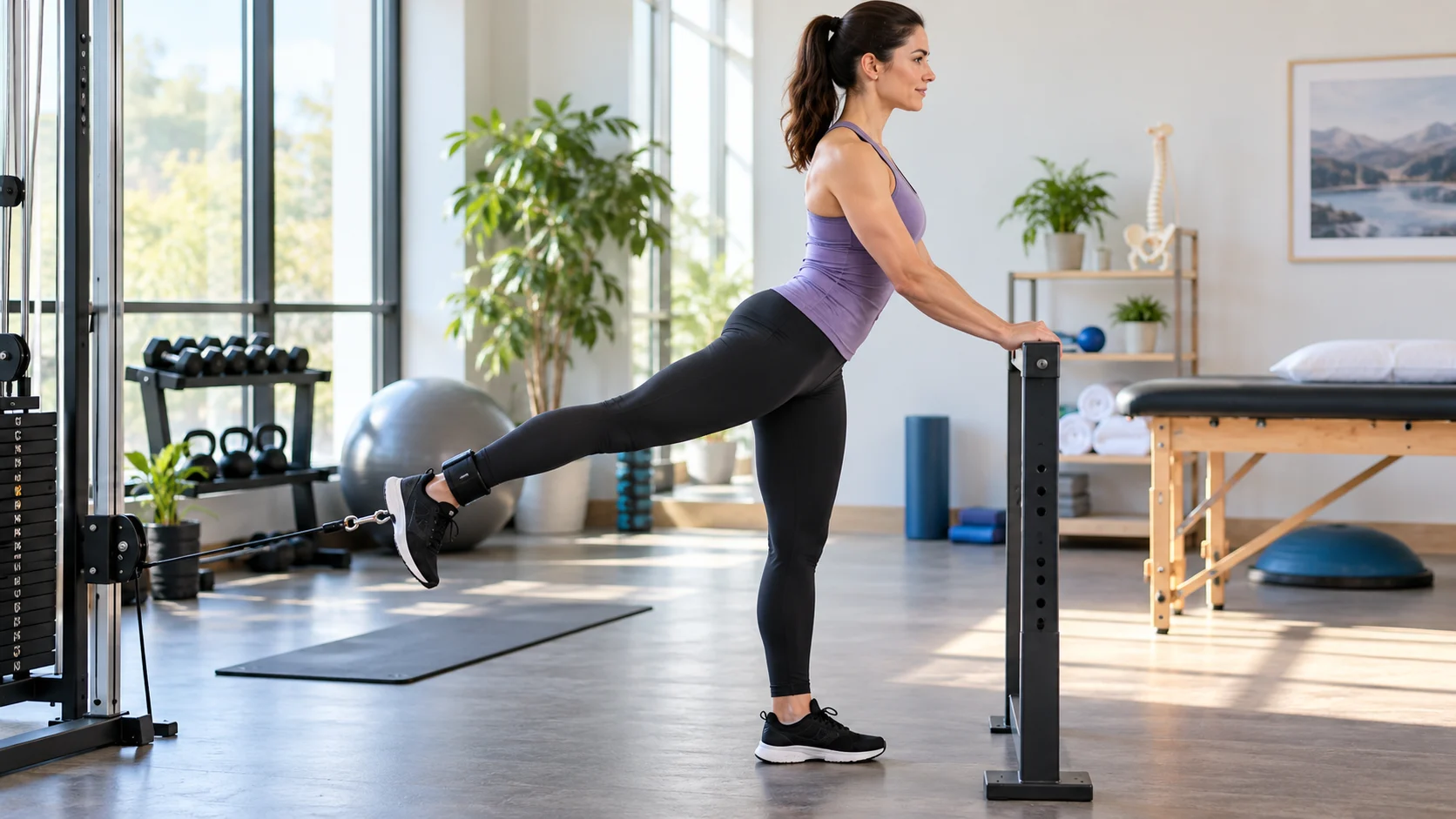
What Is Standing Hip Extension?
Standing hip extension is a lower-body exercise that involves moving one leg backward while keeping the torso upright and the pelvis controlled. The movement primarily targets muscles responsible for extending the hip, especially the gluteus maximus. It can be performed with body weight, resistance bands, cables, or an exercise machine depending on your strength level and training goals.
The exercise is commonly used in strength training, rehabilitation, warm-ups, and mobility programs. Because it is performed while standing, it also challenges balance and control in the supporting leg. This makes standing hip extension useful for developing hip strength in a position that resembles walking, running, and many other everyday movements.
The movement should come mainly from the hip rather than the lower back. You do not need to swing the leg far behind you to make the exercise effective. Keeping the pelvis steady and using a smaller controlled range often creates better glute engagement than forcing the leg backward as far as possible.
What Muscles Does Standing Hip Extension Work?
The gluteus maximus is the primary muscle worked during standing hip extension. It is one of the body’s strongest hip extensors and helps drive the leg backward during walking, running, climbing stairs, and rising from a seated position. During the exercise, it contracts as you move the working leg behind the body.
The hamstrings also assist with hip extension. These muscles run along the back of the thigh and work with the glutes during many lower-body movements. Depending on knee position and resistance, you may feel them contributing as you move the leg backward and control it while returning toward the starting position.
The muscles in the supporting leg also work to maintain balance and pelvic stability. The gluteus medius, core muscles, and small stabilizers around the ankle and foot help keep the body controlled. This means standing hip extension challenges more than just the moving leg, even though the gluteus maximus remains the main target.
Benefits of Standing Hip Extension
Standing hip extension can help strengthen the glutes without requiring a large amount of equipment or space. Stronger glutes can support walking, running, climbing stairs, lifting, and other activities that depend on hip extension. This makes the exercise useful for both general fitness and lower-body rehabilitation.
The exercise may also improve single-leg control because one leg must support the body while the other moves. Balance and hip stability are important during everyday activities such as stepping over obstacles or walking on uneven ground. Practicing controlled standing movements can gradually improve confidence in these positions.
Another benefit is that the exercise can be adjusted easily. Beginners may use body weight and hold onto a chair, while more experienced exercisers can add bands or cable resistance. This flexibility makes standing hip extension suitable for different ability levels and allows gradual progression as strength improves.
How to Perform Standing Hip Extension Correctly
Stand tall near a wall, chair, or stable surface and hold it lightly for balance. Keep your feet about hip-width apart and your torso upright. Gently brace your abdomen without holding your breath, then shift your weight onto one leg while keeping the supporting knee softly bent.
Move the opposite leg backward slowly while keeping the knee mostly straight. Stop before your pelvis begins rotating or your lower back starts arching. You should feel the glute on the moving side working as the leg travels backward through a comfortable range.
Pause briefly at the end of the movement, then return the leg slowly toward the starting position. Avoid letting the foot swing forward and backward with momentum. Complete your repetitions on one side before switching legs, focusing on control rather than trying to create the largest possible movement.
Common Standing Hip Extension Mistakes
One common mistake is arching the lower back instead of extending through the hip. This usually happens when the leg is pushed too far backward. Stop the movement earlier and squeeze the glute rather than trying to increase range by moving through the lumbar spine.
Another mistake is leaning the torso forward excessively. A small adjustment for balance may be natural, but large movements reduce the focus on controlled hip extension. Keep the chest relatively upright and use a wall or chair for support if balance makes it difficult to maintain position.
Swinging the leg is also a frequent problem. Fast repetitions use momentum and make it harder for the glutes to control the exercise. Slow down both the backward and returning phases so the hip muscles remain active throughout the entire repetition.
Standing Hip Extension With a Resistance Band
A resistance band can make standing hip extension more challenging without requiring gym equipment. Secure the band around a stable anchor or loop it around both ankles, depending on the type of band you have. Make sure the band is secure before beginning so it does not slip during the exercise.
Start with light resistance because even a small amount of band tension can make the movement noticeably harder. Keep your pelvis level and move the leg backward without rotating the foot excessively outward. The band should challenge the glutes while still allowing you to maintain smooth movement and stable posture.
As the exercise becomes easier, increase resistance gradually or add more repetitions. Avoid using a stronger band simply because it feels more challenging if your form begins to deteriorate. Good technique should remain consistent as resistance increases.
Standing Hip Extension With a Cable Machine
Cable machines provide consistent resistance throughout much of the exercise. Attach an ankle strap to a low cable and secure it around one ankle. Stand facing the machine, hold the frame lightly for balance, and take a small step backward until the cable has gentle tension.
Move the working leg backward while keeping the torso controlled and the pelvis facing forward. Avoid rotating the hips or turning the movement into a large backward kick. The cable should provide enough resistance to challenge the glute while still allowing you to move through a comfortable range.
Return the leg slowly rather than letting the cable pull it forward quickly. Using a controlled return increases muscular involvement and improves overall exercise quality. Start with a light weight and progress only when you can complete each repetition without swinging, twisting, or leaning excessively.
Standing Hip Extension and Knee Comfort
Standing hip extension can sometimes be useful when you want to strengthen the glutes without repeatedly bending the working knee. However, the supporting leg still carries body weight, so knee comfort remains important. Keep the supporting knee slightly bent rather than locking it completely straight during the set.
If you already experience knee pain when bending, standing hip extension may feel more comfortable than deeper squats or lunges in some situations. However, it is not automatically appropriate for every knee problem, especially if standing itself increases symptoms.
Use support from a chair or wall if balance causes the supporting knee to wobble or collapse inward. Stop if the exercise increases sharp knee pain or makes walking more uncomfortable afterward. A healthcare professional can help determine which lower-body exercises are appropriate when knee symptoms persist.
How Many Standing Hip Extensions Should You Do?
Beginners can start with two or three sets of approximately 10 to 15 repetitions on each side. Use a range that allows you to feel the glute working without losing balance or arching the lower back. The final repetitions should feel challenging but still controlled.
For endurance or warm-up work, higher repetitions with light resistance may be appropriate. For strength development, gradually increasing resistance while using moderate repetitions can provide a stronger training stimulus. The exact number depends on your fitness level and how standing hip extension fits within the rest of your program.
You do not need to perform the exercise every day. Two or three sessions per week may be enough for many people, especially when the glutes are also trained through squats, lunges, deadlifts, step-ups, or hip thrusts. Consider your total lower-body training volume before adding extra sets.
Standing Hip Extension vs. Glute Bridge
Standing hip extensions and glute bridges both strengthen the glutes, but they place the body in different positions. A glute bridge is performed lying on the floor, while standing hip extension challenges the hip while the opposite leg supports body weight. This gives the standing variation an additional balance component.
Glute bridges may allow stronger glute contraction with less balance demand, making them easier for beginners who struggle to stand on one leg. Standing hip extensions can be useful for training hip control in an upright position that more closely resembles walking and other functional activities.
Both exercises can fit into the same program rather than competing with each other. Bridges can build basic hip-extension strength, while standing variations can challenge balance and control. Combining the two may provide a more complete approach to glute training.
Standing Hip Extension vs. Hip Thrust
Hip thrusts allow the glutes to work against substantial resistance through hip extension. Because the upper back and feet are supported, heavier loads can usually be used compared with standing hip extension. This makes hip thrusts especially useful for building glute strength and muscle size.
Standing hip extension uses less total resistance but requires more balance and control. It can be a useful accessory movement, warm-up exercise, or rehabilitation option when lighter resistance is appropriate. The exercise also allows each side to work independently, making side-to-side differences easier to notice.
There is no need to choose only one movement. Hip thrusts can provide heavier strength work, while standing hip extension can add single-leg control and lower-load training. A balanced program can use both depending on your goals and available equipment.
When to Avoid Standing Hip Extension
Avoid the exercise if it causes sharp pain in the hip, lower back, or supporting knee. Mild muscle fatigue is expected, but pinching, radiating pain, numbness, or sudden weakness are not normal training sensations. Reduce the range or stop if these symptoms appear.
People recovering from hip surgery, major lower-body injury, or significant neurological problems should follow professional guidance. Restrictions may apply depending on the stage of healing and the type of procedure or injury. An exercise that is appropriate for one person may be unsuitable for another.
You should also be cautious if balance is significantly impaired. Use a stable surface for support and avoid resistance that makes you feel unsteady. If balance problems are new, severe, or unexplained, seek medical advice rather than relying on exercise alone.
Best Practices for Better Results
Focus first on movement quality. Keep the pelvis controlled, avoid excessive lower-back arching, and use a slow tempo. A smaller range performed correctly usually trains the glutes more effectively than a large movement created by swinging or twisting.
Progress gradually by increasing resistance, repetitions, or control over time. You can also add a brief pause at the end of the movement to make the glutes work harder. Change only one variable at a time so you can see how your body responds to the added challenge.
Combine standing hip extension with other lower-body exercises for more complete strength development. Squats, lunges, bridges, deadlifts, step-ups, and calf exercises all train different movement patterns. A varied program is more useful than relying on one exercise to develop the entire lower body.
Conclusion
Standing hip extension is a simple exercise that primarily strengthens the gluteus maximus while also involving the hamstrings, core, and stabilizing muscles of the supporting leg. It can be performed with body weight, resistance bands, or cables depending on your experience and goals.
Good technique requires a stable pelvis, upright torso, and controlled backward movement of the leg. Avoid excessive lower-back arching, swinging, or rotating the hips. Start with light resistance and progress only when you can maintain smooth, consistent form.
The exercise works best as part of a balanced lower-body program rather than as the only glute movement you perform. Stop if you develop sharp pain, numbness, or worsening joint symptoms. With sensible progression, standing hip extension can support stronger hips, better balance, and improved lower-body control.
FAQs
What muscles does standing hip extension work?
Standing hip extension mainly works the gluteus maximus, with assistance from the hamstrings. The supporting leg, core, and hip stabilizers also work to maintain balance and pelvic control.
Is standing hip extension good for glutes?
Yes. It directly trains hip extension, one of the main functions of the gluteus maximus. Adding resistance gradually can make the exercise more effective for strength development.
How many standing hip extensions should I do?
Beginners can start with two or three sets of 10 to 15 repetitions on each side. Adjust the volume and resistance based on strength, control, and your overall lower-body program.
Should I feel standing hip extensions in my lower back?
No. The glutes should perform most of the movement. Lower-back discomfort may indicate that you are extending the leg too far, arching excessively, or using too much resistance.
Can standing hip extensions help with balance?
Yes. Because one leg supports your body while the other moves, the exercise challenges balance and hip stability. Holding a chair or wall can make it safer for beginners.