
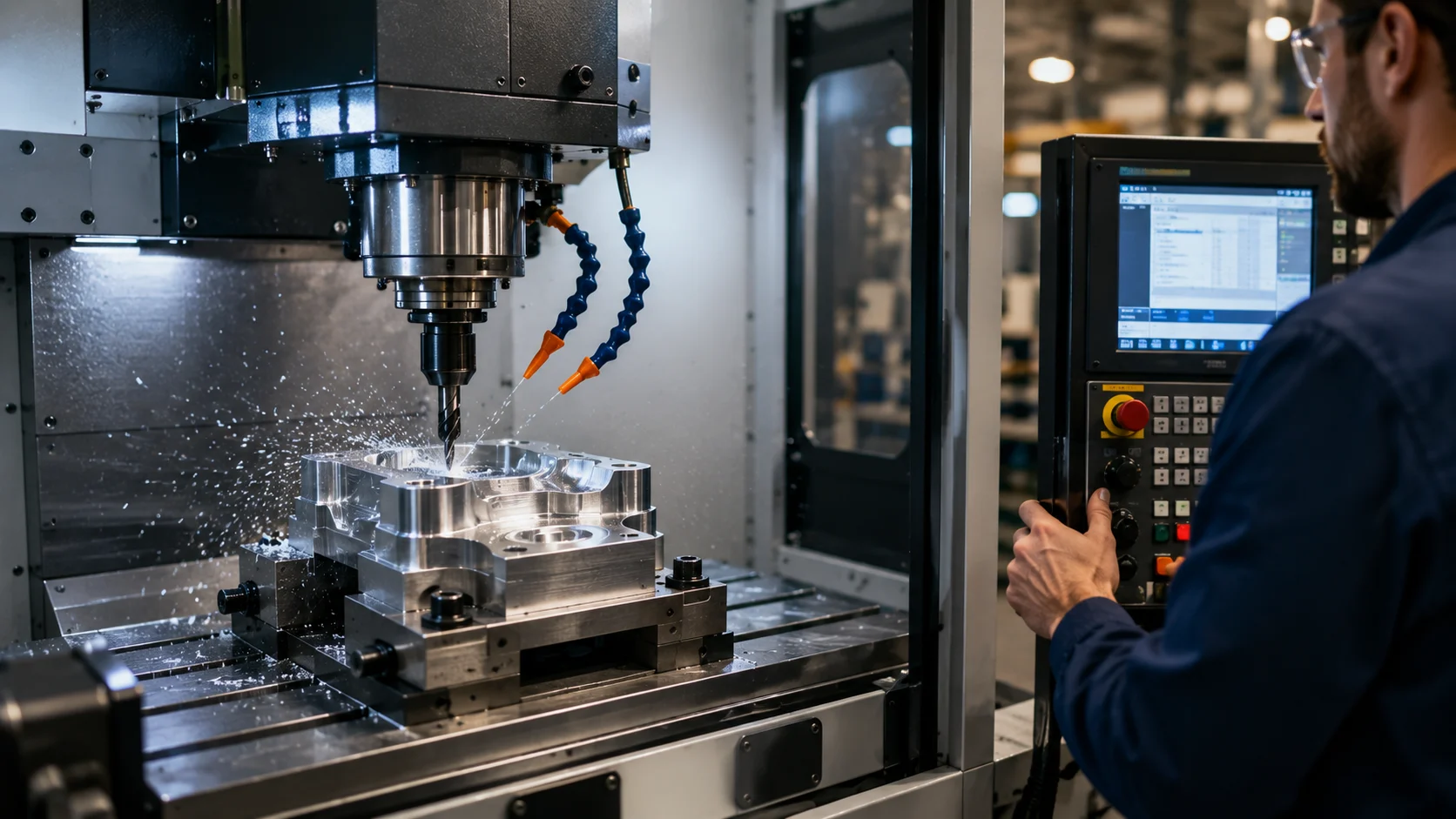
Computer Numerical Control: How CNC Works
Computer Numerical Control, commonly called CNC, is one of the most important technologies used in modern manufacturing. It allows machines to cut, drill, mill, turn, shape, and finish materials with a high level of precision by following programmed instructions. Instead of relying entirely on manual operation, CNC systems use computers to control machine movement, tool position, spindle speed, feed rate, and other machining variables. This makes production more consistent and repeatable across large numbers of parts. CNC machining is widely used in automotive, aerospace, electronics, medical manufacturing, metalworking, woodworking, and many other industries. Understanding how CNC works helps explain why manufacturers can produce complex components faster, more accurately, and with less variation than traditional manual methods.
What Is Computer Numerical Control?
Computer Numerical Control is a manufacturing method in which computerized instructions control the movement and operation of a machine tool. The machine follows a programmed sequence of commands that tells it where to move, how fast to move, and what actions to perform. These instructions can control cutting tools, spindles, worktables, tool changers, coolant systems, and other machine functions. CNC technology is used with equipment such as milling machines, lathes, routers, plasma cutters, grinders, and laser cutting systems. The primary goal is to automate machining while maintaining accuracy and repeatability. This allows manufacturers to produce complex parts consistently without requiring an operator to guide every movement manually.
The term numerical control refers to the use of coded numerical instructions to operate machinery. Early numerical control systems existed before modern digital computers became common and often relied on punched tape or similar methods to deliver instructions. Computer Numerical Control improved this idea by allowing the machining instructions to be stored, edited, and executed through a computer-based controller. Modern CNC machines can process highly detailed programs containing thousands of commands. Operators can adjust parameters, load new jobs, monitor machining conditions, and make corrections through a control interface. This combination of automation and programmability has made CNC equipment central to modern production. The technology continues to evolve with faster processors, better sensors, automation, and more advanced manufacturing software.
A CNC machine does not independently decide what part to manufacture. It follows instructions created by programmers, engineers, machinists, or computer-aided manufacturing software. These instructions are usually based on a digital design of the desired component. The program defines coordinates, cutting paths, tool changes, spindle operation, and other actions required to transform raw material into the finished shape. The machine controller interprets the instructions and sends commands to motors and other components. Sensors and feedback systems can help verify machine position and movement. CNC is therefore best understood as a combination of software, electronics, precision mechanics, cutting tools, and skilled human planning working together.
CNC machining is especially valuable when a manufacturer needs to create the same component repeatedly. A skilled manual machinist can produce highly accurate parts, but slight variations may occur between separate operations. Once a CNC program has been properly prepared and the machine is correctly set up, the same sequence can be repeated many times with consistent results. This makes CNC suitable for both batch manufacturing and high-volume production. It is also useful for prototypes and customized parts because digital programs can be modified relatively quickly. Repeatability reduces variability and can simplify quality control. Manufacturers can therefore use CNC technology to balance precision, production speed, and flexibility.
Computer Numerical Control should not be confused with a specific type of machine. CNC is the control method used to automate many different manufacturing systems. A CNC milling machine removes material using rotating cutting tools, while a CNC lathe generally rotates the workpiece against a cutting tool. A CNC router may shape wood, plastics, composites, or softer metals, while a CNC plasma cutter uses a high-temperature plasma arc to cut conductive material. Each machine operates differently, but computerized numerical instructions control its movements. Understanding this distinction makes CNC easier to grasp because the same control concept can support many manufacturing processes. The machine changes, while the fundamental idea of programmed automated movement remains consistent.
How Does CNC Work?
CNC machining begins with a design that defines the dimensions and geometry of the part to be produced. Engineers or designers commonly create this model using computer-aided design software, often called CAD. The CAD file describes the shape, holes, surfaces, features, and measurements of the component. This digital model becomes the foundation for planning how the machine will remove material. The design alone cannot usually operate the CNC equipment because the machine needs specific instructions describing how tools should move. Computer-aided manufacturing software, or CAM software, can translate the design into machining operations. This creates a connection between the engineer’s digital model and the physical actions performed by the CNC machine.
The next stage involves creating a toolpath, which is the route that a cutting tool follows while machining the part. CAM software can calculate these toolpaths according to the component geometry, selected cutting tools, machine capabilities, and manufacturing strategy. The programmer may define operations such as facing, drilling, pocketing, contouring, roughing, and finishing. Cutting depth, spindle speed, feed rate, tool engagement, and other parameters can also be configured. These decisions strongly affect machining time, surface finish, tool life, and part accuracy. Once the toolpaths are prepared, the CAM system can generate machine-readable instructions. This process is often called post-processing because the software adapts the output to a specific CNC controller and machine configuration.
The generated CNC program typically contains commands written in a programming language commonly associated with G-code. Individual commands may tell the machine to move to specific coordinates, start the spindle, change tools, activate coolant, or adjust feed rates. The CNC controller reads these commands in sequence and converts them into electrical instructions for machine components. Servo motors or stepper motors then move the axes, worktable, cutting head, or other mechanical parts. Depending on the machine, movements may occur along X, Y, and Z axes as well as rotational axes. Precise synchronization allows the machine to follow complex toolpaths. The program essentially acts as a detailed set of instructions for every stage of the machining operation.
Before production starts, the operator prepares the CNC machine and workpiece. Raw material must be positioned securely using a vise, chuck, fixture, clamps, or another workholding method. Cutting tools are installed in the spindle or tool magazine and their dimensions may be measured or entered into the controller. The operator also establishes reference positions so the machine understands the relationship between programmed coordinates and the physical workpiece. Incorrect setup can cause dimensional errors or even collisions, regardless of how accurate the CNC program is. Operators therefore verify tools, offsets, fixtures, and work coordinates carefully. Simulation and dry runs may also be used before cutting expensive material or producing a complicated part.
Once the program and setup have been verified, machining can begin. The controller executes commands while the machine moves tools and material according to the programmed path. Depending on the equipment, sensors may monitor position, spindle conditions, tool status, and other operating variables. Operators continue supervising the process, especially during new or complex jobs. After machining, the finished component may be measured using gauges, calipers, micrometers, coordinate measuring machines, or other inspection equipment. If measurements reveal variation, programmers or machinists can adjust offsets or machining parameters. CNC manufacturing is therefore not simply pressing a start button. Reliable results depend on accurate design, correct programming, careful setup, stable machining, and proper inspection.
Main Components of a CNC Machine
The CNC controller is one of the most important components because it acts as the machine’s control center. It stores and interprets the CNC program while coordinating movements and machine functions. Operators interact with the controller through a display, keypad, touchscreen, or control panel. They may load programs, edit values, set offsets, monitor machine status, and initiate operations from this interface. The controller sends instructions to drives and motors that move individual machine axes. Modern controllers may also support networking, data collection, simulation, probing, and automated diagnostics. Although the mechanical structure performs the actual cutting, the controller determines how and when those mechanical components move.
The machine axes determine the directions in which movement can occur. A basic three-axis CNC machine usually moves along the X, Y, and Z directions. These axes generally represent movement from side to side, front to back, and vertically, although machine configurations can vary. More advanced systems may include rotational axes commonly identified with letters such as A, B, or C. Adding rotational movement allows cutting tools to reach multiple sides of a component without repeated manual repositioning. Five-axis CNC machines are particularly valuable for creating complex geometries used in aerospace, medical, and precision engineering applications. More axes increase manufacturing capability but also require more sophisticated programming, setup, collision avoidance, and machine control.
The spindle is another essential component on many CNC machine tools. It rotates a cutting tool or, in the case of certain lathes, helps rotate the workpiece. Spindle speed can range considerably depending on the machine, material, tool, and machining operation. Selecting an appropriate speed helps control cutting conditions, heat generation, surface finish, and tool wear. CNC programs can automatically change spindle speed during different operations. Many machining centers also include automatic tool changers that allow multiple cutting tools to be stored inside a magazine. The machine can switch between drills, end mills, taps, and other tools without manual intervention. Automated tool changing significantly improves productivity when a component requires many different machining operations.
Workholding equipment keeps the material secure during machining. The cutting forces generated by milling, drilling, turning, or other operations can be substantial, making rigid workholding essential. Common workholding methods include machine vises, chucks, collets, clamps, fixtures, vacuum tables, and custom-designed systems. The ideal approach depends on the shape, size, material, and production quantity of the component. A poorly secured workpiece can move during cutting, producing inaccurate dimensions or dangerous conditions. Fixtures are especially useful in repeat production because they allow parts to be positioned consistently. Good workholding also improves efficiency by reducing setup time and making it easier for operators to load and unload components between machining cycles.
CNC machines also depend on several supporting systems. Coolant can reduce heat, remove chips, improve surface finish, and extend cutting tool life during certain operations. Lubrication systems protect moving machine components from excessive friction and wear. Chip conveyors or collection systems remove material that has been cut away from the workpiece. Encclosures help contain chips, coolant, and moving components while improving operator safety. Feedback devices such as encoders can report axis positions to the controller for precise motion control. Modern machines may additionally use probes, tool setters, cameras, sensors, and automated monitoring technologies. Together, these supporting components help CNC equipment operate more accurately, safely, and efficiently.
CNC Programming and G-Code Explained
CNC programming provides the instructions that tell the machine how to manufacture a component. Traditional programmers may write or edit machine commands manually, while modern manufacturing environments often generate much of the program through CAM software. Regardless of how the code is created, the machine needs clear instructions describing movement, tooling, speed, and other actions. CNC programs are organized in a sequence that the controller interprets line by line or block by block. Programmers must understand both the desired geometry and the physical capabilities of the machine. A program that appears correct mathematically can still create machining problems if it ignores tool clearance, workholding, machine travel, or cutting conditions.
G-code is the commonly used term for the commands controlling machine motion and machining behavior. A command may instruct the tool to move rapidly to a location or perform a controlled cutting movement at a specified feed rate. Other commands define coordinates, interpolation methods, units, or machining cycles. M-codes are commonly used for auxiliary functions such as starting or stopping the spindle, activating coolant, or controlling other machine operations. The exact command structure can differ between controllers and manufacturers. Programmers therefore need to understand the conventions used by the specific machine. Modern CAM software reduces the amount of manual coding required, but knowledge of G-code remains useful for troubleshooting and making efficient adjustments.
Coordinates are central to CNC programming because the machine must know exactly where the cutting tool should move. Most programs use coordinate values associated with individual machine axes. Programmers establish a work coordinate system that relates the digital part geometry to the physical material inside the machine. Tool offsets account for differences in tool length, diameter, or position. These offsets allow the same program to remain accurate even when tools are replaced or minor dimensional corrections are required. Operators can sometimes adjust an offset instead of modifying the entire program. Precise coordinate management is essential because even a small setup error can affect every feature on the finished part. Proper referencing makes programmed movement correspond accurately to real-world machining.
CAM software has transformed CNC programming by automating much of the toolpath creation process. The programmer imports or creates a CAD model, selects machining strategies, defines tools, and configures cutting parameters. The software then calculates paths that remove material according to the desired geometry. Advanced systems can simulate machining before the program reaches the physical machine. Simulation helps identify potential tool collisions, excessive travel, uncut material, or inefficient movements. Once the toolpaths are approved, a post-processor converts them into code suitable for the target CNC controller. This workflow allows manufacturers to produce increasingly complex parts while reducing the amount of programming that must be written manually.
Even with sophisticated software, experienced programmers remain important because automation does not eliminate manufacturing judgment. Someone must decide how the part should be held, which tools are appropriate, how material should be removed, and what sequence will produce reliable results. Efficient programming can reduce cycle time while extending tool life and maintaining quality. Poor strategies may cause vibration, tool breakage, excessive heat, or dimensional variation. Programmers also consider whether the machine can physically reach required surfaces. As CNC technology becomes more advanced, programming increasingly combines manufacturing knowledge with digital skills. Successful CNC programming therefore depends on understanding both software and the real behavior of machines, materials, cutting tools, and fixtures.
Types of CNC Machines
CNC milling machines are among the most widely used CNC systems. They generally use rotating cutting tools to remove material from a stationary or moving workpiece. Milling machines can perform operations such as facing, slotting, drilling, contouring, pocketing, and three-dimensional surface machining. Basic equipment may operate on three axes, while more advanced machining centers support additional rotational axes. Vertical machining centers have vertically oriented spindles, while horizontal machines use a different spindle orientation that can offer advantages for certain production tasks. CNC mills can process metals, plastics, composites, and other machinable materials. Their flexibility makes them suitable for prototypes, tooling, production components, molds, fixtures, and many precision manufacturing applications.
CNC lathes and turning centers operate differently because the workpiece commonly rotates while a cutting tool removes material. These machines are particularly suitable for cylindrical parts such as shafts, bushings, pins, threaded components, and fittings. The cutting tool moves along programmed axes while the rotating material passes against it. CNC lathes can perform turning, facing, grooving, boring, threading, and drilling operations. Advanced turning centers may include driven tools that perform milling operations without transferring the component to another machine. Some systems also include multiple spindles and turrets for greater productivity. Automated turning is widely used because it can produce large quantities of rotational components with excellent consistency and accuracy.
CNC routers are frequently used for woodworking, plastics, composites, foam, aluminum, and other materials. Their basic movement may resemble a CNC milling machine, but routers are commonly designed for larger work areas and different cutting conditions. Furniture manufacturers, sign makers, cabinet shops, aerospace companies, and fabrication businesses use CNC routers to cut panels, carve shapes, drill holes, and machine profiles. Digital designs make it possible to produce complicated patterns repeatedly without manually guiding the cutting tool. Some routers support automatic tool changing and multiple axes. Their versatility makes CNC routing accessible to both industrial manufacturers and smaller fabrication businesses. However, appropriate tooling and workholding remain important for achieving accurate, clean results.
CNC cutting systems can also use technologies that do not rely on traditional rotating cutting tools. Plasma cutting machines use an electrically conductive plasma arc to cut metal plate or sheet. Laser cutting equipment uses concentrated light energy to cut or engrave materials with high precision. Waterjet machines use high-pressure water, often mixed with abrasive material, to cut a broad range of substances. Each method has different strengths related to material type, thickness, edge quality, speed, and heat effects. CNC control allows these cutting heads to follow complex two-dimensional or three-dimensional paths. The same digital automation concept therefore supports very different physical methods of shaping material.
CNC grinding, electrical discharge machining, and specialized production equipment expand the range of computer-controlled manufacturing further. CNC grinders can create precise surfaces and tight tolerances by removing small amounts of material with abrasive wheels. Electrical discharge machining removes electrically conductive material using controlled electrical discharges rather than conventional cutting edges. CNC systems may also control bending machines, punching equipment, gear manufacturing machines, and specialized automation cells. Multi-tasking machines combine several processes into a single platform to reduce handling and setup. As manufacturing becomes increasingly integrated, the boundaries between individual CNC machine types continue to evolve. What connects them is their reliance on programmed computer control to achieve repeatable manufacturing operations.
What Materials Can CNC Machines Cut?
Metals are among the most common materials processed with CNC equipment. Aluminum is widely machined because it is relatively lightweight, versatile, and generally easier to cut than many harder metals. Steel is also common, ranging from mild grades to more demanding alloy and tool steels. Stainless steel can provide excellent corrosion resistance but often requires careful selection of cutting tools and machining parameters. Manufacturers also CNC machine brass, copper, titanium, magnesium, and nickel-based alloys. Each metal behaves differently under cutting forces and heat. Machinists must therefore select suitable spindle speeds, feed rates, tool materials, coatings, coolant strategies, and machining methods for the particular metal being processed.
Plastics can also be machined effectively using CNC equipment. Materials such as acrylic, nylon, polycarbonate, acetal, and various engineering plastics can be cut into precision components. Plastic machining presents different challenges from metalworking because some polymers can soften from heat, chip unpredictably, or distort when clamped too aggressively. Cutting tools need to remove material efficiently while limiting heat buildup. CNC machining is often used for plastic prototypes, enclosures, gears, medical components, electrical parts, and custom fixtures. It is especially useful when a designer needs a component made from production-grade plastic without creating an injection mold. This makes CNC machining valuable for low-volume production and engineering development.
Wood is another important CNC material, particularly in routing applications. CNC routers can cut plywood, hardwood, medium-density fiberboard, laminated panels, and various engineered wood products. Cabinet manufacturers use CNC systems to create panels with precisely positioned holes, slots, and edge profiles. Furniture makers can produce decorative shapes and repeatable joinery, while sign manufacturers use routing for lettering and dimensional designs. Computer control improves consistency when many pieces must fit together during assembly. Dust extraction is especially important when machining wood because cutting generates significant airborne particles and debris. Different cutter geometries may also be selected according to the wood material, finish requirements, and desired cutting direction.
Composite materials require specialized CNC strategies because they combine different materials with distinctive cutting behavior. Carbon-fiber-reinforced components, fiberglass, laminates, and other engineered composites are used in aerospace, automotive, sporting goods, and industrial applications. These materials can be difficult to machine because cutting may cause delamination, fiber pullout, abrasive tool wear, or poor edge quality. Appropriate tooling and controlled machining conditions help reduce these problems. Dust management may also be important because certain composite particles should not be allowed to spread through the workplace. CNC systems provide the precision necessary for trimming, drilling, and finishing complex composite components. Their programmable nature makes them particularly useful after molded parts require final machining.
Foam, ceramics, graphite, and other specialized materials can also be processed using appropriate CNC technologies. Foam is commonly machined for patterns, molds, prototypes, packaging, and architectural designs. Graphite may be machined into electrodes for electrical discharge machining and other industrial uses. Certain ceramics can be processed using grinding or specialized cutting methods, although their hardness and brittleness require careful equipment selection. Not every CNC machine can cut every material. The appropriate process depends on hardness, conductivity, heat sensitivity, thickness, desired tolerance, and surface requirements. Manufacturers therefore choose both the machine and tooling according to the material. CNC control provides precision, but successful machining still depends on matching the process to the physical properties of the workpiece.
Advantages of CNC Machining
Precision is one of the strongest advantages of CNC machining. Computer-controlled movements allow tools to follow defined coordinates much more consistently than most repetitive manual operations. Well-maintained CNC machines can produce features with tight dimensional tolerances, although achievable accuracy depends on equipment, tooling, material, setup, and environmental conditions. This precision is particularly important for industries where components must fit together reliably. Aerospace assemblies, medical devices, engines, electronics, molds, and industrial equipment can all require carefully controlled dimensions. CNC programming also allows corrections through offsets when measurements begin to drift. The combination of mechanical accuracy and digital control makes CNC highly suitable for manufacturing components where consistent dimensions matter.
Repeatability is closely related to precision but represents a different benefit. Once a machining process has been properly developed, the machine can execute the same programmed movements repeatedly. This allows manufacturers to produce dozens, hundreds, or thousands of similar components with less variation. Repeatability simplifies assembly because interchangeable parts are more likely to fit together properly. It also supports quality control because inspectors can monitor a stable process instead of dealing with significant variation from one operator-controlled part to another. However, cutting tools still wear and materials can vary, so manufacturers must monitor production. CNC repeatability works best when equipment maintenance, tooling, workholding, and inspection remain consistent throughout the manufacturing process.
Productivity can improve significantly through CNC automation. A machine can perform complex sequences without requiring an operator to manually control every movement. Automatic tool changers allow multiple machining operations to occur during the same cycle, and pallet systems can reduce time between workpieces. Some manufacturers use robotic loading to keep machines operating for extended periods with limited direct intervention. One skilled operator may also supervise several machines under appropriate conditions. These improvements can reduce labor time per component and increase equipment utilization. Setup and programming still require skilled work, particularly for new parts. Once production becomes stable, however, automated cycles can generate parts efficiently and consistently, making CNC particularly valuable for repeated manufacturing.
CNC technology also provides strong design flexibility. Complex curves, pockets, hole patterns, and three-dimensional surfaces can be manufactured directly from digital models. Five-axis machining can create shapes that would be extremely difficult to produce using simple manual equipment. Designs can also be changed by modifying the digital model and CNC program rather than constructing entirely new manual templates. This is useful for prototypes and product development because engineers can test several design versions relatively quickly. Customization becomes practical even for small production runs when programming and setup costs are manageable. CNC therefore supports both mass manufacturing and specialized low-volume work. The same equipment can produce very different components simply by changing tooling, fixtures, and programs.
Automation can improve workplace safety by reducing direct interaction with moving cutting tools during machining. Modern CNC machines often operate inside enclosed work areas that contain chips and coolant while separating operators from cutting operations. Safety interlocks can prevent certain machine actions when doors are open. However, CNC equipment is not risk-free. Operators still handle heavy materials, sharp tools, moving components, compressed systems, electrical equipment, and potentially dangerous chips. Incorrect programs or setups can also cause severe machine collisions. Proper training and safety procedures remain essential. CNC reduces some traditional manual machining exposure, but safe manufacturing still depends on responsible operation, equipment maintenance, appropriate protective measures, and adherence to workplace safety requirements.
Limitations and Challenges of CNC Machining
The initial cost of CNC equipment can be substantial. Industrial machining centers, turning centers, laser cutters, and multi-axis systems may require significant capital investment. Businesses may also need tooling, fixtures, inspection equipment, CAM software, workholding systems, coolant equipment, and facility infrastructure. Installation and operator training add further expenses. Smaller manufacturers must therefore consider whether expected production volume justifies the investment. Contracting machining work to an external supplier may be more economical for occasional requirements. However, companies with steady production demand can recover equipment costs through higher productivity and lower per-part labor. The financial value of CNC depends on utilization, job mix, maintenance costs, production volume, and the type of work being performed.
Programming and setup can require substantial skill and time. Producing a single simple part manually may sometimes be faster than creating a complete CNC program and fixture. Complex components may require hours of CAD preparation, CAM programming, simulation, tool selection, setup, and inspection before stable production begins. These upfront tasks become easier to justify when the same program will produce many components. For low-volume work, manufacturers must carefully manage programming and setup costs. Modern software has reduced some of this effort by automating toolpath generation and supporting reusable templates. Experienced programmers can also standardize proven machining strategies. Even so, CNC manufacturing is most efficient when planning work is considered part of the total production process.
Machine maintenance is another important challenge. CNC equipment contains precision bearings, guideways, ball screws, spindles, motors, electronics, hydraulic systems, lubrication components, and other parts that must operate reliably. Wear or misalignment can gradually reduce machining accuracy. Unexpected failures may stop production entirely, making preventive maintenance valuable. Manufacturers often inspect lubrication systems, clean equipment, monitor spindle condition, check coolant, and calibrate machine geometry according to maintenance schedules. CNC systems also contain computer hardware and software that may require updates or technical support. Reliable machines can operate for many years, but neglecting maintenance can lead to poor surface finish, dimensional problems, unplanned downtime, and expensive repairs.
CNC machining also creates material waste because many processes are subtractive. A component may begin as a solid block or bar and lose a significant portion of its material as chips during machining. This can become expensive when using titanium, specialty alloys, or other high-cost materials. Manufacturers may recycle metal chips, but the recovered value rarely eliminates all waste-related cost. Engineers can reduce unnecessary stock by choosing appropriately sized blanks, castings, forgings, or near-net-shape starting materials. Additive manufacturing may be more material-efficient for certain complex geometries, although it has its own limitations. CNC remains valuable because of its accuracy and material options, but material utilization should be considered during process planning.
A shortage of skilled personnel can also limit CNC productivity. Modern machines automate movement, but they still depend on experienced people who understand programming, tooling, workholding, inspection, troubleshooting, and machining fundamentals. Poorly prepared programs can damage tools, scrap expensive material, or cause machine collisions. Training new operators takes time because effective CNC work combines theoretical knowledge with practical experience. Manufacturers increasingly use simulation, digital work instructions, and automation to make processes easier to manage. Still, skilled machinists and programmers remain important for solving unexpected problems and optimizing production. Companies that invest in workforce development are generally better positioned to gain the full productivity benefits of advanced CNC technology.
CNC Machining vs Manual Machining
Manual machining relies heavily on an operator directly controlling machine movements. A machinist may turn handwheels, set feeds, position tools, and monitor each cutting operation throughout the job. This approach provides excellent flexibility for skilled operators and can be efficient for simple repairs, modifications, or one-off components. CNC machining instead uses programmed instructions to control movements automatically. Once the program is prepared, the machine can repeat operations with limited manual intervention. Neither method is universally superior. The appropriate choice depends on part complexity, quantity, tolerance, setup requirements, available equipment, and labor skills. Many manufacturing shops use both manual and CNC machines because each approach remains useful for different types of work.
CNC generally offers an advantage when repeatability is important. Producing hundreds of identical parts manually requires the machinist to repeat the same movements while maintaining consistent dimensions. CNC machines can perform the programmed cycle repeatedly, making large batches easier to control. Manual machining may still be efficient when only one simple component is required because no CNC programming time is necessary. For this reason, toolrooms and maintenance departments often keep manual lathes and mills available. Experienced machinists can complete straightforward jobs quickly using conventional equipment. Production departments, by contrast, frequently depend on CNC because automated cycles become increasingly valuable as production quantities rise and parts become more complicated.
Complexity is another important difference. CNC equipment can follow intricate toolpaths derived from digital three-dimensional models. Multi-axis systems can produce sculpted surfaces and features from several orientations during a single setup. Creating these shapes manually would require extraordinary skill and could be impractical in many cases. However, CNC complexity depends on advanced programming and careful process planning. Manual machinists can respond immediately to visual and tactile feedback while working, whereas automated machines execute programmed instructions regardless of whether those instructions are wise. Experienced CNC professionals therefore combine automation with machining knowledge. Technology changes how machine movements are controlled, but it does not eliminate the need to understand cutting behavior.
Labor requirements also differ between the two approaches. Manual machining typically requires the operator to remain directly engaged with the equipment for much of the machining cycle. CNC machines can perform programmed operations while operators prepare another job, inspect components, or supervise additional machines. This can improve labor productivity. However, CNC environments shift skill requirements toward setup, programming, troubleshooting, process optimization, and quality control. Organizations may employ fewer people for direct machine movement while requiring stronger technical expertise. Automation therefore changes the nature of machining work rather than simply removing human involvement. Skilled employees remain necessary because production still depends on intelligent decisions before, during, and after the automated cycle.
Many successful manufacturing operations combine CNC and manual machining strategically. CNC equipment handles repeat production and complex geometry, while manual machines support quick adjustments, repairs, tooling, and simple low-volume tasks. Experienced machinists who understand both methods can choose the most efficient process instead of assuming every component requires the most advanced equipment. Manual skills can also strengthen CNC programming because programmers who understand how material behaves during cutting tend to make better machining decisions. CNC should therefore be viewed as an extension of manufacturing expertise rather than a complete replacement for traditional machining knowledge. Digital control improves precision and productivity, while human understanding remains essential for process selection and problem solving.
The Future of CNC Manufacturing
Automation is becoming increasingly integrated with CNC machining. Robots can load raw material, remove completed components, change fixtures, or move parts between manufacturing processes. Pallet systems allow machines to switch between jobs with limited operator intervention. These technologies can enable longer production periods and increase equipment utilization. Manufacturers sometimes refer to highly automated unattended operation as lights-out manufacturing, although reliable implementation requires carefully controlled processes. Tool life, chip removal, part inspection, and material supply must all remain predictable. Automation is particularly valuable for repetitive production where stable processes have already been established. As robotic equipment becomes easier to program and integrate, smaller manufacturers may also adopt automated CNC cells more widely.
Artificial intelligence and data analytics are beginning to influence CNC production as well. Machine sensors can collect information about vibration, spindle load, temperature, cycle time, tool condition, and other operating variables. Analytics systems can use this information to identify patterns that may indicate tool wear or equipment problems. Predictive maintenance aims to repair machines before unexpected failures interrupt production. Adaptive machining technologies can also adjust certain parameters in response to real operating conditions. These capabilities do not eliminate the role of machinists, but they can provide better information for decision-making. The future of CNC is likely to involve deeper integration between physical machining processes and real-time digital monitoring.
Digital twins and advanced simulation are also improving manufacturing planning. A virtual representation of a CNC machine can help programmers evaluate toolpaths and machine movements before running the physical equipment. This is especially useful for multi-axis machining where collisions can be expensive. Simulation can reveal whether tools, holders, fixtures, or machine components might interfere with one another. Manufacturers can correct the program before risking equipment or material. Virtual commissioning and process planning may also reduce setup time for complicated jobs. As computing power improves, simulation can become increasingly realistic. These tools support a broader manufacturing trend in which more problems are identified and solved digitally before physical production begins.
Hybrid manufacturing may further change how CNC equipment is used. Some advanced systems combine additive manufacturing with conventional subtractive machining. Material can be deposited to create a rough form and then CNC cutting tools can finish critical surfaces to precise dimensions. This combination may reduce waste while retaining the accuracy and surface quality associated with machining. Additive processes can also create geometries that are difficult to manufacture from solid stock. CNC machining then provides final holes, threads, sealing surfaces, and dimensional features. Hybrid manufacturing is not appropriate for every component, but it illustrates how manufacturing technologies can complement rather than replace one another. Future factories may increasingly select processes dynamically according to each feature of a component.
Despite growing automation, human skills will remain important in CNC manufacturing. Machines can execute increasingly sophisticated instructions, but people still define manufacturing goals, develop processes, solve unusual problems, and evaluate tradeoffs involving quality, cost, and production time. Future machinists may spend more time working with digital models, simulation, robotics, automation, and data than previous generations did. Programming interfaces may become easier, while more decisions are supported by intelligent software. However, understanding tooling, materials, workholding, and machining physics will continue to provide significant value. CNC technology is evolving from isolated automated machines toward connected manufacturing systems, creating new opportunities for people who combine practical manufacturing knowledge with digital skills.
Frequently Asked Questions About Computer Numerical Control
What does CNC stand for?
CNC stands for Computer Numerical Control. It describes a method of controlling machine tools through programmed computer instructions rather than relying entirely on manual movement.
How does a CNC machine work?
A CNC machine follows a programmed sequence that tells its motors and machine components how to move and operate. The program controls variables such as coordinates, cutting paths, spindle speed, feed rate, tool changes, and other machining actions.
What is G-code in CNC machining?
G-code is a common programming language used to control CNC machine movements and machining operations. It contains commands that can define tool positions, motion types, speeds, coordinate systems, and other functions required to manufacture a component.
What are the most common CNC machines?
Common CNC machines include milling machines, lathes, turning centers, routers, laser cutters, plasma cutters, waterjet systems, grinders, and electrical discharge machines. Each uses computer control but performs material processing in a different way.
Is CNC machining fully automated?
CNC automates many machine movements, but skilled people are still needed for design, programming, tooling, setup, inspection, troubleshooting, maintenance, and process improvement. Advanced systems can automate more production tasks, yet human expertise remains an important part of reliable CNC manufacturing.