
What Are Hip Stability Exercises?
Hip stability exercises are movements designed to strengthen the muscles that control the pelvis, femur, and surrounding joints during everyday activity and exercise. These muscles help keep the hips aligned when you walk, run, climb stairs, squat, or stand on one leg. Good stability allows the body to move efficiently without unnecessary shifting, dropping, or rotation through the pelvis.
The main muscles involved include the gluteus medius, gluteus maximus, deep hip rotators, core muscles, and several smaller stabilizers. These muscles work together rather than acting independently. When they provide adequate strength and control, the hips can better manage forces from the ground and maintain a more stable position during both slow and fast movements.
Hip stability is different from simply having strong legs. Someone may be able to lift heavy weights but still struggle to control the pelvis during single-leg tasks. Stability exercises focus on coordination, balance, and movement quality, helping the muscles respond at the right time instead of relying only on maximum strength.
Why Hip Stability Is Important
Stable hips create a strong foundation for movement because the pelvis connects the upper and lower body. During walking or running, the body repeatedly transfers weight from one leg to the other. The hip muscles must control that shift so the pelvis remains relatively level and the knee and ankle can move in a comfortable, efficient alignment.
Poor hip control can cause the pelvis to drop or rotate excessively when standing on one leg. This may change how forces travel through the knee, lower back, and foot. Although hip weakness is not the only reason people develop discomfort, improving stability can support better movement mechanics and reduce unnecessary compensation elsewhere in the body.
Hip stability also matters for sports that involve jumping, cutting, changing direction, or sudden acceleration. Strong and responsive stabilizers help control the position of the leg during fast movements. Recreational exercisers benefit too because better control can make squats, lunges, stairs, and everyday activities feel smoother and more balanced.
Benefits of Hip Stability Exercises
One major benefit of hip stability exercises is improved balance and control. Many exercises challenge you to maintain alignment while moving one leg or shifting body weight. Over time, this can improve the ability to stay steady during walking, running, hiking, and sports, especially when the surface is uneven or movement changes quickly.
These exercises may also improve lower-body movement patterns. Better control of the hip can help prevent the knee from collapsing excessively inward during squats, lunges, or landings. This does not mean hip exercises automatically prevent every injury, but stronger stabilizers can improve how forces are shared throughout the leg during demanding activities.
Another benefit is improved confidence during single-leg movement. Activities such as climbing stairs, stepping off a curb, or running require brief periods of supporting the body on one side. Training this ability in a controlled environment can make everyday movement and exercise feel more secure, coordinated, and efficient.
Best Hip Stability Exercises for Beginners
Glute bridges are a simple starting exercise because they strengthen the hips while keeping both feet supported. Lie on your back with your knees bent and feet flat, then gently lift your hips while keeping the ribs relaxed. Squeeze the glutes near the top without forcing the lower back into an exaggerated arch, then lower with control.
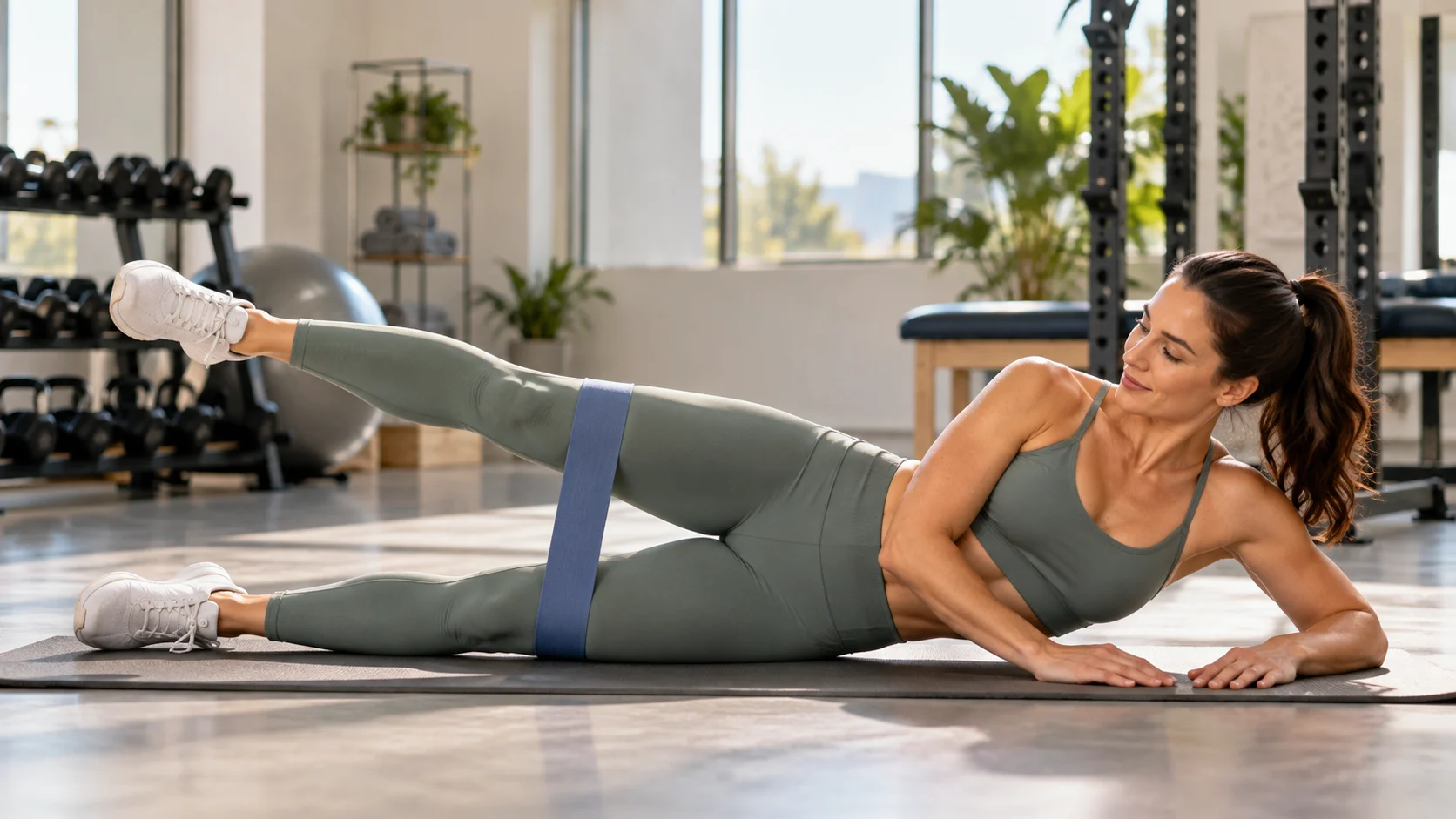
Side-lying leg raises can target the muscles along the outside of the hip. Keep the pelvis stacked rather than rolling backward, and lift the top leg only as high as you can without losing position. Moving slowly makes the exercise more challenging because the hip muscles must control the leg throughout the entire range.
Clamshells are another beginner-friendly option that trains hip rotation and lateral stability. Lie on your side with the knees bent, keep the feet together, and slowly lift the top knee without allowing the pelvis to rotate backward. The movement may be small, but good control is more important than creating a large range.
Single-Leg Exercises for Better Hip Control
Single-leg balance is one of the simplest ways to challenge hip stability. Stand tall on one leg while keeping the pelvis level and the knee softly bent. Try to avoid leaning the trunk dramatically or gripping the floor with the toes, because the goal is to develop calm, controlled stability rather than simply surviving the position.
Step-downs add movement while maintaining the single-leg challenge. Stand on a low step, slowly lower the opposite heel toward the floor, and return to the starting position. Keep the supporting knee aligned comfortably with the foot and focus on preventing the pelvis from dropping or rotating as you descend.
Single-leg Romanian deadlifts combine balance, hip strength, and trunk control. Hinge from the hip while extending the free leg behind you and keeping the spine in a comfortable neutral position. Start without weights until you can control the movement consistently, then gradually add resistance once your balance and technique improve.
Hip Stability Exercises for Runners
Running requires repeated single-leg support, making hip control particularly important for runners. During each stride, the gluteal muscles help stabilize the pelvis and control the position of the thigh. If these muscles fatigue quickly, movement may become less efficient and the runner may compensate through the lower back, knee, or other areas.
Lateral band walks are useful because they challenge the outer hip muscles while the knees remain slightly bent. Keep your feet roughly parallel and take controlled steps without letting the knees collapse inward. Avoid taking steps that are so large that you lose posture, because consistent tension and alignment matter more than maximum distance.
Runners can also benefit from step-ups, split squats, and controlled single-leg squats. These exercises build strength in positions that resemble the demands of running more closely than purely isolated movements. If symptoms also involve nerve-related tightness or tingling, learning about nerve glides may help clarify whether different mobility strategies deserve consideration.
How to Perform Hip Stability Exercises Correctly
Good form begins with controlling the pelvis rather than chasing a larger range of motion. During standing exercises, imagine keeping the waistband relatively level instead of allowing one side to drop. The knee should generally track in a comfortable direction over the foot, while the trunk remains controlled rather than swinging excessively to create momentum.
Move slowly enough to notice when your form starts to change. A controlled repetition allows the nervous system and muscles to practice the exact movement pattern you want to improve. If the exercise becomes easier only because you are using speed, bouncing, or body rotation, reduce the difficulty and return to deliberate movement.
Breathing should remain natural throughout the exercise. Avoid holding your breath or bracing so aggressively that the rest of the body becomes rigid. Hip stability requires enough tension to control movement while still allowing the joints and surrounding muscles to move naturally through a comfortable range.
Common Hip Stability Exercise Mistakes
One common mistake is choosing resistance that is too difficult. Heavy bands or weights may cause the knees, pelvis, or trunk to move out of position, reducing the quality of the exercise. Start with a resistance level that allows controlled repetitions, then increase difficulty only when you can maintain consistent alignment from beginning to end.
Another mistake is focusing only on the glutes while ignoring the rest of the movement chain. Hip stability also depends on the trunk, feet, ankles, and coordination between multiple muscle groups. A balanced program should include both isolated exercises and functional movements so the body learns to use hip strength during realistic activities.
Performing the same easy exercise indefinitely can also limit progress. Once basic bridges or clamshells become comfortable, the muscles need gradually greater challenges. Progress can come from resistance, slower tempo, longer holds, larger ranges, or single-leg variations rather than simply adding dozens of repetitions to the same beginner exercise.
How Often Should You Train Hip Stability?
Most people can include hip stability work two or three times per week, depending on overall training volume and exercise intensity. Short sessions can be effective when the exercises are performed with good technique. There is usually no need to complete long, exhausting workouts solely for the hips, especially if you already perform strength training or sports.
Beginners might choose four to six exercises and perform one to three controlled sets of each. The exact number of repetitions depends on the movement, but quality should remain the priority. Stop the set when technique begins to deteriorate rather than continuing only to reach a predetermined repetition target.
Recovery matters as the exercises become more demanding. Weighted split squats, single-leg deadlifts, and heavy step-ups may require more recovery than low-resistance activation exercises. Organize training so challenging hip work does not consistently interfere with running, sports practice, or other lower-body strength sessions.
How to Progress Hip Stability Exercises
Progression should begin only after you can perform the current version with consistent control. For example, once a basic bridge feels easy, you might add a resistance band, increase the hold time, or progress toward a single-leg bridge. Changing one variable at a time makes it easier to determine how your body responds.
Balance exercises can progress by narrowing the base of support or adding slow movement. A basic single-leg stance may become a controlled reach, step-down, or single-leg squat. You can also introduce an unstable surface in selected situations, although stable-ground strength work is usually more useful for developing force and movement control.
Resistance can gradually increase as technique improves. Dumbbells, kettlebells, cables, and resistance bands can make hip exercises more challenging without changing the basic movement pattern. The best progression is one that increases difficulty while preserving control, rather than a variation that looks advanced but causes obvious compensation.
Hip Stability and Lower Back or Knee Comfort
The hips influence both the knees and lower back because they sit between these regions and help transfer force during movement. Limited strength or control may encourage other areas to compensate. Improving hip stability can therefore be one part of a broader exercise approach for people who experience discomfort during walking, running, lifting, or other activities.
For knee control, the hip muscles help manage the position of the thigh during squats, steps, and landings. Stronger lateral hip muscles may improve the ability to prevent excessive inward movement of the knee. However, persistent knee pain should not automatically be blamed on weak hips because many factors can contribute to symptoms.
The same principle applies to the lower back. Hip strengthening may reduce unnecessary compensation when poor pelvic control contributes to the problem, but it is not a universal cure. If pain is severe, persistent, worsening, or accompanied by numbness or weakness, professional assessment is more appropriate than relying only on exercises.
Best Practices for Building Stronger, More Stable Hips
Consistency is more important than performing a large number of exercises. Choose a small group of movements that challenge different functions, including hip extension, abduction, rotation, and single-leg control. Practicing them regularly allows strength and coordination to improve gradually without making the routine unnecessarily complicated or difficult to maintain.
Combine stability exercises with general lower-body strength training. Squats, deadlifts, lunges, step-ups, and carries can reinforce hip control while also developing strength in the legs and trunk. Isolated exercises can help target specific muscles, but functional movements teach those muscles to work together under realistic loads.
Finally, pay attention to how your body responds over time. Mild muscular fatigue is expected, but sharp joint pain or worsening symptoms should not be ignored. Adjust resistance, range, or frequency when needed, and seek guidance from a qualified professional if discomfort repeatedly prevents you from progressing safely.
Conclusion
Hip stability exercises strengthen the muscles that help control the pelvis and legs during walking, running, sports, and everyday movement. Better stability can support balance, coordination, and efficient force transfer throughout the lower body. The most useful exercises combine good technique with gradual increases in difficulty.
Begin with simple movements such as bridges, clamshells, side-lying leg raises, and single-leg balance. As control improves, progress toward step-downs, split squats, single-leg deadlifts, and other more demanding exercises. Quality repetitions are more valuable than rushing through large numbers with poor alignment.
A consistent routine performed two or three times per week can fit easily alongside general strength or cardio training. Progress gradually and adjust the exercises if pain develops. Persistent or worsening symptoms deserve professional assessment so the underlying cause can be identified before training continues.
FAQs
What are the best exercises for hip stability?
Good options include glute bridges, clamshells, lateral band walks, step-downs, split squats, and single-leg deadlifts. The best choice depends on your current strength, balance, and exercise experience.
How can I tell if my hips lack stability?
Difficulty balancing on one leg, noticeable pelvic dropping, or poor control during step-downs may suggest limited hip control. These signs are not a diagnosis, but they can highlight areas worth strengthening.
How long does it take to improve hip stability?
Changes may become noticeable within several weeks of consistent training, although progress varies by person. Strength, coordination, training frequency, exercise difficulty, and previous activity levels all influence the timeline.
Can hip stability exercises help knee pain?
They may help when poor hip control contributes to knee movement patterns, but knee pain can have many causes. Persistent or worsening symptoms should be assessed instead of assuming hip weakness is the only problem.
Should I do hip stability exercises every day?
Daily training is usually unnecessary, especially when exercises are challenging. Two or three focused sessions per week often provide enough practice while allowing recovery, although gentle balance or activation exercises may sometimes be performed more frequently.