
What Is an IoT Network? How It Works & Examples
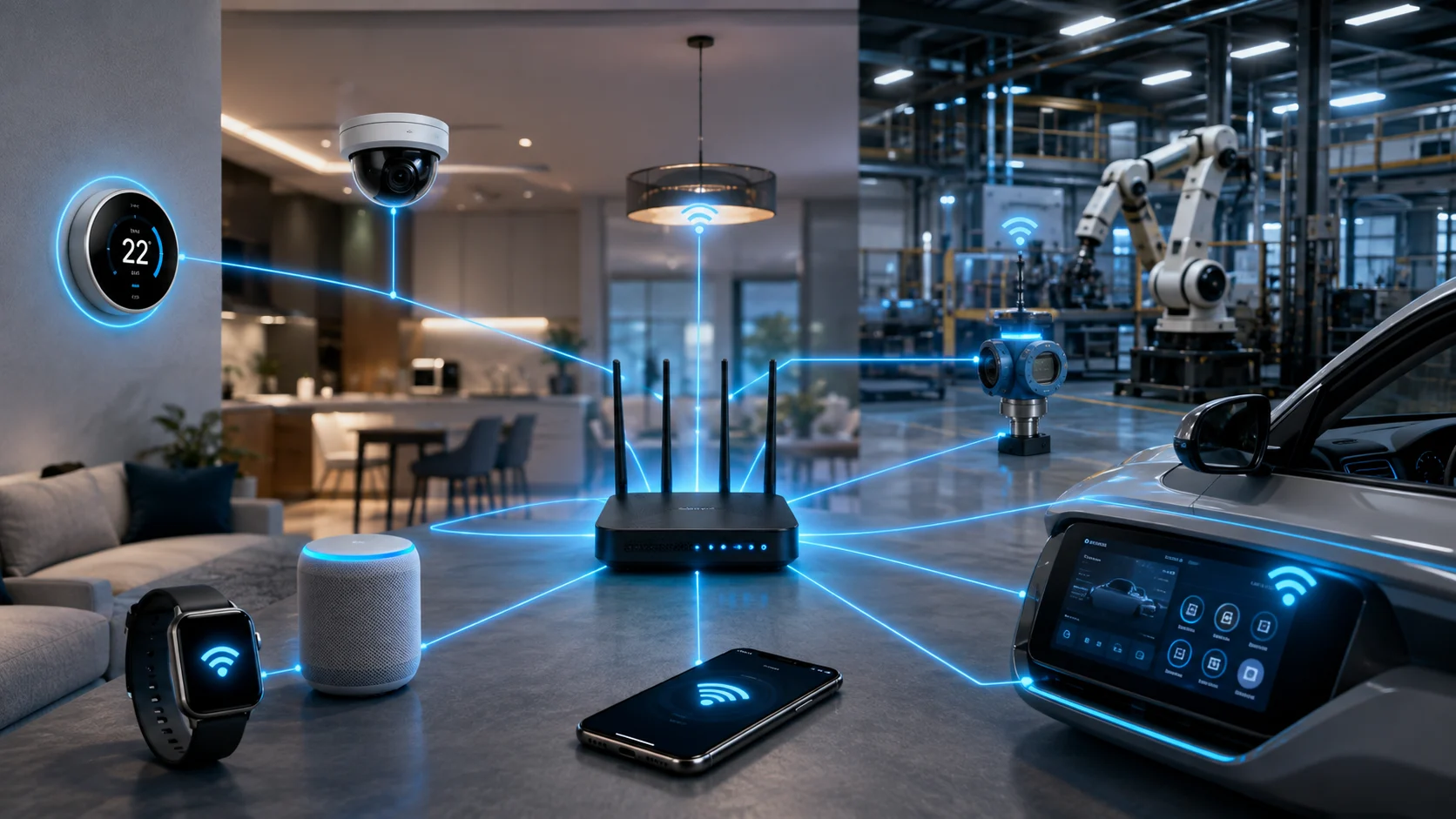
An IoT network is a connected environment in which physical devices collect, exchange, and sometimes act on data through wired or wireless communication technologies. These devices can include sensors, smart appliances, industrial machines, vehicles, cameras, medical equipment, and thousands of other connected objects. Unlike a traditional computer network that primarily links laptops, servers, and smartphones, an IoT network can connect everyday physical equipment to digital systems. The devices may communicate directly with cloud platforms, through local gateways, or with edge computing infrastructure. Data collected from these devices can be analyzed to automate actions or support better decisions. This combination of physical devices, connectivity, software, and data forms the foundation of the Internet of Things.
IoT networks are becoming increasingly important because organizations and consumers want more visibility into what is happening around them. A factory can monitor machine temperature, a farmer can measure soil moisture, and a homeowner can control lighting from a mobile application. Businesses can also track equipment, manage energy consumption, monitor shipments, and predict maintenance requirements. The value does not come simply from connecting an object to the internet. Real value appears when collected information helps people automate processes, identify problems, reduce waste, or improve experiences. An effective IoT network therefore combines communication infrastructure with sensors, analytics, applications, and intelligent decision-making.
The way an IoT network operates depends heavily on the environment in which it is deployed. A smart home may rely mainly on Wi-Fi, Bluetooth, Thread, or other short-range wireless technologies. A manufacturing facility may combine Ethernet, industrial protocols, private wireless networks, and edge computing systems. Large agricultural or utility deployments may use low-power wide-area technologies to connect sensors spread across significant distances. Cellular IoT technologies can support devices that need connectivity while moving between locations. Because applications have different requirements for range, bandwidth, battery life, latency, cost, and reliability, there is no single networking technology that fits every IoT deployment.
Security is another central consideration because connected devices can create new pathways into digital environments. An insecure sensor, camera, gateway, or controller can potentially become a weak point if authentication, software updates, encryption, and access controls are poorly managed. Organizations therefore need to think about IoT cybersecurity from the beginning rather than treating it as an optional feature added after deployment. Device identity, network segmentation, monitoring, firmware management, and secure communication all contribute to stronger protection. The challenge becomes greater as the number of connected devices increases. A well-designed IoT architecture balances connectivity and convenience with security, reliability, scalability, and long-term device management.
Understanding IoT networks is useful for anyone working with smart buildings, industrial automation, connected vehicles, healthcare technology, logistics, energy management, agriculture, or consumer smart devices. The basic concept is straightforward, but real implementations involve multiple layers of hardware, software, networking, and data processing. Knowing how these layers work together helps explain why some IoT projects succeed while others become difficult to maintain. The following sections explore the meaning of an IoT network, its components, communication technologies, architecture, security requirements, benefits, and real-world examples. Together, these concepts provide a practical picture of how connected devices communicate and create useful digital services.
What Is an IoT Network?
An IoT network is a communication system that connects physical devices capable of sensing, processing, transmitting, or receiving data. These connected devices are often called IoT devices, smart devices, connected objects, or endpoints. Each device may contain sensors, processors, communication modules, software, and a power source depending on its purpose. Some devices collect environmental information such as temperature, motion, pressure, humidity, or location. Others receive instructions and perform actions, such as opening a valve or adjusting a thermostat. The network allows these devices to exchange information with other devices, gateways, servers, cloud platforms, applications, or users.
The term Internet of Things describes the broader ecosystem in which physical objects are connected to digital services and communication networks. An IoT network represents the connectivity layer that enables these objects to communicate. Some IoT devices connect directly to the internet, while others communicate through a local gateway that forwards information to another system. Devices can also operate primarily inside private local networks without sending every piece of information to a public cloud. The appropriate design depends on security, latency, privacy, availability, and business requirements. This flexibility allows IoT technologies to support everything from a single smart thermostat to enormous industrial sensor deployments.
IoT networks differ from conventional enterprise networks because they often include devices with limited processing power, memory, bandwidth, or battery capacity. A laptop can support complex security applications and frequent software updates, while a small environmental sensor may need to operate for several years using a small battery. These limitations influence how devices communicate and which network protocols are appropriate. Many IoT systems therefore use lightweight messaging methods and low-power wireless technologies. Network designers must consider energy consumption as carefully as data speed. The goal is to provide enough connectivity for the application without consuming unnecessary power, bandwidth, or computing resources.
Another characteristic of IoT networking is the enormous variety of connected equipment. An organization may operate cameras, smart meters, industrial controllers, temperature sensors, asset trackers, lighting systems, and environmental monitors within the same environment. Each device category can have different operating systems, communication protocols, manufacturers, and security capabilities. Managing this diversity is one of the most difficult parts of large-scale IoT deployments. Standardized device management and interoperability approaches can reduce complexity, but older or specialized equipment may still require custom integration. Successful architectures therefore emphasize visibility, documentation, segmentation, and centralized management wherever practical.
Ultimately, an IoT network exists to move useful information between the physical and digital worlds. Sensors transform physical conditions into digital data, networks transport that information, software interprets it, and applications allow people or automated systems to respond. The process may happen within milliseconds or over much longer intervals depending on the use case. A safety system may require immediate processing, while an agricultural sensor might transmit measurements only a few times per day. These differences demonstrate why IoT networking is not simply another version of ordinary internet connectivity. It is a flexible communication model designed around the needs of physical devices and real-world processes.
How Does an IoT Network Work?
An IoT network usually begins with a device that observes or interacts with the physical environment. A temperature sensor may measure heat, a motion detector may identify movement, or a connected meter may record energy consumption. The device converts this information into digital data that can be processed locally or transmitted elsewhere. Some devices contain enough computing capability to filter or analyze information before sending it. Others perform very little processing and simply transmit measurements to a gateway or server. This first stage is often called data acquisition because the IoT system is collecting information from the physical environment.
After data is collected, it must travel through an appropriate communication channel. A device may connect through Wi-Fi, Ethernet, Bluetooth, cellular networks, Zigbee, Thread, LoRaWAN, or another technology. The choice depends on factors such as distance, bandwidth, power usage, device mobility, environmental conditions, and deployment cost. A smart camera may require high bandwidth, while a soil sensor transmitting a few measurements per hour can operate efficiently on a low-data-rate network. Devices may communicate directly with cloud services or send information through an IoT gateway. The gateway can aggregate, translate, secure, or preprocess information before forwarding it to another platform.
Once the information reaches a processing environment, software can store, analyze, and interpret it. This processing may occur in the cloud, inside a private data center, at an edge computing location, or directly on the device. Cloud platforms are useful when organizations need large-scale storage, analytics, centralized management, or integration with enterprise applications. Edge computing is valuable when decisions need to happen quickly or when sending every piece of data to a remote cloud would consume too much bandwidth. Many IoT architectures combine both approaches. Immediate decisions happen close to the device, while historical analysis and centralized management occur through cloud or enterprise systems.
After processing, the IoT application can present information or trigger an action. A building management system might display energy consumption on a dashboard and automatically adjust heating based on occupancy data. An industrial monitoring platform may detect abnormal vibration and generate a maintenance alert before equipment fails. A smart irrigation system can use moisture readings to determine when plants actually need water. Some workflows involve human decisions, while others operate automatically according to predefined rules or machine learning models. This ability to connect sensing with action is what makes IoT systems particularly valuable. Data becomes useful when it influences a real process or improves a decision.
The process then repeats continuously or according to scheduled intervals. Devices collect new information, networks transport it, software analyzes it, and applications respond. Large IoT environments may perform this cycle across millions of individual messages every day. Device management systems help administrators monitor whether endpoints remain connected, secure, properly configured, and updated. Alerts may identify failed devices, unusual traffic, low batteries, or communication problems. Reliable operation therefore requires more than just initial connectivity. An IoT network needs ongoing monitoring, maintenance, security, and optimization to remain dependable throughout the lifecycle of the connected devices.
Main Components of an IoT Network
IoT devices and sensors form the most visible part of an IoT network because they interact directly with the physical environment. Sensors can measure temperature, pressure, humidity, light, vibration, location, speed, movement, sound, air quality, and many other conditions. Actuators perform the opposite function by taking physical action based on digital instructions. Examples include motors, valves, locks, switches, and robotic components. Some devices combine sensing and actuation within the same product. The capabilities of each device determine how much data it generates, how frequently it communicates, and how much processing power it requires. Choosing appropriate devices is therefore fundamental to IoT system design.
Connectivity infrastructure is the second major component because devices need a reliable way to exchange information. This infrastructure can include Wi-Fi access points, Ethernet switches, cellular networks, Bluetooth connections, mesh networks, private wireless systems, or low-power wide-area networks. Different communication technologies offer different combinations of range, speed, battery efficiency, and cost. Network designers may use several technologies together within one IoT environment. For example, sensors may communicate with a gateway using a short-range wireless protocol while the gateway connects to the cloud through Ethernet or cellular service. Connectivity design must reflect the specific needs of the devices and the application.
IoT gateways provide an important bridge between devices and larger networks. A gateway can collect information from multiple nearby sensors and forward it to cloud platforms or enterprise systems. It may also translate between communication protocols when devices cannot communicate directly with other parts of the architecture. Modern gateways can perform local data filtering, security checks, analytics, and edge computing functions. Processing data locally can reduce bandwidth requirements and improve response times. A factory gateway, for example, might identify an urgent machine condition immediately instead of waiting for data to travel to a distant cloud service. Gateways therefore support both connectivity and distributed intelligence.
IoT platforms and application software provide the management and intelligence layer of the environment. These platforms can register devices, manage identities, receive messages, store information, trigger workflows, and provide dashboards for users. They may also integrate IoT information with business applications such as enterprise resource planning, maintenance systems, customer platforms, or analytics tools. Device management capabilities allow administrators to change configuration settings and deploy firmware updates remotely. Without centralized management, operating thousands of connected endpoints can quickly become impractical. A strong IoT platform helps transform large collections of devices into an organized system that can be monitored and controlled efficiently.
Data storage, analytics, and security services complete the architecture. IoT deployments can generate enormous amounts of time-series and event data, so organizations need systems capable of storing and analyzing information efficiently. Analytics may identify patterns, anomalies, equipment failures, or opportunities to improve operations. Artificial intelligence and machine learning can extend these capabilities by identifying complex relationships that simple rules might miss. Security tools protect device identities, communications, applications, and stored information from unauthorized access. Monitoring systems provide visibility into both cybersecurity and operational health. Together, these components allow an IoT network to move beyond basic connectivity and become a reliable source of automated intelligence.
IoT Network Technologies and Protocols
Wi-Fi is one of the most familiar connectivity options for IoT devices because it is widely available in homes, offices, warehouses, and public environments. It can provide relatively high data rates and direct IP connectivity, making it useful for cameras, appliances, displays, and devices that transmit larger amounts of information. However, traditional Wi-Fi can consume more power than technologies designed specifically for low-energy devices. Range can also be limited by walls, interference, and access point placement. For battery-powered sensors, another technology may therefore be more appropriate. Wi-Fi works best when devices have sufficient power and need convenient access to existing local network infrastructure.
Bluetooth and Bluetooth Low Energy are commonly used for short-range IoT communication. Bluetooth Low Energy is particularly attractive for battery-powered wearables, sensors, beacons, and personal devices because it is designed to minimize power consumption. Devices can communicate directly with smartphones or dedicated gateways, allowing users to interact with them without requiring independent internet connections. The tradeoff is that range and bandwidth are generally more limited than technologies designed for large-area coverage. Bluetooth is therefore most suitable when endpoints operate relatively close to another connected device. Smart health devices, trackers, locks, and environmental sensors frequently use this type of communication model.
Mesh-oriented technologies can help devices communicate across larger local areas without every endpoint needing a direct connection to a central router. Protocols such as Zigbee and Thread can allow compatible devices to relay information through nearby nodes depending on network design. This approach can be useful in smart homes, commercial buildings, lighting systems, and automation environments containing many low-power devices. Mesh networking can increase coverage and resilience because information may have multiple possible paths through the network. However, successful deployment still requires careful planning around compatibility, interference, security, and device placement. Different ecosystems also vary in how well products from multiple manufacturers work together.
Low-power wide-area networking technologies are designed for devices that need long communication ranges while transmitting relatively small amounts of information. LoRaWAN is one example commonly associated with smart agriculture, utilities, environmental monitoring, and remote infrastructure. These technologies can support sensors that operate for long periods on batteries because they prioritize power efficiency over high data rates. They are not intended for bandwidth-intensive applications such as continuous video transmission. Instead, they work well for measurements, alerts, and status messages sent periodically. Their long range makes them particularly useful in rural areas, campuses, industrial sites, and cities where sensors may be distributed across large geographic areas.
Cellular technologies provide connectivity for mobile or geographically distributed IoT devices. Connected vehicles, asset trackers, vending systems, utility equipment, and remote monitoring devices can communicate through mobile networks without relying on local Wi-Fi infrastructure. IoT-oriented cellular options can support different combinations of coverage, power efficiency, bandwidth, and latency. Private cellular networks may also be used inside industrial sites where organizations want more control over coverage and performance. The best protocol ultimately depends on application requirements rather than popularity. Engineers must evaluate range, power, reliability, security, bandwidth, mobility, cost, and infrastructure availability before selecting the networking technology that best fits a specific IoT deployment.
Edge Computing and Cloud Computing in IoT Networks
Cloud computing plays an important role in many IoT systems because it provides scalable infrastructure for storing, processing, and analyzing device data. A cloud platform can receive information from thousands or millions of connected endpoints without requiring an organization to build equivalent computing capacity internally. It can also provide databases, analytics tools, dashboards, artificial intelligence services, and device management features. Centralized cloud systems make it easier to compare information collected across multiple locations. Organizations can analyze long-term trends and coordinate devices through one management environment. However, sending all IoT data directly to the cloud is not always practical or desirable.
Latency is one reason organizations use edge computing. If a system must make a decision within milliseconds, sending information to a distant cloud service and waiting for a response may take too long. Edge computing moves processing closer to the device generating the data. An industrial controller might analyze machine conditions locally and stop equipment immediately when it detects a dangerous situation. The same data can later be sent to the cloud for historical reporting. This architecture provides fast local response while preserving centralized analysis. Edge systems can be located inside gateways, local servers, network equipment, or specialized computing devices positioned close to the physical process.
Bandwidth consumption is another reason to process data at the edge. A camera can generate a large continuous stream of information, but an application may only need to know when a particular event occurs. Instead of sending every video frame to the cloud, an edge device can analyze the stream locally and transmit only important events or summaries. This significantly reduces network traffic and cloud storage requirements. Similar techniques can be used with industrial sensors generating high-frequency measurements. Local filtering allows organizations to retain useful information without moving enormous amounts of unnecessary raw data. This can improve both performance and operating efficiency.
Privacy and resilience can also influence the decision to use edge computing. Certain information may be sensitive enough that organizations prefer to process it locally rather than continuously transmitting it outside the physical environment. Edge processing can reduce the amount of sensitive raw information that leaves a facility or device. Local systems can also continue performing certain functions when internet connectivity is temporarily unavailable. This resilience is particularly valuable in factories, remote locations, healthcare environments, and critical infrastructure. However, edge systems introduce their own management and security requirements. Organizations must patch, monitor, authenticate, and protect distributed computing resources just as carefully as cloud infrastructure.
Most sophisticated IoT networks therefore use a hybrid approach combining device, edge, and cloud processing. Simple calculations can happen directly on the sensor, time-sensitive analysis can occur at a nearby gateway, and long-term analytics can run in the cloud. Each layer performs the work most appropriate to its capabilities and location. This distributed architecture can reduce latency, control bandwidth costs, improve resilience, and support centralized intelligence simultaneously. Designing the right balance requires understanding how quickly decisions must happen and how much data should be retained. An efficient IoT architecture sends information where it creates value rather than automatically moving every measurement to one centralized destination.
IoT Network Security and Device Management
IoT security begins with knowing exactly which devices are connected to the environment. Organizations cannot effectively protect equipment they cannot identify or manage. Each endpoint should ideally have a unique identity and an authorized reason for accessing the network. Inventory systems can track device models, software versions, locations, owners, configurations, and security status. Automated discovery tools can help identify unknown or unmanaged IoT equipment. This visibility becomes especially important in large organizations where employees, contractors, or departments may introduce connected devices independently. Asset management therefore provides the foundation for stronger IoT cybersecurity because it allows teams to understand the size and nature of their connected-device environment.
Strong authentication and access controls help prevent unauthorized devices or users from interacting with sensitive systems. Default passwords are particularly dangerous because attackers may already know manufacturer credentials used across large numbers of products. Organizations should change default settings, use strong authentication methods, and restrict privileges according to actual requirements. Devices should receive only the network access necessary to perform their intended functions. A building sensor, for example, usually does not need unrestricted access to financial databases or employee systems. Applying least-privilege principles limits the damage that could occur if a connected endpoint becomes compromised.
Network segmentation provides another important layer of protection. Instead of placing every IoT device on the same network as laptops, servers, and critical business applications, organizations can separate device categories into controlled network segments. Security policies can then restrict which systems each segment is permitted to communicate with. This approach reduces opportunities for attackers to move laterally across the environment after compromising one device. Firewalls, access control lists, virtual networks, and software-defined segmentation technologies can support this architecture. Monitoring traffic between segments can also reveal unusual communication patterns. Segmentation does not eliminate security risks, but it can significantly reduce the potential impact of individual device compromises.
Software and firmware management remain major challenges because IoT devices can stay deployed for many years. Vulnerabilities may be discovered long after installation, requiring manufacturers or administrators to provide security updates. Devices should support secure update mechanisms that verify software authenticity before installation. Organizations should also understand how long a manufacturer plans to provide security support before purchasing equipment. Unsupported devices may eventually become difficult to protect. Automated management platforms can help administrators track versions and deploy updates across large device fleets. Lifecycle planning should include not only installation but also maintenance, replacement, and secure decommissioning when devices reach the end of support.
Encryption, monitoring, and incident response complete a layered IoT security strategy. Sensitive communication should be protected against interception or unauthorized modification whenever appropriate. Security monitoring can identify unusual authentication attempts, unexpected destinations, excessive network traffic, or sudden changes in device behavior. Organizations should establish procedures for isolating compromised devices quickly without disrupting unrelated operations. Backups and configuration records can support faster recovery after security incidents. Security should also be included in procurement and architecture decisions rather than added only after installation. The most resilient IoT networks treat cybersecurity, operational reliability, and device management as continuous responsibilities throughout the entire device lifecycle.
Benefits of IoT Networks
One of the biggest benefits of IoT networks is improved visibility into physical operations. Traditional systems often depend on employees manually inspecting equipment, recording measurements, or reporting problems. Connected sensors can collect this information automatically and provide continuous insight into conditions across buildings, factories, farms, vehicles, and infrastructure. Managers can access dashboards showing what is happening without being physically present at every location. Historical information can also reveal patterns that manual observations might miss. Better visibility supports faster and more informed decisions. Organizations can move from relying primarily on periodic inspections toward continuous monitoring based on real operational data.
Automation is another major advantage because IoT devices can trigger actions without requiring a person to respond manually every time. A building system can adjust lighting when rooms become occupied, while an irrigation controller can activate watering when soil becomes too dry. Warehouses can track inventory movement automatically, and industrial equipment can adjust operating parameters according to sensor readings. Automation can reduce repetitive work and improve consistency. It can also help organizations respond more quickly to changing conditions. The value is particularly high when large numbers of small decisions occur continuously. IoT networks turn these physical events into information that software can evaluate and act upon automatically.
Predictive maintenance is a particularly valuable industrial use case. Traditional maintenance schedules often replace components according to fixed intervals regardless of their actual condition. IoT sensors can monitor vibration, temperature, pressure, electrical consumption, or other indicators associated with equipment health. Analytics software can identify unusual patterns that suggest a component may be degrading. Maintenance teams can then investigate before a complete failure interrupts production. This condition-based approach can reduce unnecessary maintenance while also lowering the risk of unexpected downtime. It demonstrates how IoT data can create operational value by helping organizations move from reactive maintenance toward more proactive decision-making.
Energy and resource efficiency provide another area where IoT networks can produce measurable benefits. Smart meters and environmental sensors can reveal where electricity, water, fuel, or heating is being consumed unnecessarily. Automated systems can respond by reducing lighting in unused spaces or adjusting climate controls according to occupancy and weather conditions. Industrial operations can identify equipment that consumes more energy than expected. Agricultural systems can deliver water only where soil conditions indicate it is needed. These improvements can reduce costs while supporting sustainability objectives. The effectiveness depends on accurate sensors, reliable connectivity, sensible analytics, and operational processes capable of acting on the information.
IoT networks can also create better customer experiences and entirely new business models. Manufacturers can offer connected products that provide remote diagnostics, personalization, automatic replenishment, or usage insights. Logistics companies can provide real-time shipment visibility, while service providers can monitor equipment remotely and address problems before customers report them. Organizations may shift from selling products alone to offering ongoing connected services. However, these benefits depend on trust and reliability. Customers expect connected products to protect their information and continue functioning properly. Successful IoT strategies therefore combine innovation with security, privacy, usability, and long-term support rather than focusing solely on connectivity.
Real-World IoT Network Examples
Smart homes provide one of the most familiar examples of IoT networking. Connected thermostats, lights, door sensors, cameras, appliances, and smart speakers can communicate through home networks or dedicated hubs. Users can monitor and control these devices through smartphones, voice assistants, or automation routines. A motion sensor can trigger lighting, while a thermostat can adjust temperature according to schedules and occupancy. Some devices process information locally, while others depend heavily on cloud services. The quality of the experience depends on reliable connectivity, interoperability, and security. Smart home networks demonstrate how IoT can combine multiple ordinary household objects into a coordinated digital environment.
Manufacturing facilities use industrial IoT networks to monitor machinery and improve production operations. Sensors can track vibration, temperature, pressure, speed, energy use, and product quality throughout manufacturing lines. Edge systems can analyze measurements near equipment and generate immediate alerts when conditions become abnormal. Historical data can support predictive maintenance and production optimization. Connected tools can also provide managers with greater visibility into machine utilization and downtime. Industrial environments often require particularly reliable networks because connectivity failures can affect physical operations. Security is also critical because compromised industrial systems could potentially disrupt production or create safety concerns.
Agriculture provides another powerful IoT example because farms can cover large areas that are difficult to monitor manually. Soil sensors can measure moisture and temperature, while weather stations provide local environmental information. Connected irrigation systems can use these measurements to decide when and where water is required. Livestock trackers can help farmers monitor animal location and activity. Drones and other remote sensing technologies may add additional information about crop conditions. Low-power wide-area networks are useful because many agricultural devices need long battery life and must communicate across significant distances. These technologies help farmers make decisions using more precise field information instead of relying entirely on generalized assumptions.
Transportation and logistics companies use IoT networks to track vehicles, shipments, containers, and environmental conditions. GPS-enabled devices can report location, while sensors inside refrigerated trucks can monitor temperature during transportation. Fleet managers can use vehicle information to analyze fuel consumption, route efficiency, maintenance requirements, and driver behavior. Logistics platforms can alert staff if a shipment leaves an expected route or if sensitive goods experience unacceptable conditions. These capabilities improve supply chain visibility and can reduce losses. Cellular connectivity is particularly useful because vehicles and shipments continually move between different locations. The resulting data helps organizations understand physical movement in near real time.
Smart cities and utilities represent some of the largest potential IoT environments. Connected streetlights can adjust brightness according to conditions, while smart meters provide detailed information about electricity or water consumption. Sensors can monitor air quality, parking availability, traffic flow, waste containers, or infrastructure conditions. Utilities can use connected equipment to detect service problems and understand demand more accurately. These systems may include thousands or millions of endpoints spread across large areas. Managing such deployments requires scalable connectivity, strong security, device lifecycle management, and carefully designed data platforms. Smart infrastructure demonstrates how IoT networks can extend beyond individual businesses and become part of everyday public services.
How to Build an Effective IoT Network
Building an effective IoT network should begin with a clearly defined business or operational problem. Organizations sometimes become interested in connected technology before identifying what information or outcome they actually need. A successful project starts by asking what should be measured, which decisions could improve, and what value connectivity will create. Requirements should include expected device quantities, deployment locations, data frequency, battery life, performance, availability, and security needs. These details influence almost every architectural decision that follows. Starting with the use case prevents teams from choosing expensive technology that does not solve a meaningful problem. IoT should support an objective rather than become an objective by itself.
The next step is selecting appropriate devices and connectivity technologies. Sensors must be accurate enough for the intended application and durable enough for the environment where they will operate. Industrial locations may expose devices to heat, moisture, vibration, dust, or electromagnetic interference. Outdoor sensors may require weather-resistant enclosures and long battery life. Connectivity must also match range and bandwidth requirements. A video device has different needs from a sensor sending a few bytes every hour. Evaluating these requirements carefully prevents organizations from forcing all devices onto one network technology simply because that technology is already familiar.
Architecture design should determine where information will be processed and stored. Some applications can send data directly to cloud services, while others benefit from gateways and edge computing. Architects need to decide what should happen if cloud connectivity becomes unavailable and whether devices must continue operating locally. Data retention policies should define how much information needs to be stored and for how long. Integration with existing enterprise applications should also be planned early. A technically successful sensor network provides limited value if employees cannot use the information inside their normal workflows. Architecture therefore needs to connect device data with practical business processes.
Security and device management should be designed before deployment begins. Every device should have a clear identity, approved configuration, ownership record, and expected communication pattern. Network segmentation can isolate IoT equipment from unrelated business systems. Secure update mechanisms allow vulnerabilities to be corrected after installation. Organizations should also establish procedures for lost, stolen, compromised, or unsupported devices. Monitoring should identify communication failures and suspicious behavior throughout the network. Planning these controls from the beginning is usually easier than trying to secure thousands of deployed devices later. Lifecycle management is particularly important because some IoT equipment may remain operational far longer than ordinary consumer electronics.
Finally, organizations should begin with a manageable pilot before attempting large-scale deployment. A pilot can verify connectivity, battery performance, sensor accuracy, application integration, security controls, and business value under realistic conditions. Teams can identify unexpected problems and refine installation procedures before adding thousands of endpoints. Measurements from the pilot can also help improve cost estimates and demonstrate whether the use case produces the expected benefits. Once the architecture has been validated, deployment can expand in planned stages. Continuous monitoring and optimization should continue after launch. A successful IoT network is not simply installed; it is continuously operated, secured, measured, and improved throughout its lifecycle.
Conclusion
An IoT network connects physical devices so they can collect, exchange, and act on information through digital systems. These devices can range from simple temperature sensors to sophisticated industrial machines and connected vehicles. The network provides the communication layer that allows information to move between devices, gateways, edge systems, cloud platforms, and applications. Sensors observe the physical world, software interprets their data, and connected systems can trigger useful actions. This basic cycle powers many of the smart technologies people now encounter at home, at work, in transportation, and across public infrastructure. The exact architecture varies according to the needs of each application.
The most important feature of IoT networking is flexibility. Different use cases require different communication technologies depending on distance, bandwidth, power consumption, mobility, latency, and cost. Wi-Fi may work well for connected cameras, while Bluetooth Low Energy can support wearables and local sensors. Low-power wide-area technologies can connect remote agricultural equipment, and cellular networks can support moving vehicles. Industrial sites may use combinations of wired and wireless infrastructure. Choosing the correct technology requires understanding the application rather than following a single standard approach. IoT networks are therefore best viewed as diverse ecosystems rather than one universal networking model.
Edge computing and cloud computing further expand what IoT networks can accomplish. Edge systems process information near the source when fast decisions or reduced bandwidth are important. Cloud platforms provide centralized storage, large-scale analytics, device management, and integration with enterprise applications. Many modern IoT architectures use both approaches. Immediate decisions can happen locally while historical information is analyzed centrally. Artificial intelligence and machine learning can add additional intelligence by identifying patterns across large collections of device data. These technologies help transform simple sensor measurements into information that can support automation, maintenance, planning, and business decisions.
Security remains essential throughout every stage of IoT networking. Connected devices can create additional attack surfaces if identity, software updates, access control, encryption, and monitoring are poorly managed. Organizations should maintain accurate inventories and isolate devices according to their communication requirements. Firmware and security updates should be supported throughout the useful life of the equipment. Monitoring should identify unusual behavior and failing devices before they create larger problems. Security therefore cannot be separated from operational management. A reliable IoT network needs continuous visibility, maintenance, lifecycle planning, and incident response just as much as it needs good connectivity.
Ultimately, IoT networks are valuable because they create a digital connection to physical processes. They allow businesses and individuals to understand what is happening, automate repetitive actions, manage resources more efficiently, and respond quickly to changing conditions. Smart homes, manufacturing plants, farms, transportation fleets, utilities, and cities all demonstrate different ways this concept can be applied. The most successful deployments start with a clear problem and choose technology that directly supports the required outcome. When connectivity, security, analytics, device management, and business processes are designed together, an IoT network can become a practical foundation for smarter and more responsive operations.
Frequently Asked Questions About IoT Networks
What is an IoT network?
An IoT network is a communication environment that connects physical devices such as sensors, appliances, machines, vehicles, or trackers so they can exchange data with other devices, gateways, applications, or cloud platforms. The network allows information collected from the physical world to be processed and used for monitoring, automation, or decision-making.
How does an IoT network work?
IoT devices collect information through sensors and transmit that data using technologies such as Wi-Fi, Bluetooth, cellular connections, or low-power wireless networks. Gateways, edge computers, or cloud platforms process the information and may display it to users or automatically trigger actions.
What are examples of IoT networks?
Common examples include smart home systems, industrial sensor networks, connected agriculture, fleet tracking systems, smart meters, building automation, and smart city infrastructure. Each environment uses connected devices to collect information and support a particular physical or operational process.
What devices can connect to an IoT network?
IoT networks can connect sensors, cameras, thermostats, smart appliances, industrial machines, vehicles, wearable devices, environmental monitors, asset trackers, medical devices, and many other connected objects. The specific devices depend on what information needs to be collected or what actions need to be controlled.
Are IoT networks secure?
IoT networks can be secure when organizations use strong device identities, authentication, encryption, network segmentation, monitoring, secure updates, and proper lifecycle management. Security risks increase when devices use default credentials, outdated firmware, excessive network access, or unsupported software.